


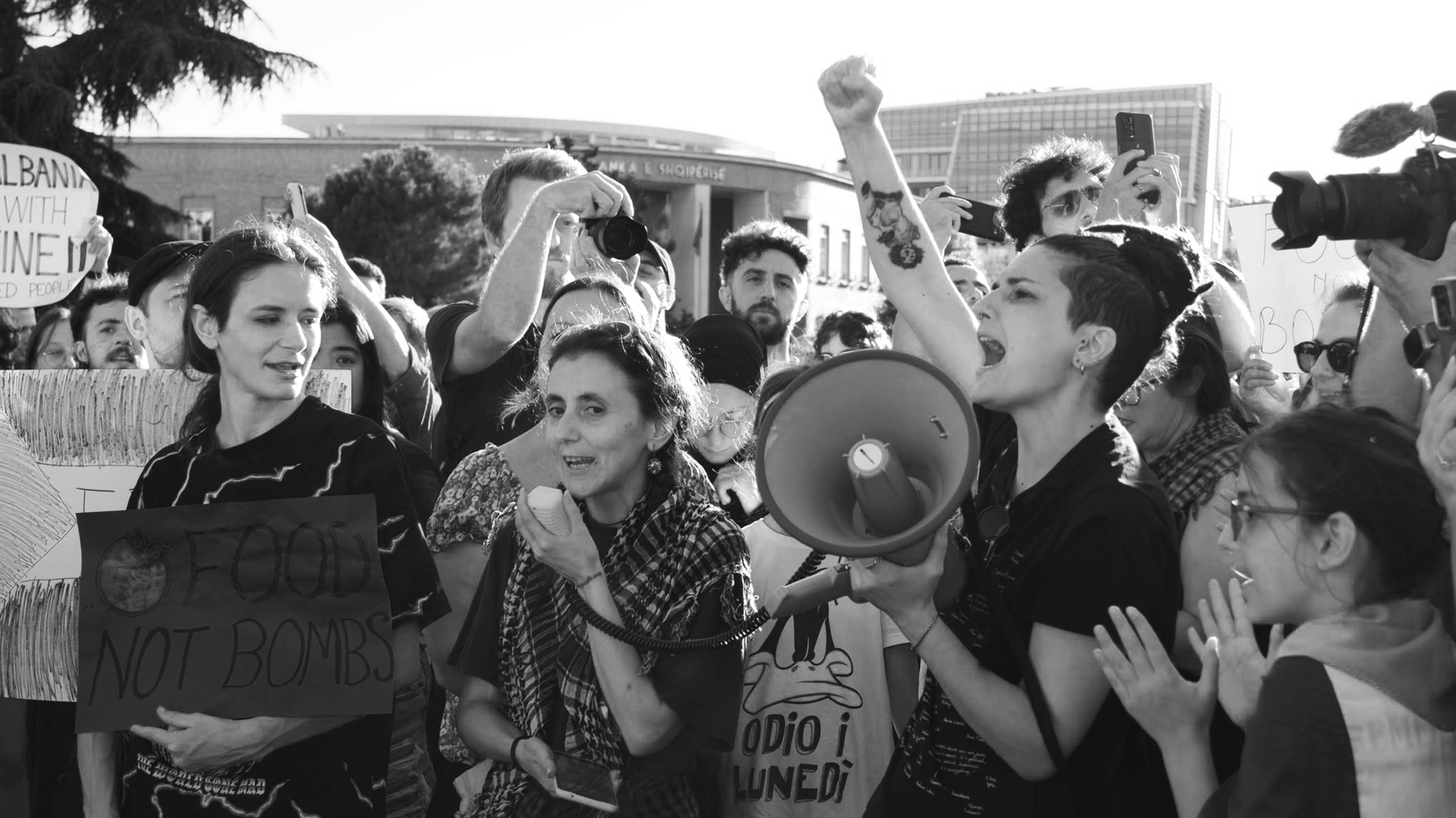
For several days now, Albania has risen up in massive protests against the destruction of Pishë Poro-Nartë, which is part of the Nartë-Vjosa protected area, one of the most biodiverse areas in Europe. These protests have united, as rarely before, hundreds of thousands of protesters, activists, environmental organizations, new opposition parties, and dozens of diaspora collectives in opposition to the multibillion-dollar tourist resort project, behind which are Ivanka Trump and Donald Trump’s son-in-law, Jared Kushner.
Known otherwise as the Flamingo Revolution, the massive civic participation has articulated five non-negotiable demands, starting with the resignation of Prime Minister Edi Rama together with his entire cabinet. The consistency, the novelty in the forms of political articulation, and the ever-growing scale have drawn worldwide attention and coverage in major international media.
The information that Kushner and Trump are behind the interventions in these protected areas, coupled with the deprivation of the local population’s right to common property, reeks of patterns of settler colonialism fused with venture capitalism: the privatisation of land and resources by outside capital, backed by political power, at the expense of those who have long depended on them.
Criticism of the Albanian government for subordinating itself to a colonial order in order to gain international legitimacy while intensifying oppressive local practices is mounting steadily and has surfaced repeatedly throughout this protest. The protest has drawn together thousands of citizens, activists and environmental organizations, local communities, activists from human rights groups, as well as pro-Palestinian activists and collectives in Albania.
“I left the barbed wire in occupied Palestine, and I found it in Zvërnec. A week ago, I left the executioners in occupied Palestine and found them in Zvërnec. Edi Rama is not the Prime Minister of Albania, he is Israel’s governor in Albania… That the fence will be removed, there is no doubt. That the project will be cancelled, there is no doubt. What we demand is resignation!”

These were the words by Baki Goxhaj at the 1st of June protest against the ecocidal project in Pishë Poro-Nartë, delivered no more than two weeks after he returned from the Global Sumud Flotilla mission towards Gaza.
Baki touched the hearts of Albanian-speaking communities everywhere when he participated in the mission in May this year. Israeli military forces intercepted his vessel and detained him for three and a half days. Shaken by the violence he experienced and witnessed against his companions, he affirmed publicly that they have been subjected to ‘extreme violence’ and ‘torture practices’.
Baki has followed the Palestinian cause for over 15 years. However, the fact that all of Albania’s political, intellectual and cultural elites, who are tied to Rama’s power, have aligned themselves with Israel and condemned Palestinian resistance following the events of 7 October 2023 marked a turning point in his political engagement in the public sphere.
As an activist of the Palestina e Lirë (Free Palestine Collective), he has been involved in a number of initiatives since 2023. These include drafting the petition ‘Not in My Name’, which was signed by over 6,500 people in opposition to Albanian Prime Minister Edi Rama being awarded the presidential medal of honour by Israeli President Isaac Herzog in 2024. He has also filed a criminal complaint against Chief Rabbi Joel Kaplan for participating in war crimes and crimes against humanity.
Locally, he has been working alongside his partner Eriselda Balliu in the coastal city of Vlorë. He has also created the ‘themulsimvote‘ platform to help Muslim voters make more informed decisions in primary elections (2025) and vote against parties that support genocide.
Connected Struggles
Israel’s genocide against the Palestinians has mobilized many cities across Europe, including Southeastern Europe. Nevertheless, with the exception of Slovenia, almost no official statements condemning this genocide were made from governments of this region.
Dissent and solidarity in Albania, Kosovo and Albanian diaspora, Bosnia-Herzegovina, Serbia, Croatia, Slovenia, North Macedonia, Montenegro, Greece, and Bulgaria came from citizen protesters, activists, collectives, and religious communities. Political articulations were expressed through protests, marches, student encampments and actions in support of the BDS movement and the Global Sumud Flotilla. Demands included a ceasefire, an immediate halt to the genocide, accountability for genocidal acts, the arrest of Netanyahu, sanctions, the termination of economic agreements with Israel and boycotts of artistic, cultural and sporting organisations.

There was also a call for an end to double standards in relation to both Ukraine and Palestine and for respect for international law. In Albania, the government’s strong alignment with Israel, which occurred alongside the ongoing genocide in Gaza, provoked revolt and waves of anger and indignation among Albanian citizens. Despite political challenges, this created fertile ground for the Palestine solidarity movement in Albania.
The Rama government’s alignment with Israel has prompted many activists to engage in more intense solidarity with Palestine. Dorela Binjaku, a feminist activist and member of the same collective explains, “As long as it is our own government doing this, we cannot remain silent because silence is complicity.”
Some of the activists we spoke with are also involved in other causes, including anti-colonial movements. The wealthy Western states contribute disproportionately to displacement and migration, that is in turn managed through increasingly exclusionary border regimes, through the exploitation of nature and the global commons as well as military interventions and conflicts.
Fioralba Duma, co-founder of the Free Palestine Collective, has a long history of working with migrant rights in Italy and Albania, and with marginalized social groups without political rights. It was through her work on the Palestine cause that Fioralba came to understand decolonisation more deeply, and how this critical lens could be applied to the political and social dynamics in Albania.
This implies an in-depth understanding of history from a Palestinian perspective, and a critical love for one’s country that affirms positions locally and globally which support humanism and international law, while condemning the Albanian government’s complicity in the genocide. As Duma explains, referring to Serbia’s war against Kosovo (1999) and the genocide of muslim Albanians in Çamëria (1944-45):
“Free Palestine’s approach is this: we are Albanians, we have lived through genocide, and we understand what it means. It’s not a special status that we hold; but we lived it, and that means we understand it and we don’t want anyone else to ever experience it either. Today it’s the Palestinians; tomorrow it could be an entirely different people.”
A Solidarity Ecology
The Palestine solidarity movement that emerged in Albania after 7 October 2023 is notably heterogeneous, comprising individuals and groups with sometimes opposing political stances. The Palestinian cause has focused on articulating an end to the genocide, boycotting, divesting from and sanctioning the Israeli State, holding the Albanian government accountable for its recent collaborative stance, terminating all agreements with Israel, and recognising Palestine’s right to self-determination.

These demands have created conditions in which diverse groups have been able to overcome deep ideological, political and religious differences, and even direct opposition, to unite in protest against the genocide unfolding in Palestine. As a solidarity ecology, Palestine has brought together queer and LGBT+ activists, feminists, progressive leftists, Muslims, Christians, conservatives, patriots, nationalists and even conspiracy theorists.
Despite mutual distrust and suspicions about the potential instrumentalisation of the cause, these groups have engaged in lengthy negotiations to unify their voices. In the words of Duma, “Palestine has helped us cross these borders”. As emerges from interviews with other activists, Palestine is the issue that pushes everyone to transcend their own specific, radical positions, which may differ sharply from one another.
They emphasise that now is the time to focus more than ever on Palestine, on solidarity and on mutual cooperation, and they do not hesitate to affirm that this inclusive process has made them more open and given them a broader sense of solidarity towards those who do not think as they do. “It is Palestine that unites us,” Duma says.
In a context marked by fragmentation and significant challenges to political organisation, stemming from social, political, historical, economic and international factors, the Palestinian cause has sparked hope that differences can be overcome, both within organisations in the country and across regional Balkan organising.
Since October 2023, pro-Palestinian protests in Albania have been among the most sustained in terms of duration, mobilisation of resources, and social media attention, even if they have not always been massive in scale. As Duma affirms, engagement with Palestine has democratised activist spaces, with the call for liberation serving as a unifying symbol of solidarity.
Another activist, part of the group Shalqi për Paqe (Watermelon for Peace), who was initially involved in pro-Palestinian internationalist movements outside Albania, emphasises the importance of building bridges as a metaphor for cooperation between different people, highlighting the need to care for others despite their differences: “If we are going to create a bridge, people have to meet in the middle. If we are going to build a bridge, it has to be a safe one for everyone to be on that bridge.”
From interviews with activists describing the nuances of engagement within their respective groups, the concept of comradeship emerges as a common political horizon. This political bond helps to overcome specificities and political particularities in order to engage in emancipatory, egalitarian political struggle. As one activist explains, “We can be comrades; we don’t need to be friends.” Some activists place a stronger emphasis on intersectionality, while others focus more on local and situated decolonial practices built on the concept of patriotism.
Creative Disruptions
From November 2023 to June 2026, pro-Palestinian organizations in Albania have organised, co-organised and participated in numerous nationwide protests, primarily in the capital city of Tirana. Alongside these mobilisations, activists have established social media platforms aimed at disseminating information, mobilising supporters, networking and circulating announcements related to local and international actions and initiatives.
Pro-Palestinian activists, including grassroots groups such as Palestina e Lirë, Shalqi për Paqe, Liri Palestinës, the Balkan Solidarity Network and other activist and online groups, have launched national campaigns to boycott socio-cultural activities organised by the Israeli Embassy in Albania and to sustain boycotts of Israeli products. These campaigns are in line with the international Boycott, Divestment and Sanctions (BDS) movement.

Since its inception, the pro-Palestine movement in Albania has involved public demonstrations in streets, buildings, historical monuments and peripheral neighbourhoods. The ‘Palestina e Lirë’ collective operates horizontally in an effort to be as inclusive as possible, maintaining a state of readiness for swift and unexpected actions in physical public spaces and online.
Fioralba refers to these actions as ‘disruptive actions’. According to her, the difficulty of organising while a genocidal war is unfolding and across social networks lies in the frequent emergence of misunderstandings, and the impossibility of sitting down to talk properly, meeting in assemblies and strengthening relationships around shared values.
Actions are often organised through social media, with people who don’t know each other personally coming to an agreement. These actions have an impromptu character, which sometimes puts the action at risk until the last moment. However, this mode of organising emerged from urgency, and activists have transformed these precarious conditions into strengths, giving their actions an element of surprise while minimising the risk of sabotage or infiltration by the authorities.
Some of these actions include: unfurling a large Palestinian flag in Tirana in opposition to the visit of U.S. Secretary of State Antony Blinken; protests against the visit of President Isaac Herzog to Tirana; and a banner near the National Museum reading ‘Ukraine 2 years: 30,457; Palestine: 144 days, 30,000″, which highlights perceived double standards in responses to war and Russian aggression. Other actions include graffiti condemning the IDF’s genocidal acts, expressions of support for imprisoned activists in the UK, solidarity with the Freedom Flotillas‘ humanitarian actions, and broader calls for Palestine’s liberation.

The Albanian government’s, and in particular Prime Minister Edi Rama’s support for the Israeli state has been widely exposed, criticised and challenged by writers, scholars and activists. As an alternative to campaigns calling for ‘non-action’, such as the boycott of the International Israeli Cultural Week in Albania, activists from various collectives have developed platforms for collective cultural and artistic creation in response and in opposition to Rama’s ‘cultural diplomacy’.
In June 2024 and 2025, these grassroots groups established and curated the Month of Palestinian Culture in Albania. Activities included poetry readings, meetings with activists engaged in the Palestinian cause across the Balkan region, marches and protests, film screenings, discussions with Palestinian authors and activists, feminist readings, Palestinian culinary evenings and “Queers for Palestine” cinematic events.
These activities were hosted across multiple social centres and alternative spaces in Tirana, Vlorë, Elbasan and Kamëz, in collaboration with independent, activist- and community-run venues such as Kur’ajo Press (Bulevard Art Space), Tek Bunkeri, Smart Centre and Drejtësi Sociale. Some of these activities extended beyond Albania through cooperation with activist centres in Kosovo, including the ‘Sekhmet’ Centre and the Feminist Collective, among others.
In addition to these engagements activists consistently sought to raise awareness of the Palestinian cause alongside other issues. For instance, they incorporated calls for Palestine into the ‘Flamingo Revolution’ protests, LGBT+ protests and 8 March feminist protests of the last three years. Activities such as marathons and football tournaments were explicitly organised in solidarity with the Palestinian cause, raising its profile through symbolic gestures, active participation, and coordinated dissemination on social media platforms.
Furthermore, these collectives issued calls of solidarity with Iran, Lebanon, Sudan and others, such as the Albanian student movement in North Macedonia. Through anarcho-feminist activism, Binjaku emphasises:
“Colonialism is not only territorial, it is patriarchal, it is racial, it is class-based. The freedom of Palestine is freedom against all these forms of violence. You cannot support a liberation that ignores violence against queers, against women, against the poor. There can be no true liberation without the liberation of everyone. It is not only a war for territory; it is a social and bodily war, an assault that affects us all, an assault against existence, against truth, against life.”

A notable innovation in grassroots organising has been the interconnection of the Balkan region around the Palestinian cause. As activists explain, one of the first meetings leading to the creation of Balkan Solidarity Network took place online, through the event “Connecting Struggles: A Palestinian Perspective”, held as part of Palestine Cultural Month, and organised by Palestina e Lirë, Shalqi për Paqe, and Boulevard Art and Media Institute (Kur’ajo Press). After this encounter, a physical meeting was organized in Ljubljana in 2024. The Network was established as a platform that mediates and strengthens connections between anti-colonial, feminist, queer, and anti-imperialist struggles across the Balkans and beyond.
This period was accompanied by the question of whether groups in the region, historically on opposing sides, would be able to come together. This marks the transition from local organising in individual cities in Albania, to national organising across Albania, to pan-Albanian organising, encompassing all Albanian-speaking spaces beyond official borders, and finally to regional organising, spanning the countries of the Balkans and Southeastern Europe, and extending further internationally.
If It’s Small and Insignificant, Why Police It?
In an interview with Middle East Eye, Yoel Kaplan – the Israeli chief rabbi who has been present in Albania since 2012 – dismissed the Palestine solidarity protests in the country as “tiny and irrelevant”, likening them to “bad publicity is still good publicity”. He added that he has the backing of Albanian Prime Minister Edi Rama and that, consequently, the protests will have no real effect.
In September 2025, activist Baki Goxhaj submitted a complaint to SPAK (the Special Anti-Corruption and Organised Crime Structure), accusing the aforementioned Chief Rabbi Yoel Kaplan with six offences, including genocide, war crimes and crimes against humanity. Kaplan has publicly and proudly acknowledged that he participated in combat as an IDF soldier alongside his son.

Three months later, in December 2025, the Anti-Terrorism Directorate of the State Police filed a criminal complaint against Goxhaj for “inciting hatred and discord” – an offence carrying a prison sentence of two to ten years. Listed as ‘evidence’ in the complaint, were Goxhaj’s social media posts criticising the Zionist views of Albanian MPs, journalists and intellectuals.
All of the posts cited as incriminating acts dated from after September – the same period in which Goxhaj had filed his complaint against the chief rabbi. Ultimately, the case was dismissed due to a lack of evidence.
In an article titled “Anti-terrorism terrorizes Muslims”, Goxhaj summarised the entire history of his persecution and dismantled every argument put forward in the State Police directorate’s complaint. He concluded that “the violence of Rama’s Zionist system will only deepen against Muslim believers, especially those who speak out”.
The Albanian state’s serious investment in intimidation as evidenced by the level of attention given to it, sits in direct contradiction with the assumption that Palestine solidarity mobilisations are ‘irrelevant’.
Consider, for example, how the police cordon surrounding every protest in solidarity with the Palestinian people has prevented protesting communities from marching freely through the capital or in front of the prime ministerial building. This alone speaks volumes about the state’s criminalising and surveilling atmosphere.
Far from the ‘calm’ that Chief Rabbi Kaplan suggests, the state appears deeply unsettled. In January 2026, two protests were held in response to Edi Rama’s official visit to Israel – widely regarded by the Albanian public as the “shameful visit” due to its normalisation of genocide – during which Eriselda Balliu, a protester, educator and activist, had her posters torn by a plainclothes police officer. She was then forcibly removed from the area near the prime ministerial building and detained alongside fellow protester Enes Jashari. After spending several hours at the police station, they were released.
From the very beginning of its organising, the Palestine solidarity movement in Albania has been accompanied by these small acts of repression and policing. In June 2024, a protest organised by the Free Palestine Collective was surrounded by what appeared as an excessive number of police officers alongside two rapid response vans and the anti-explosive unit (Forcat Renea).
In July 2025, the police cordoned off Skanderbeg Square, preventing hundreds of protesters from marching towards the Prime Minister’s Office. The same thing happened a month later on 16 August 2025, when protesters were again denied the right to march freely. The September 2025 gathering, though notified in accordance with legal requirements, was blocked outright by police forces.
Activists have noted that, in the overwhelming majority of protests, the police have intervened using subtle tactics aimed at stopping or demotivating protesters, such as changing the time or day of the protest, changing the location, blocking marches, postponing dates, using disproportionate force and making outright arrests. Despite these attempts, the state seems more intimidated than intimidating.
Against Genocide, Across Borders
Activist groups across Southeastern Europe have articulated what scholar Francesco Trupia has called “spontaneous and transnational postulates of solidarity” in line with global pro-Palestinian anti-colonial movements of the Global South. These groups are motivated by emotional and historical experiences tied to post-colonial, post-socialist, and post-genocidal processes, as well as by different premises and current contexts.

Historically marginalised, these groups are nevertheless grounded in specific local realities in relation to Palestine. Operating under difficult social and organisational conditions, ranging from state-controlled media censorship to ongoing intimidation and criminalisation attempts, these movements have been careful to avoid any accusation of antisemitism in their anti-Zionist statements about Gaza and Palestine, as seen through the lens of feminist, urban, environmental, intersectional, and anti-colonialist activism.
Pro-Palestinian mobilisation in Albania has not broadly rearticulated any socialist legacy rooted in the history of friendly relations between the Albanian state and Palestine during the socialist regime, but has instead mobilised a new political language which links a systemic critique of the Albanian government’s neoliberal practices with collective traumas of war and genocide in Kosovo and Albania. It also reclaims Holocaust memory and the Albanian protection of Jews, insisting on them as reasons not to tolerate genocide and crimes against humanity.
At the same time, it appeals to society on moral and legal grounds. Palestine has served as a prism through which the personal traumas of post-genocidal generations in the Balkans have been viewed and rearticulated – collective histories of expulsion, war, segregation and occupation.
For nearly three years, Palestine has been at the centre of historical analogies used to mobilise against genocide, regardless of ideological differences. After many months, mass protests in Albania have also embraced the Palestinian cause, challenging the colonial practices of Israel and the United States which affect even the most marginalised communities worldwide.