

What happened this April in Pristina regarding an exhibition on the crimes committed during the Kosovo War illustrates the contradictions in the memory of violence in Europe’s youngest country. What had been conceived as a tribute in memory of the victims of the conflict ended with the exhibition being cancelled, the author of the book on which the exhibition was based being arrested, his computer and mobile phone seized by the authorities, and demonstrations demanding his expulsion from the country as a traitor.
The sociologist and intellectual Shkëlzen Gashi, author of “Massacres in Kosovo 1998–1999”, has long been aware of the price to be paid for challenging the dominant narrative of those in power.
According to the Special Prosecutor’s Office of Kosovo, his offence is “distorting the truth about the Kosovo War of Liberation”. Gashi, however, believes that the reason for the persecution is that he has written “the first book on this subject that avoids hate speech and addresses all victims on all sides, regardless of their ethnicity, religion or political ideology”.

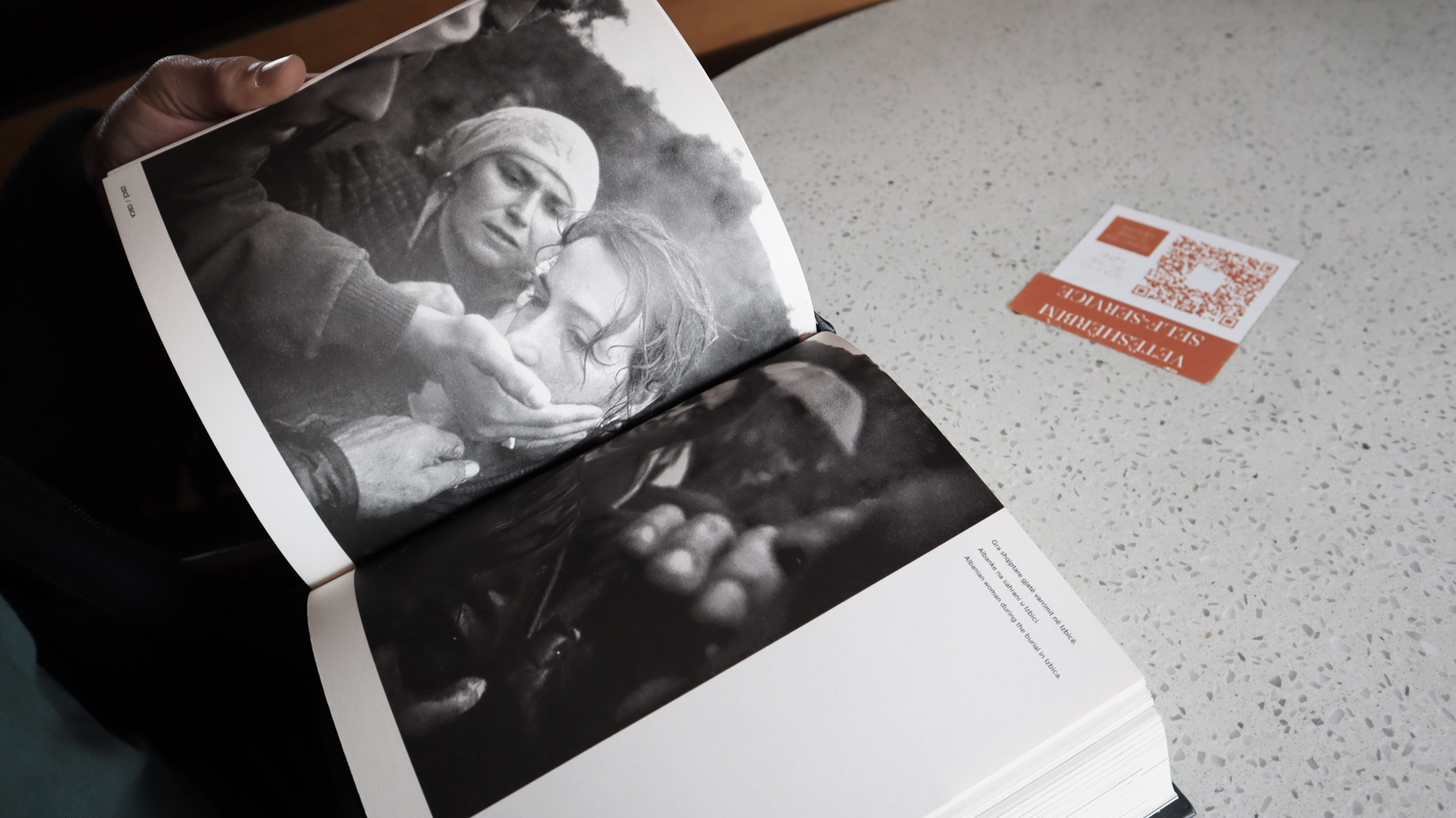
Gashi’s book lists names, numbers and locations, totalling 10,333 bodies across 83 massacres, arranged in chronological order. “In total I counted 105, but there are 22 about which nothing is known,” he says as he turns the pages featuring photographs of piles of bodies, funerals and mass graves, “and the most significant thing is that, for the majority of these killings, no one has been convicted. 90% of the massacres I recount in the book end with this sentence: to date, no one has been tried or convicted for these crimes.”
Regarding the identity of the victims, he explains that “90% are Albanians killed by Serbian police, military or paramilitaries. Crimes committed by Albanians account for only 10%; they took place after the war, as acts of unorganised revenge, and were not carried out by Albanian military or police.”
Gashi dared to break the taboo surrounding the war crimes committed by Kosovo Albanians against Serbian communities; at the same time, he honours the memory of other ethnic and religious groups—Roma, Ashkali or Catholics—who have been marginalised from the official narrative and are difficult for both Serbian and Albanian nationalism to come to terms with.
The Albanian writer and dissident Fatos Lubonja has written a scathing article in which he argues that “this lynching speaks volumes about the kind of state that is in danger of being built in Kosovo (…) History teaches us that tragedy, in the form of war or dictatorship, begins when the parties identify with the truth and seek to impose it on everyone by any means”.

For their part, representatives of the veterans’ associations of the Kosovo Liberation Army (UCK), the guerrilla group that fought the Serbs, are calling for “a law to be enacted to protect the history of the UCK, and for anyone wishing to write on the subject to obtain evidence from the relevant authorities”. Or, in other words, from those who do not question their version of events.
“Peacebuilding also involves establishing the truth and creating shared narratives about what happened, as well as reconciliation and letting go. In Kosovo, we haven’t had that, and it’s a serious problem. The Albanian and Serbian communities continue to live within their own constructions of reality, so there are competing narratives about the past,” laments Ramadan Ilazi, head of research at the Kosovar Centre for Security Studies.
Whilst this was happening in Pristina, thousands of kilometres away, in a cell at The Hague prison, Hasim Thaci, the former leader of the UCK and the West’s main ally in NATO’s bombing campaign against Serbia, awaits sentencing following the trial that concluded last February.
The Prosecution at the Special Court for Kosovo is seeking 45 years’ imprisonment for Thaci and three other guerrilla commanders for war crimes, crimes against humanity, kidnapping, torture, cruel treatment of prisoners and murder in 102 cases.
Whatever the jury’s verdict, which is expected by the end of July 2026 it will have a major impact on Kosovo’s politics: “If he is convicted, it will have consequences for the UCK and would give Serbia a weapon to use against Kosovo and oppose its independence. If they are found not guilty, I believe it would have a major impact on domestic politics, because they would return as heroes,” explains analyst Emir Abrashi.
Disinformation and Hybrid Warfare
On 24 April, a court in Pristina found three Kosovo Serbs guilty of terrorism and “serious acts against the constitutional order and security of Kosovo” for their involvement in an attack carried out by a Serbian-backed group of armed men in the Kosovo village of Banjska in September 2023, which resulted in the death of a Kosovo police officer.

According to the judge’s verdict, this was a “well-trained” group that “in an organised manner, entered the Republic of Kosovo illegally from the Republic of Serbia with dozens of vehicles, some armoured”. “The aim was to destabilise and destroy the basic political, constitutional, economic, and social structures of the Republic of Kosovo, through a well-organised plan. They attempted to secede parts of the territory in northern Kosovo, which have a majority Serbian population, and join them with Serbia”, the judge argued.
Furthermore, it claims that the attackers were trained at a military camp in Serbia, and that Serbia provided all the military and logistical infrastructure needed to carry out the attack, in which up to 44 people are implicated. According to a journalistic investigation by BIRN, the grenade launchers seized by the Kosovar police had passed through Serbian state maintenance centres; and the ammunition used by the attackers matches that manufactured in 2022 by a Serbian state arms producer.
“Serbia continues to harbour hegemonic ambitions over Kosovo,” says Arben Fetoshi, a professor at the University of Pristina and director of the Octopus Institute for Hybrid Warfare Studies, “but it is waiting for a favourable geopolitical context to reclaim Kosovo. Right now they cannot invade Kosovo, which is why they are resorting to hybrid warfare: disinformation, propaganda and acts of aggression to destabilise Kosovo as an independent country.”

“In the months leading up to the attack in September 2023, we detected a large amount of disinformation originating from Serbia and focused on northern Kosovo,” confirms Fitim Gashi, executive director of SBunker, a media organisation dedicated to monitoring and combating disinformation in Kosovo, “and the main argument behind all that disinformation is that the Kosovo government wants to expel the Serbs. The message conveyed by these campaigns, many orchestrated by the Serbian government, is that Serbs are not safe in Kosovo and must take action to defend themselves.”
According to Ilazi, this is a misguided view of the nature of Kosovo’s political system. “Kosovo wasn’t designed to be a state of a single ethnic group,” he argues, “but I think social media is amplifying these kinds of messages that seek to perpetuate this sense of permanent conflict because certain politicians stand to gain from it. You can win elections by selling dreams or selling nightmares, and I think politics has a lot to do with maintaining this atmosphere of fear and hatred.”
To Question the Narrative is to Question the Elites
Jeton Neziraj has devoted much of his literary work and his role as a public intellectual to the very opposite: to breaking down taboos, bringing people of different backgrounds together, and telling stories that overcome fear and hatred. This playwright knows well the feeling of being the one who challenges the prejudices of the majority and the demands of the powerful.

He was one of the promoters of POLIP, the first literary festival to bring together Serbian and Albanian authors. Furthermore, his plays explore the most uncomfortable aspects and blind spots of his country’s culture, politics and society: corruption, the LGBT community, the role of guerrilla veterans, relations with Europe and post-war reconciliation.
For his plays, he has been branded ‘unpatriotic’, ‘Yugonostalgic’ and a ‘traitor to national interests’. His latest play is “Under the Shade of a Tree I Sat and Wept”, a co-production with a South African theatre company exploring forgiveness between communities.
“I don’t know if I’ve been very stupid or very brave,” says Neziraj as he looks back on all the times his words have proved controversial or divisive. “But I believe that is the role of an artist, to be critical. And I think it’s been useful. I believe there is now more freedom of expression in Kosovo than there was fifteen years ago. There are still problems, of course, but I think that now we wouldn’t have to call the police at a theatre premiere because there are people protesting outside, as happened to us on one occasion, or because veterans wanted to boycott the play which, allegedly, defamed the UCK.”
It is precisely this problem with veterans that has placed Gashi at the centre of the storm in recent weeks. Gashi, like Neziraj, knew that questioning the heroic narrative of the war was ultimately tantamount to questioning the system of power that has governed the country ever since.
The former guerrilla leaders and affiliated organisations, explains the sociologist, took control of all spheres of public life: “The university, the judiciary, television, the administration, the political parties and the media are under the control of this so-called elite that has ruled Kosovo for two decades.” In these circumstances, “the UCK has manipulated the war and its memory to stay in power. Since they supposedly liberated the country, they claim the right to rule it and justify their corruption through terror”.
In 2020, Gashi received threats and lost his job as an adviser to President Kurti for stating on television that “some senior officials in the UCK committed war crimes and should be punished for them”. The focus of his historiographical work centres on civilian victims and on the peaceful resistance against Serbian oppression, which, in his view, has been overlooked by official historians intent on highlighting the role of the guerrillas.
“My aim with this book was to clarify what had happened in each of the massacres. A book like this should be written about every single violation of humanitarian law that took place during the war. First we must know exactly what happened, then there must be reparations, and it is very important that the history textbooks used in schools are revised.”
The Views of Veterans
Gazmend Syla joined the UCK at the age of 16 and today, at 45, he is the vice-president of the National Veterans’ Association, an organisation with branches in virtually every municipality in the country. Syla speaks with pride of the sacrifices made by his comrades, which, in his view, have not been sufficiently recognised by his compatriots.

We are at the organisation’s headquarters in Peja, one of the main guerrilla strongholds during the conflict, and the walls are covered with flags, emblems and photographs of the martyrs. “Nobody likes war. But you have to go if someone wants to kill you,” he explains after recounting the exploits of some of the “3,000 martyrs” recognised by the organisation.
Syla explains that the organisation’s mission is, at its core, like that of an NGO: “We help veterans when they have a need and mediate with the government to convey their demands.” And what about its influence in politics? “We don’t have a party of our own, but we do have relations with many different parties,” he replies.
Asked about the trial in The Hague against Thaci and other guerrilla leaders, Syla replies indignantly: it is a set-up against innocent men, the witnesses have been bribed to testify against the UCK and it all boils down, in essence, to “a political issue”.
The veterans’ association has organised mass demonstrations in Pristina, Tirana and The Hague to demand the acquittal of the accused. He does not wish to conclude the matter without pointing the finger at Western nations: “We fought alongside the United States, the United Kingdom and Germany. They helped create the UCK, fought with us and supplied us with weapons. If we are guilty, then NATO is too.”

Syla is unwavering in his defence of the UCK’s political and military role in Kosovo’s independence, and regards the guerrilla movement as one of the pillars of national life. “We are free now and my children go to school,” he explains, “before, in Yugoslavia, we had nothing and the police and the military would beat us for speaking our own language. We had to fight to be free, and now we are doing well. Perhaps we’re not like Switzerland or Spain, but this is our country and we’re happy here.”
However, his view on relations with Serbia and the Serbs of Kosovo is not what one might expect from a former guerrilla fighter. “The Serbs are citizens of Kosovo just like anyone else. They’re not to blame. They are my neighbours and I get on with them just fine. Their freedoms and political rights are recognised by the Constitution, and that is how it should be.”
Syla is highly critical of Prime Minister Albin Kurti’s attempts to exclude Lista Sprska, the main Serbian political party in Kosovo, from the elections or to outlaw it: “They should be left in peace.”
“The things I think and am telling you now, I can’t say them at meetings with the veterans,” Syla laments, sadly, “there, they only want strong, more aggressive rhetoric. And it’s a shame.”