




On Tuesday, 21 April 21, European Union governments voted to keep flagrantly violating their obligations both under their own rules. These choices undermine international law and institutions as well. They add instability to an already exceptionally delicate and dangerous moment in global politics.
Enable, Rinse and Repeat
Just as they did last year, EU Foreign Affairs Ministers considered the suspension of the Association Agreement with Israel for its flagrant violations of human rights. And just like last year, Spain, Ireland and Slovenia pointed out that the Agreement should be suspended for evident violations of human rights. And just like last year, there was no majority for any concrete action.
Most governments and major media outlets shrugged the whole thing off as just another vote. After all, until there is a clear majority if not unanimity among EU governments, how could the Union act?
Meanwhile, the media and political debate lost themselves in discussions of complex EU voting procedures or reading tea leaves of possible shifts in key European governments.
This, however, misses the point. Whether such a majority exists or not has nothing to do with the legal obligations of the EU and its member states. These obligations require the EU to act.
Breaking its Own Rules
The European Union is under two major kinds of legal constraints: internal and international.
Internally, the EU’s legal commitment to human rights is hard-wired into all aspects of policy and action by the Lisbon Treaty. This ‘constitution’ says the Union is founded upon “democracy, human rights and fundamental values” and that these must be upheld in every dimension of the EU’s policies and practices.
In fact, precisely for this ‘hard-wiring’, some argue that Israel’s occupation of Palestine, Lebanon and Syria means that the Association Agreement never ought to have been signed at all.
In addition, Article 2 of the EU-Israel Association Agreement says all links are subject to “respect for human rights”. The evidence of Israel’s massive and systematic violations of human rights internally, internationally and of course in the Occupied Palestinian Territories is so well-known and so overwhelmingly vast that it cannot be summarised here.
Save to say that it has been necessary to invent new terms for what is being done in Palestine (and elsewhere like in Lebanon and Iran): domicide, urbicide, medicide, scholasticide, ecocide, econocide, unchilding, and journocide killing the most journalists worldwide in each of the last three years running – a combined total greater than all journalists killed in the U.S. Civil War, both World Wars, the Korean and Vietnam Wars (including Cambodia and Laos conflicts), the Yugoslav wars of the 1990s and 2000s, and the post-9/11 Afghanistan war. Not to mention the use of ‘double tap’ or ‘triple tap’ attacks in all these cases: targeting civilians/non-combatants, protected categories (medics, journalists), aggravated by perfidy.
All this is an incontrovertible matter of public record. Even an internal review by the EU’s own External Action Service found Israel had violated international law in Gaza.
For those violations alone, the Agreement ought to have been suspended years ago.
There is no room for interpretation: by the EU’s own internal rules, it should already have suspended the Agreement if not cut relations with Israel entirely.
Breaching International Law
The European Union’s obligations under international law are if anything even stronger.
Take the duty to prevent genocide as an example.
The Genocide Convention establishes a duty to use “all means reasonably available” to prevent genocide. This obligation was confirmed in January 2024 by the International Court of Justice, which also accepted that Palestinians’ right to be protected from genocide ‘may’ be being violated.
As its largest commercial partner, the EU patently has the leverage to act. The European Union and Israel are linked by defence and security contracts and collaborations, and through academic and commercial research relations. The EU has the obligation not to continue any such ties which in any way support those violations.
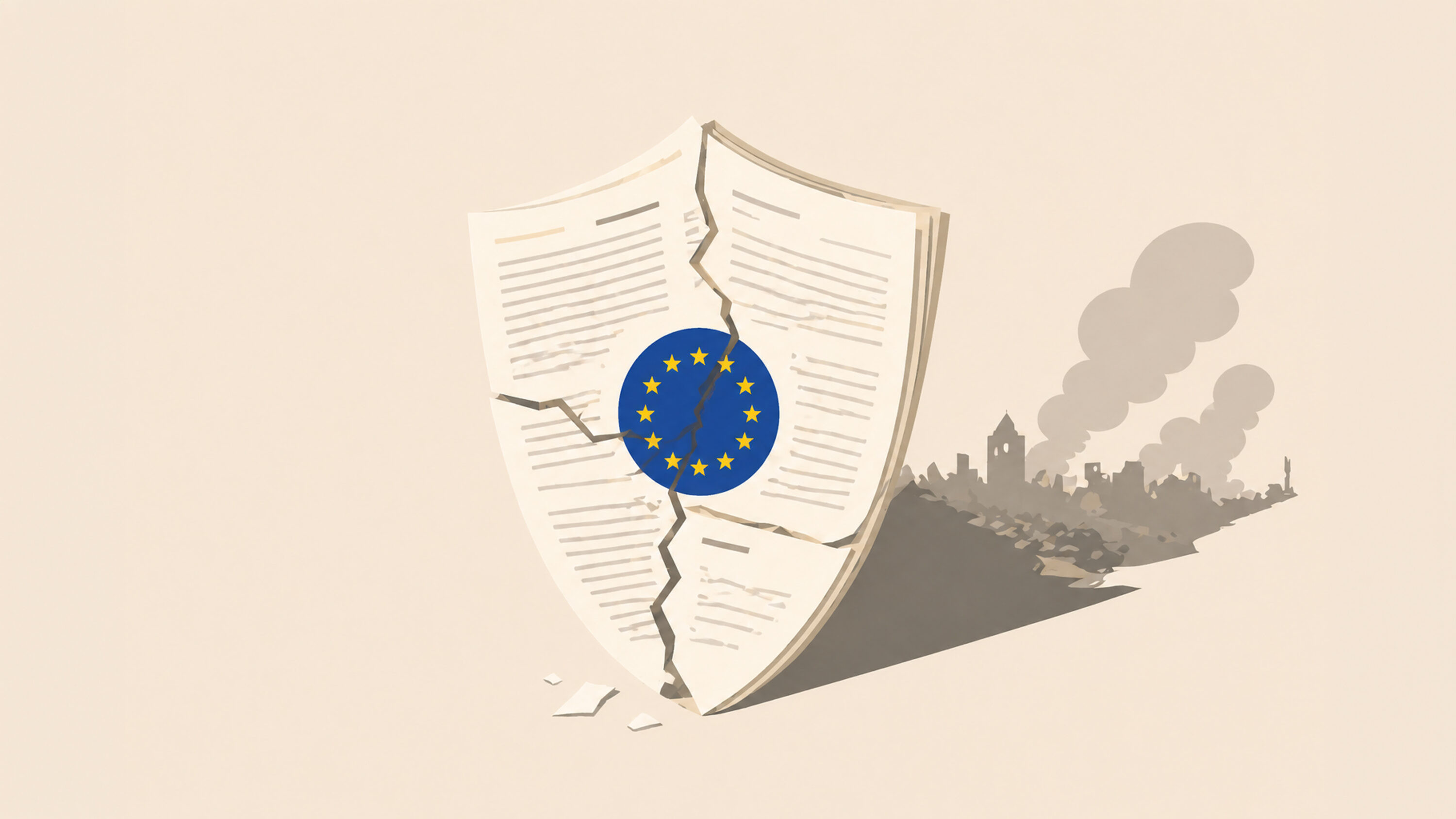
The same goes for individual states. Two of Israel’s top three arms suppliers are key EU Member States: Germany and Italy. Like any other government, both have a duty not to sell weapons used in the devastation of Gaza, in the colonization and ethnic cleansing of the West Bank, and in the unprecedented destruction of South Lebanon.
Hiding Behind Procedures
Yet the European Commission and many Member States in the Council fail to act. Year after year, they hide behind voting regulations to avoid acting on those obligations.
How?
Human rights assessments ought to be routine, but in practice must be requested by Member States which then need to obtain that such reviews be tabled for a vote by the Foreign Affairs Council. As in 2025, reports are usually not tabled on the basis that there is no perceived consensus for suspending the Agreement, or a ‘qualified majority’ to suspend portions of it or agree on sanctions. So, in practice, breaches of Article 2 are never openly discussed or voted on.
For the EU’s rhetorical commitment to human rights to be taken seriously, the assessments of, and votes on, human rights should be transparent, routine and compulsory.
Instead, for decades, the EU has avoided saying how it defines “human rights conditions” or specifying how these should be measured and assessed. It has failed to make reviews regular or transparent. It has made sure that whether those reviews come to a vote or are even tabled is not automatic but is at the Council’s discretion.
It is impossible not to conclude that the self-proclaimed paladin of human rights and fundamental values never intended to take its human rights commitments seriously.
Rules Unfit for Purpose
The fact that there are too few member states willing to vote for suspending the agreement with Israel is entirely irrelevant.
What these votes mean is simply that a majority of EU governments are happy to continue to break their own rules and international law.
The obligation to prevent genocide or crimes against humanity doesn’t suddenly disappear, it cannot be dismissed or deferred just because the EU’s internal procedures are unfit for purpose. If the EU’s procedures result in illegal outcomes, those rules must be changed. They certainly don’t absolve EU leaders of their legal responsibilities.
What is astonishing is not only that the EU is failing to uphold international law or its own principles, it is also damaging itself geopolitically.
The EU’s reputation as a ‘normative actor’ – its influence from promoting universal human rights and democracy – lies in tatters. Its self-proclaimed role as paladin of the rule of law has been reduced to little more than a bitter irony.
European representatives failed to condemn the evident violation of the UN Charter when the US and Israel attacked Iran or when Israel invaded Lebanon just as they failed to support the cases brought against Israel before the International Court of Justice and the International Criminal Court. Ignoring international law in this way helps undermine the international institutions of the ‘United Nations system’.
Consigning Europe to Irrelevance
Europe has nothing to show for all this damage. It is not even sacrificing principle for power. It is weakening and isolating itself.
For the last few decades, European governments have lost political and strategic autonomy by increasingly aligning themselves with the US. The failure to set clear political distance from the US and to use what leverage Europe has, only worsens this isolation and irrelevance. Europe is taken for granted in Washington and is diplomatically irrelevant for China, Russia or Iran, which might have found a respected but relatively independent interlocutor useful to facilitate diplomacy.
One example of this is the EU’s striking absence from any negotiations over the conflicts in the Persian Gulf and the East Mediterranean.
Instead, by ignoring the rule of law on Israel while increasing sanctions on Iran and Russia, barely hours before the Iran/US ceasefire deadline, the EU added instability to an already exceptionally volatile and dangerous moment in world history.
In other words, by disregarding its self-proclaimed values, international law and its own self-interest, the EU is consigning Europe to global irrelevance.