






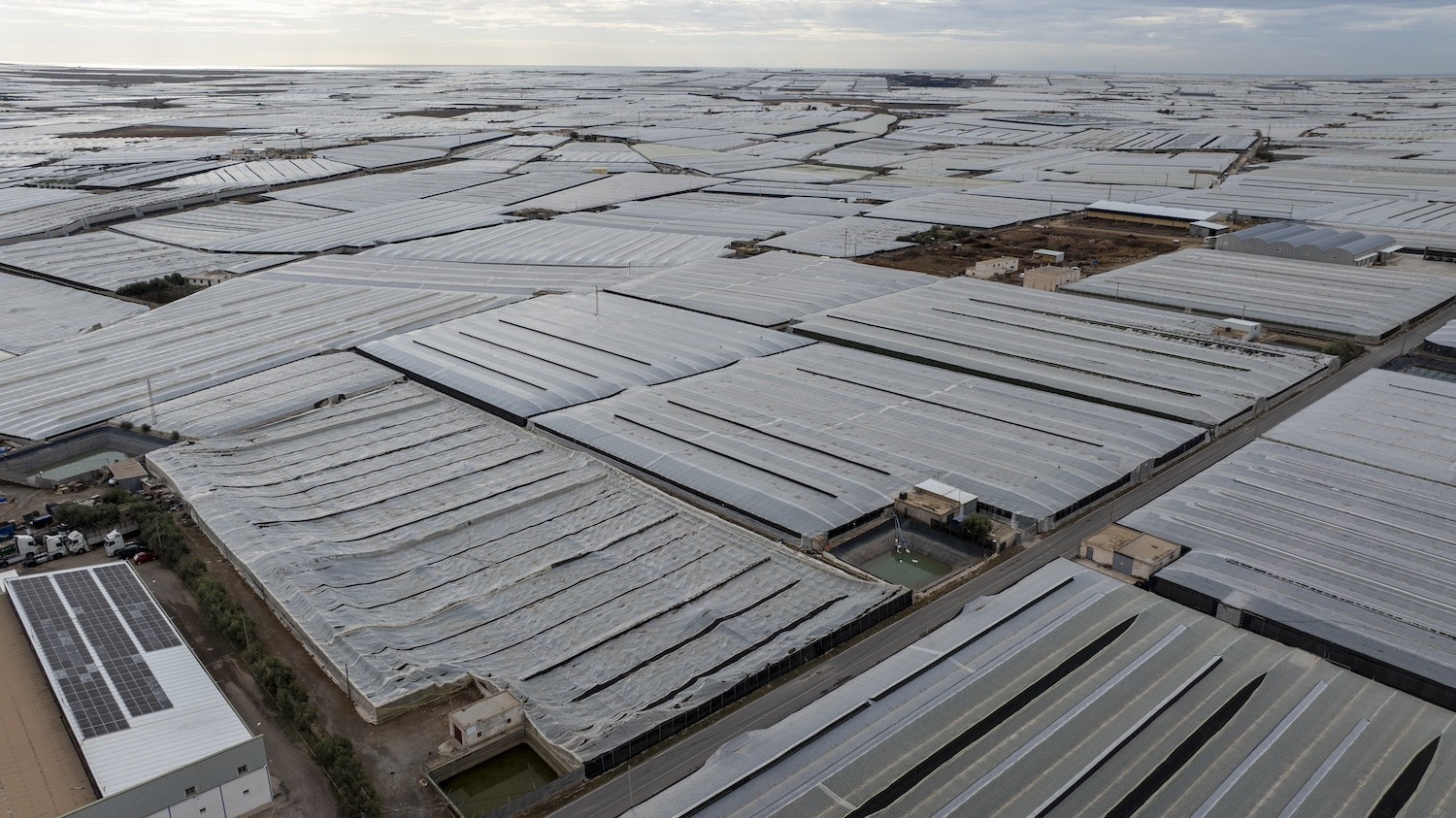
Mustapha stands up straight and groans with exhaustion, wiping the sweat out of his eyes. Although it’s only 9am, it’s already well over 35 degrees. The white-washed plastic sheeting overhead glows blindingly white, somewhere nearby he can hear the occasional drip of water from an irrigation pipe as it hits the dry, sandy soil below. The baking air around him carries the pungent, earthy smell of tomato stems–he closes his eyes and pictures the hairy stems he knows so well.
Mustapha is one of over 100,000 workers–mostly migrants from North and West Africa–who tend the vegetables grown under more than 32,000 hectares (320km2) of plastic-covered greenhouses in the Spanish province of Almería, nestled along the south-east coast of the Mediterranean. The region produces over 3 million tonnes of produce (tomatoes, courgettes, cucumbers, peppers, aubergines and more) destined for export to western Europe–Germany, France, and the UK mainly.
Most of the 14,000 farming families have grown food in these greenhouses since Franco gave them small parcels of land in the 1940s, with the sole purpose of achieving national food security. Some are now extremely wealthy. Some struggle to make a profit. Probably, all of them employ migrant workers and the vast majority are likely to be doing so illegally–low-paid undocumented labour is the only way many of them can make ends meet.
Food Imperialism
The Spanish government has recently announced the regularisation of almost 1 million undocumented workers–many of the workers in Almería who are given papers will try to move on from exhausting greenhouse work to better-paid jobs in restaurants and hotels. The empty jobs will soon be filled by people surviving the grueling journey on foot from Istanbul or by small wooden boat from West Africa to the Canaries. There are always people whose livelihoods have been destroyed by poor trade agreements and overfishing back home.
This is food imperialism – the way in which corporations and nations in the Global North exert control over the Global South by dictating what food is produced and exported to ensure the world’s wealthiest citizens have a constant supply of affordable, year-round produce on their supermarket shelves.
Our food system is the product of hundreds of years of unequal distribution and control of global power. The British Empire controlled the production of sugar and palm oil to feed its malnourished and tired workers back home–relying on slave labour and productive lands in the tropics to provide the expendable resources needed to continue to reap profits as they deplete these lands and waste their people. A lot has changed since the empires of old–today’s empires belong to the likes of Unilever and Cargill. Food is still treated as a commodity to generate profits, but the playbook of actions needed to keep the bloated food system functioning is less of a secret these days.
When my co-hosts and I began interviewing experts for our new podcast series, Edible Empire, we wanted to map out this modern playbook and uncover who really pays the hidden costs of our food. What we found is that today’s corporate giants rely on the exact same mechanisms of control as the empires of the past. As political economists like Professors Raj Patel and Harriet Friedmann point out, the global food system has always been structured around these regimes of power, transitioning from colonial monopolies to corporate ones. Today, as Professors Jennifer Clapp and Phil Howard warn, an unprecedented concentration of corporate power means a handful of firms now dictate global agricultural policy, market access, and ultimately, what ends up on our plates.
Palm oil is a perfect example of food imperialism–the ubiquitous, often hidden ingredient across foods and cosmetics, driving catastrophic deforestation across Southeast Asia. Researchers like Professor Jonathan Robins have documented how this versatile crop came to be embedded in global capitalism, while activists and researchers on the ground, such as Farwiza Farhan and Professor Helena Varkkey, see the direct ecological and social fallout—vital rainforests cleared and Indigenous livelihoods lost to feed Western consumerism under the guise of sustainable development.
The same pattern plays out in the intensive dairy farms half a world away in Aotearoa New Zealand, where the work of researchers like Drs Mike Joy and Milena Bojovic highlights the severe local ecological degradation caused by industrial farming. The harm extends far beyond New Zealand’s borders, however; as artist and researcher Dr Crystal Bennes notes, this intensive system relies on phosphate fertiliser extracted from the illegally occupied territory of Western Sahara, where half the population has been displaced to refugee camps in Algeria. It is a textbook example of hidden externalities: wealth is accumulated in the Global North, while the geopolitical, social, and environmental damage is borne by vulnerable populations in the Global South, hidden from view from consumers.
Awareness is Everything
Neoliberalism has created extreme freedom in food markets, allowing continued profiteering as ecosystems collapse and livelihoods fail–Mustapha left his home in The Gambia because his family could no longer find enough fish to sell at the market, and no money meant no food. He stepped into a small wooden fishing boat and took the 11-day journey to Tenerife knowing that 1-in-5 people who took that journey would die.
He was a lucky one—he made it to Spain and found a job (most days) in the greenhouses in Almería. Living in a slum made from discarded pallets and greenhouse plastic, he could save enough money to send a little home to support his sisters and parents. But as investigators like Hazel Healy and Brigitte Wear have revealed, the fish back home continue to be exploited by the Global North. Their populations have been destroyed by industrial overextraction for the production of fishmeal. These pellets have been fed for decades to carnivorous salmon in thousands of farms dotted around the fjords of Norway—salmon that are then exported to wealthy countries around the world. As West African marine ecologists and activists like Dr Aliou Ba and researchers like María Alonso Martínez have documented, this creates a bleak cycle where local food security is stolen to supply luxury seafood abroad.
This is food imperialism.
Ultimately, our damaging food system relies on a lack of public awareness to continue; the inner workings of these complex, global supply chains are too easily hidden from view. But awareness is everything, and there are alternative paths forward. Thinkers and activists like Anitra Nelson, Million Belay, Ali Thomas, and Chris Smaje offer powerful visions of hope rooted in degrowth, food sovereignty, minimising food waste, and agroecology. They show that smallholder farming and local food networks can dismantle this corporate stranglehold, replacing exploitation with equity.
To challenge this system, we first have to see it clearly. We need to understand where our food comes from, and recognize that the choices we are presented with on supermarket shelves are not really choices at all.
Neal Haddaway, Benjamin Eitelberg, and Emma Strutt are the creators of Edible Empire, a new podcast series exploring the hidden costs of the global food system. You can listen to the full interviews and subscribe to the series at www.thesalmonandthetomato.org/listen.