




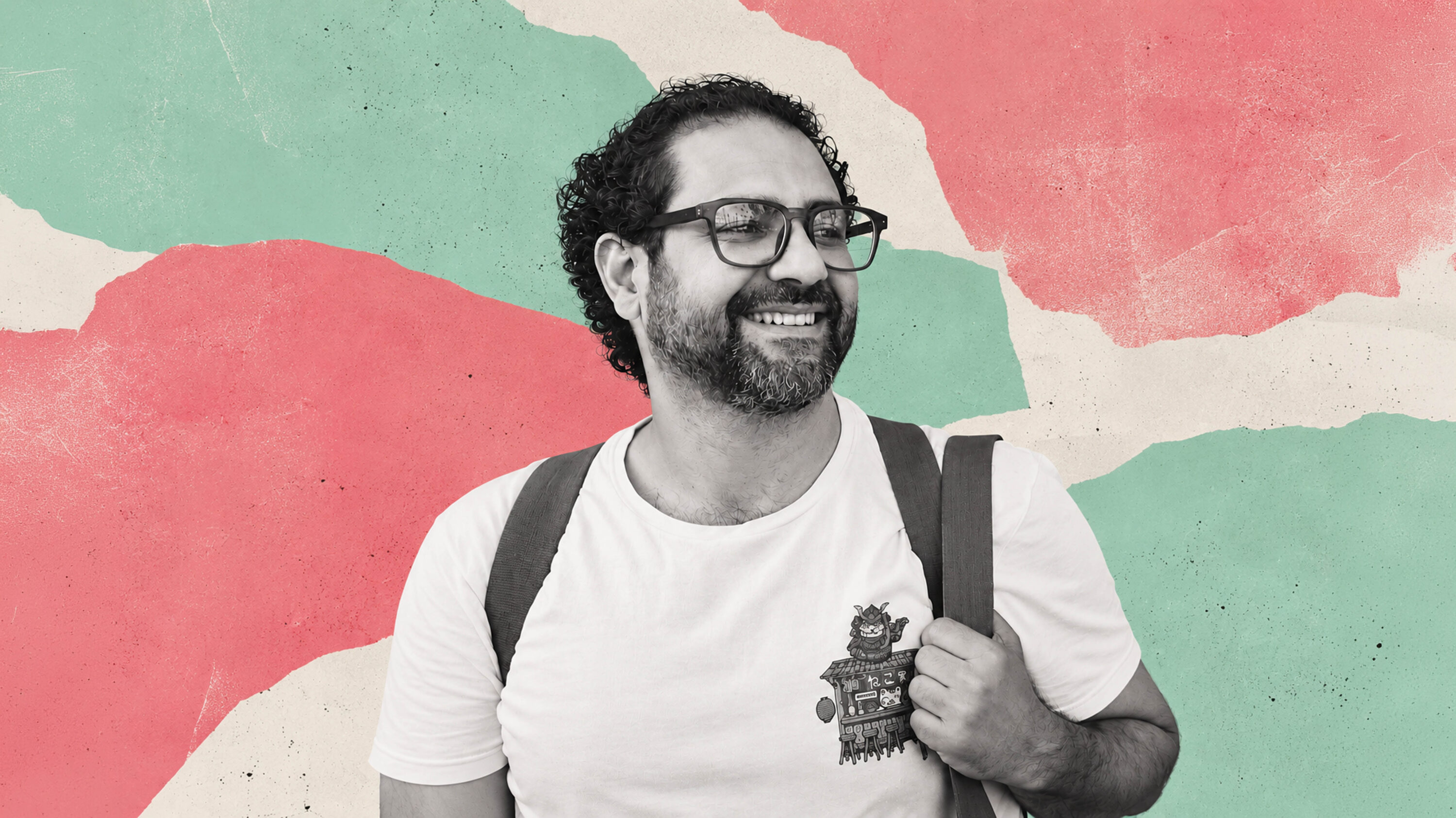
It has been just over a year since the Egyptian computer scientist and activist received a presidential pardon, following a long imprisonment that sparked a broad international solidarity campaign.
In this interview conducted in Ferrara, as he attended the Internazionale festival, organized by the magazine Internazionale, Abd el-Fattah spoke about the regime, his time in prison, Gaza, and AI, and how the internet radically changed.
His eyes sparkle behind square frames. On his black T-shirt, Arabic letters spell out “That’s me in the corner”, a line from Losing My Religion by the pop American band R.E.M. The arrests and abuses of power he has endured for twenty years, the price paid for his political and social activism in Egypt, have not stripped him of his sense of irony.
Alaa Abd el-Fattah looks anything but cornered as he raises a clenched fist before a packed cinema audience.
“Not in our lifetimes, perhaps, but we will have a world without prisons, we will have a world without occupation, without genocide. It might take rebuilding after a disaster. Or it might take, you know, resistance that would consume all of our lives…But it will happen. There will be a future. There will be a human future. And there will be a future for people to live in it and be creative, loving and caring. This is not a choice”.
From Techie to Symbol
Since 2011, Alaa Abd el-Fattah has become an internationally renowned figure, thanks to Manalaa, the blog he ran alongside his wife, Manaal Bahey al-Din Hassan. Their posts, some written in English, chronicled the protests that led to the famous 18-day occupation of Tahrir Square and the fall of Hosni Mubarak’s regime.
Alaa was arrested multiple times: first under Mubarak, then during the subsequent presidency of Mohammed Morsi and during the interim rule of the Supreme Council of the Armed Forces led by Hussein Tantawi. Yet it is Abdel Fattah el-Sisi, the latest dictator and current president, who has persecuted him most harshly, repeatedly imprisoning him for a total period of over ten years. From an accidental leader of the revolution, Alaa has become an, even more accidental, icon as one the victims of a brutal counter-revolution.
He was involved in grassroots political activism at a very young age. In 2004, while just in his early twenties, he managed the server hosting many of the country’s opposition websites, following in the footsteps of the anti-globalization movement and initiatives like Indymedia. As he was frequently implicated whenever a dissident was arrested for expressing their views online, he soon became a staunch defender of online freedom of speech.
During the years of the anti-globalization movement, Alaa’s advocacy for internet freedom led him to adopt a critical stance on intellectual property. He participated in the Egyptian Group Against Globalization (AGEG), which was then engaged in debates over international treaties managed by the World Trade Organization (WTO), treaties viewed as highly discriminatory against countries in the Global Majority, particularly regarding access to medicines and patent laws.
Ultimately, however, Alaa’s story embodies the trajectory of the internet itself: a space that seemed to offer freedom and possibility in 2011, but which has increasingly transformed over the years into a tool for repression and a trap for dissent. Although he was never arrested directly for his online activity, his social media posts were used, for instance, to fabricate the charges behind his most recent indictment in 2021.
His history as an activist is marked by struggles on many fronts, ranging from battles against the militarization of the justice system to campaigns against the demolition of churches and Christian neighborhoods, particularly during the rule of the Muslim Brotherhood. Yet, his primary role is that of a “techie”, as he describes himself.
Rewinding the Cables
Our conversation begins here: with the dashed hopes of those who, in the early 2000s, dreamed that the internet could be a powerful accelerator for internationalism. And the place that epitomizes the shifts of our times, also when it comes to the online world dynamics, is Gaza. It is the quintessential victim-place that power sacrifices in an attempt to school the masses, across every latitude, to demonstrate the “incredible, destructive, and lethal potential of the elites”, as Alaa puts it, so that “we all live in fear”.
Giulia Beatrice Filpi: You spoke of the need for a ‘human future’. How do you see the role of artificial intelligence, amidst global wars and genocide?
Alaa Abd el Fattah: For me, the story isn’t that AI is being used to pick targets. Israelis would carpet bomb and kill civilians with or without it. Imperialism kills civilians. This is what it does and it always claims that it does it in a smart way. But in the end, it always just kills everybody. So, this is just the latest incarnation of it. What is terrifying isn’t that the machine is making the decisions, as these are the same old decisions, since the 19th century.
What is terrifying is rather that there is no separate data center for the military. There is no separate AI training set for the military. It is the very same code or, you know, the very same Anthropic or Open AI model servers you use and push at you every day. It is the same codes being blamed for the Minab massacre, for bombing the 150 schoolgirls in Iran. So, all of the internet is now dual use. All of the internet is now a legitimate military target. And everybody working on the internet is now contributing to a machine that is killing us.
These AI systems are being used for controlling migration, for targeting people in Gaza, for surveying dissidents in the Arab world and at the same time are being used to market and push rubbish at you and are destroying the environment.
GBF: What advice would you give today to anyone who wants to use the digital space to spread their political demands?
AAF: It’s changed. Completely. For my generation, the moment of political awakening was the Second Intifada. I had a conversation with some young Egyptian activists in their early 20s, and, for them, that moment is the Toufan, the “flood” of the 7th of October. When it happened, these kids reclaimed the streets, the campus, with no prior organization, with no connection even if most of their professors who were activists are today either in prison or in exile. The few who are still able to teach are very quiet about their history, so there’s no infrastructure for the movement. But still, the movement was so powerful, for both the inspiration by the resistance, and then the horror about the genocide. They mobilized and claimed the streets for a few weeks, I don’t know how long, I was in prison.
For them, the space of possibility and emancipation is not the internet. The internet is a horrible place. When I show them my website, the aggregator or any movement website or on the wayback machine, or when I just speak about this, also organizing on the ground, but just like what the internet looked like, it’s almost like they are in shock: it’s a completely different space now. There was a sense of freedom that they cannot imagine. And it isn’t just about state oppression. It’s about shadow banning. It’s about reach, it’s about how online voices police each other. And it’s also about how much exposure you have today, as your virtual persona involves your body.
In my time, because they were not visual, so you had virtual personas, completely disembodied. So, you were much freer.
GBF: Do you think there is a way to push for a reform, let’s say, a democratic one, of how the major platforms are managed?
AAF: No, I think what we need is to imagine the internet as a public utility first. It is public infrastructure, from its building, inventing, running. It is already deeply subsidized by public money. You couldn’t reform it anyway. These companies acquired so much power, it is ridiculous they are allowed to act this way. We need to become much more hostile toward them. In other words, it is not okay to work for them, whether as a cleaner or as an engineer. These companies should be treated like Lockheed Martin (the largest U.S. arms manufacturer, A/N). These monopolies need to cease to exist. Also because the people who actually own them are not just aligned with the interests of capital, they are deeply ideologically misogynists and racists.
We are making demands around children, around hate speech, around the new fascism that is emerging. And how do we do it? The only way to do that is to centralize online speech. And the only way to centralize online speech is to either hand it to governments or hand it to capitals. The question is would these forms of expression be as dangerous in a non-addictive internet? Is it possible to go back to a decent internet?
GBF: What do you think of the calls to abandon social media and boycott big tech products?
AAF: It’s the strangest thing ever. You don’t even need to have techies to inform people about how much these platforms are harmful and horrible and that they are owned by evil people. Everybody hates them. Everybody knows they affect us badly at the psychological level. Everybody knows they are ruining our children’s childhood.
And yet, not only we don’t stop using them, we are also not going to embrace an alternative. It’s not that nobody’s building any, there are alternatives, but it’s as if the effort required to stop using these things and use something else on the same devices and the same network is psychologically unbearable. I don’t understand why, but right now this is what I want to do: to document, in a non-nostalgic fashion, what is the internet we could have had, and what is the internet we did have, and then to try and understand why is it that we continue to be trapped in an internet we absolutely don’t want.
GBF: Perhaps the problem is that platforms are inherently designed to be addictive?
AAF: I’m sure this is part of the answer. It’s also a very disempowering answer. As a matter of fact, as the case of the Italian collective Autistici/Inventati proves, there is power involved. This was an independent movement owned infrastructure and they’re being punished as if they are terrorists. So it’s not just a psychological issue, right? They are making sure that, if my account on Facebook can be shadow banned, my servers can also be shadow banned. The first monopolized and centralized hosting, even before they monopolize publishing and online personas. Now everything is in the hands of Google, Amazon, and the other big players.
I’m interested in a truth that has an objective and material connection with reality, in a material theory in a Marxist fashion. This is something that can empower a collective and enable a socialized reaction. If I just say it’s addictive, this is defeatist. And I refuse that.
*A version of this interview was previously published in Italian on OrientXXI.