



The high school student protest movement, which began in Créteil on September 17, is characterized by its scale, its endurance, and, above all, the expression of new political subjectivities among the protesting youth. Beyond the demands themselves, it is indeed the fleeting emergence of a new collective subject, a “we” built from the ground up, starting with Gen Z, that is partly upending the “traditional” frameworks for analyzing social mobilizations and thwarting the authorities’ attempts to divide the movement. The question remains: how can we precisely characterize what is currently being expressed in the struggle and how can we ensure its political sustainability, as an unprecedented wave of repression and racist backlash unfolds?
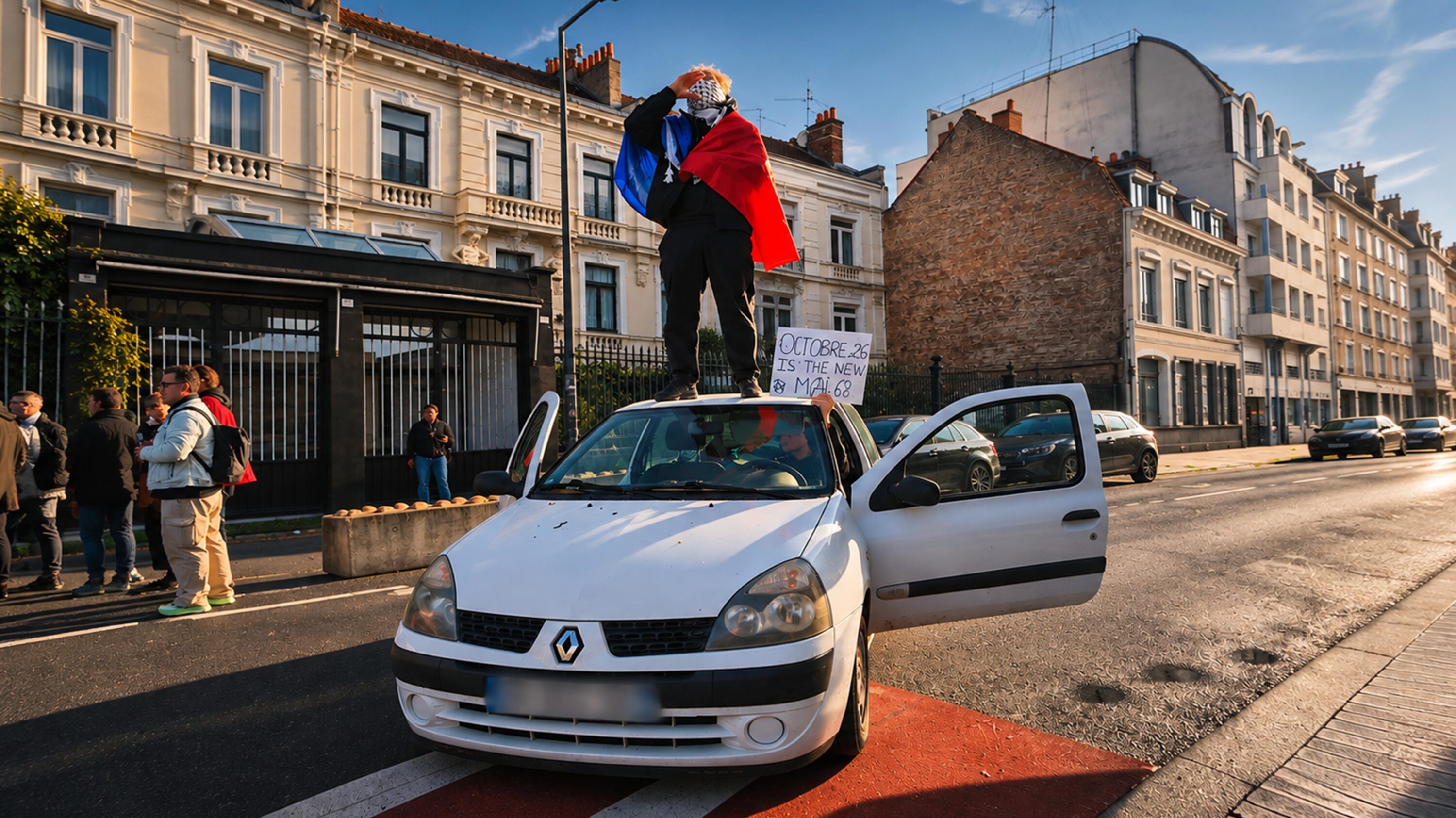
The scene takes place in Lille during a demonstration on October 17, 2026. Near the procession, which is both long and dense due to the impressive number of demonstrators (the press reported 50,000 participants, a record since the 2006 protests against the First Employment Contract), a car stops in the middle of the road. Two young Arabs (a boy and a girl) are driving it. The young man climbs onto the roof of the vehicle, wearing a keffiyeh around his neck and holding a French flag in one hand. He calls out to the demonstrators: “We are the French, and we will win!”.
Behind the wheel, the young woman wears a headscarf. She holds a sign out of the vehicle on which the letters “A” have been replaced by circled “A”s (the symbol of the anarchists): “October 2026 is the new May 68.”
We must pause for a moment to consider what this scene represents for any activist over the age of 40. It is truly bewildering. Unreadable. Almost unsettling, given that the symbolism employed draws from categories long considered either antagonistic (the French flag and the circled “A” / the French flag and the headscarf) or the exclusive domain of communities that are impervious to, or even ignorant of, one another (the headscarf and the keffiyeh versus the French flag and the circled “A”).
At that moment, in that very place, the old categories of analysis are shattered. Both the white monopoly on participation in the demonstrations and the defeatist Constat amer of the past 20 years regarding la jeunesse indigène (youth with a post-colonial background, a clear reference to the Parti des Indigènes de la République, a decolonial, anti-imperialist and anti-racist political party founded in 2010, Ed.).
And at the same time, all of this is dazzlingly beautiful. Just like the signs, each more ingenious than the last (“Tasty Crousti Antifascisti”, “October 17, 1961, Algerians in the Seine, October 17, 2026, Algerians in the streets”); the Palestinian, French, Moroccan, Congolese, and Algerian flags all mingling together; and Naruto and Spider-Man accompanying the procession.
This gathering of anger reflects the combined result of several movements for the recomposition of the radical left and the social movement. First, there is the still-strong influence of the Gilets Jaunes movement, whose legacy now inspires a generation too young to have participated in it but old enough to have felt its momentum and to identify with it (and this, surprisingly, despite the whiteness that characterized that movement in 2018–2019).
Here lies the outcome of a process that is difficult to predict: the reappropriation of the Gilets Jaunes movement by a segment of the jeunesse indigène. Even though they could not have been part of it in 2018, they set aside this fact to integrate it into their repertoire of protest, both in terms of methods of direct action and the absence of clearly identified leadership. It remains to be seen whether the reverse movement is conceivable: are the petits blancs (working class white people) capable, in turn, of appropriating the mobilizations for Nahel and for Palestine? Will they be moved by the racist killing that has just plunged the town of Trappes into mourning?
Another factor enabling this coming together of Gen Z across racial lines is the work of political anti-racism and the now-significant role played by the fight against Islamophobia and the condemnation of the genocide in Palestine within the radical left.
Moreover, the issues faced by young people in working-class neighborhoods are now being taken seriously by the radical left: as early as September 21, Clémence Guetté and Louis Boyard (of the party La France Insoumise, ed.) were present at the blockade of the Créteil high school. Finally, behind this new ability to unite lies the political proposal for a “New France”, and we can now see just how much resonance it has found among young people.
The result is an expression of collective strength and joy that’s accelerating the growth of support, even within the autonomous left:
“We felt pretty much the same thrill as on March 16, 2019, on the Champs-Élysées. But this time, it wasn’t just a bunch of white folks, and that’s great. Yesterday, as we were all together, I’ll admit, I sang La Marseillaise for the first time. And I didn’t believe what you were saying a year ago about internationalist patriotism and all that. I didn’t think we could reclaim those symbols. And honestly, singing La Marseillaise, with the French flag, the Palestinian flag, and the Congolese flag, it was beautiful”, said a comrade from Soulèvements de la Terre (a radical, ecological collective founded in 2021, Ed.) during the “Leaving the Contemporary Era” gathering on October 18.
Defending Public Schools Despite Everything
As we know, the republican school system has, since its inception, served the ambiguous dual purpose of exercising control and instilling patriotic and bourgeois values. By prioritizing intellectual pursuits over manual labor in the allocation of merit, it perpetuates the bourgeois claim to dominate and organize labor.
Nevertheless, school remains a fertile ground for building unity, because everyone has experienced school, and belief in academic meritocracy remains extremely strong in France, including among the indigènes. Several amused commentators, such as the stand-up comedians in Akim Omiri’s show, have noted that high school students are mobilizing in part to demand “more teachers”, whereas the previous generation wanted only one thing: for teachers to be absent.

Joking aside, we must therefore agree on what this movement materially expresses, and what it does not: what high school students, quickly joined by college students, are demanding is a “right to a future” within the framework of a public secondary and higher education system that functions properly, despite the assimilationist role that the republican school system has historically played and continues to play in colonial and postcolonial contexts.
What high school students are defending, therefore, is fundamentally a return to conditions of study and rules of the game that are acceptable to the greatest number of people, without the dice being loaded in advance. Not in order to restore a fantasized old order, but with a view to reestablishing the minimum level of equality through which a people can agree to form a society.
In this regard, the high school student movement has succeeded where, for decades, the teachers’ unions (which are predominantly co-managerial and blind to the issue of racial discrimination) have failed: by shedding light on the deplorable state of the public education system and on the extent of geographic and racial discrimination that structures the national education system. In vocational high schools in particular (though not exclusively), students have voiced numerous demands against school administrators’ policing of dress codes.
“Occupez vous du viol plutôt que du voile“ (Focus on rape rather than the headscarf) is for example regularly seen on signs, even as, among educational staff, voices calling for the repeal of the law of March 15, 2004, remain an extremely small minority, if not virtually inaudible.
Similarly, while high school students have overwhelmingly criticized the lack of personal time they have due to overloaded schedules, it is ironic to note that, as these lines are being written, the Ministry of National Education’s website still features an article regarding “extended hours from 8 a.m. to 6 p.m.” dedicated exclusively to schools classified as part of the “Priority Education Network”. In veiled terms, this means a quarantine for young people in these neighborhoods, whom the administration had at one point hoped to force to stay within the walls of their schools so they wouldn’t be hanging out outside, which, according to the ministry, “encourages risky behavior”.

While, like so many others, this project has remained an empty shell, at least the high school student movement has made it clear that no student wants to stay at school that late. And then, above all, there is Parcoursup, the platform dubbed “the dream-crushing machine” by high school students, and regarding which the Sud Éducation Union states that “a student with an African-sounding name is eight times less likely to gain access to higher education through Parcoursup“.
Through its protest, this movement challenges the return to an educational system where one’s birth determines an inescapable destiny, where social reproduction operates at full force, with no possibility of escape. This unequal system is both activated and concealed by forms of geographic, racial, class-based, and algorithmic segregation.
Repressive Shock and Racist Reassignment
When it comes to strategies of division, those in power have resorted to the same old rhetorical tropes: pitting “good” protesters against “bad” ones; “high school students with legitimate demands” and “those who come to cause destruction and aren’t even high school students”; equating high school blockades with “urban violence”; resorting to racialized rhetoric about “thugs”; and deliberately blurring the lines between “violence” and “vandalism“, and so on.
For the time being, these strategies of division have been at least partially thwarted among high school students, as evidenced by the blockades, and this, too, is a new development—that have also involved prestigious institutions such as the Lycée Henri IV in Paris, Assas, and the École Alsacienne, with expressions of solidarity toward the Republic’s marginalized areas.
This is an unprecedented development, one we should welcome, but it remains extremely fragile, since there is no material necessity for the blockades organized from the highly privileged areas of the Parisian capital to sustain the mobilisations over time.
But precisely because it has temporarily succeeded where others have failed, the high school student movement is also accelerating the increasingly irreversible antagonism between, on the one hand, the radical left, which stands alongside the students and defends the legitimacy of their demands, and, on the other, the coalition of the extreme center and the far right. The latter, with figures like Lecornu and Bardella, brings a strategy of terrorizing protesters (maiming, police custody, summary trials) and the public: a barrage of disturbing images and rhetoric about the vandalism and looting of stores during the October 17 demonstration to justify the headlong rush toward repression.
Here, a hypothesis comes to mind: perhaps it is precisely because the strength of the high school students is unprecedented and because, through Gen Z, a temporary alignment between white youth and the youth indigéne is emerging, that the police are striking so hard.

Just look at the brutal treatment: police using their vehicles as battering rams, the maiming of high school students with flashballs or crowd-control grenades, humiliating police custody, and legal prosecutions—of an entire generation of minors whom the police terrorize in police stations, and whom we forget are, in theory, legally protected by their status as children.
Just look and remember: the denial of childhood status is a constant feature of colonial and racist systems of domination, whether to brutalize bodies (think, for example, of the police treatment of Black adolescents and young men) or to drag adolescents through the courts (the colonial situation in Palestine provides countless examples here).
Let us also judge this in light of the “rioter-pays” bill introduced by the government on October 13, which seeks to establish—as in colonial times (but also as in soccer stadiums), a principle of joint liability for anyone present in a gathering where acts of vandalism are committed: the lack of individualized penalties was also at the heart of the Code de l’indigénat. Indigenous Code. Finally, consider the return of curfews decreed by Prime Minister Lecornu beginning October 19, a method directly derived from colonial administration.
This reality is gradually being extended to all protesters, with, as far as criminal proceedings are concerned, guidelines intended to be “exemplary”, and in fact unprecedented, issued directly by Minister of Justice Gérald Darmanin to prosecutors: suspension of the right to vote, notification of employers when a conviction is handed down, Lecornu’s proposal to block access to social media, and so on. What we are seeing here is indeed a barely concealed plan of fascisation of the society.
Nevertheless, the era of judicial repression against protesters has only just begun, and it’s a safe bet that, in practice, it will serve as an opportunity to reaffirm the racial and colonial hierarchy between “legitimate protesters” in city centers and “barbaric protesters” in the neighborhoods. At the same time, the increasingly frequent presence, since the looting on October 17, of small fascist groups, largely tolerated by the police, as well as the government’s irresponsible messaging calling on shop owners to resort to self-defense to protect their stores, raise fears of a deliberate dynamic of racist radicalization and a strategy of tension that is being fully embraced.
According to several media outlets, Kevin T., the suspect in the Trappes shooting that resulted in the death of Pengo Bossio Wangi, told police that he wanted to “avenge the shopkeepers” whose businesses had been looted during the violence of October 17, 2026. This is proof, if any were needed, of the rising dangers and acts of fascist violence tolerated by the authorities to crush protests.
Even so, the protests show no signs of waning, and the marches on October 24 were at least as large as those from the previous week. Characterized by a very young average age, these protests are serving as a catalyst for the rapid political socialization of Gen Z, which may well take to the streets again when classes resume after the autumn break, thereby giving itself another chance to turn this unexpected “we” into something that goes beyond a mere temporary alignment of interests.
*This article was originally published in French by QG Décolonial on 26 October 2026. UntoldMag translated and edited the text for flow.