


It was a quiet autumn morning on November 1 when a caravan of protesters took the desolate road leading to the Gjader migration detention centre, an Italian-operated facility in Albania.
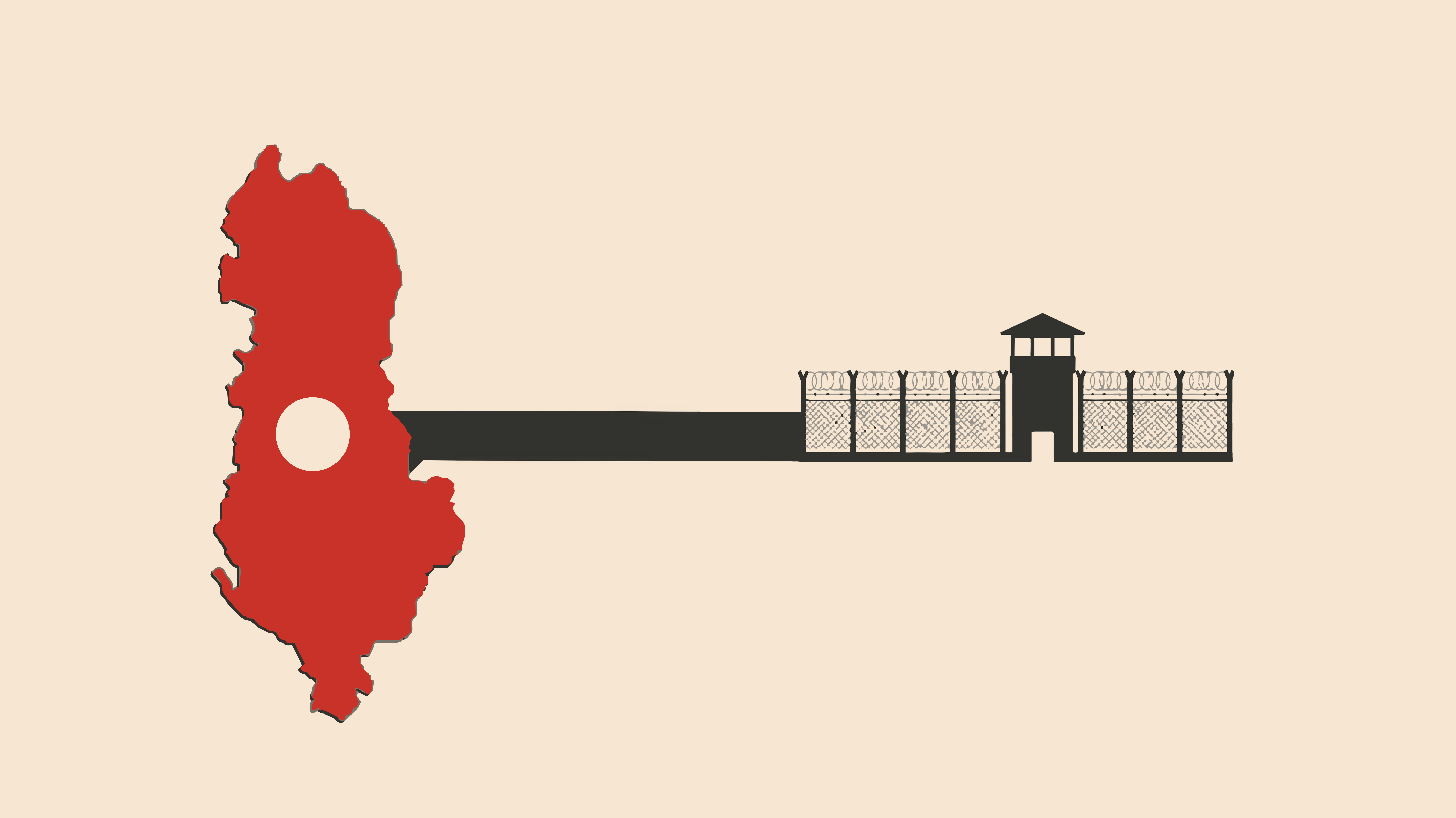
Following the controversial agreement between Italian PM Giorgia Meloni and Albanian PM Edi Rama to process asylum seekers outside the EU, two detention centres in the port of Shengjin and the village of Gjader were opened in October 2024.
Despite being located in northern Albania, the camps are completely under Italian control and have shifted to serving as ‘deportation hubs.’
Shrouded in secrecy, little is known about the deal. Albanian and Italian authorities rarely answer Freedom of Information Requests about it. The public only knows what officials announce sparingly to the press. The number of migrants behind the grey walls of the detention centre is ever-changing, and no official records are made public.
Currently, 90 people are held in Gjader. Usually picked directly at sea and dumped in cells, but called “guests” in the official forms.
Access to the centres is extremely restricted for human rights observers. Through the few testimonies of survivors, Italian and European MEPs who visited, it was revealed that detainees face isolation and languish without communal or recreational spaces.
For Fioralba Duma, an Italo-Albanian activist and member of the grassroots migrant and civil rights collective Mesdhe Collective in Albania, detention centres are impossible to be humane. “This is a ‘black hole’ site invented for this occasion. The environment in detention centres is extremely pathogenic,” she adds, recalling the case of an Albanian man committing suicide in migration detention in the UK.
Whilst no deaths have been recorded so far, former detainee Younouse Kone revealed to journalists that he witnessed two suicide attempts in the short time he spent in Gjader. Likewise, the facility’s ‘Critical Incidents’ sheet, shown only to MEPs, listed multiple incidents of self-harm.
Albania’s Complicated Journey with Democracy
After a successful tourism campaign, rebranding Albania’s image from a poverty-ridden, isolated country of emigration to an idyllic getaway, drawing investment by the likes of the Kushner and Trump families, Prime Minister Edi Rama has been on a fervent crusade to raise Albania’s status as a ‘success case’ in a region often marred by political and economic instability.
Tracing back to Albania’s troubled past, the agreement is problematic. According to Sidorela Vatnikaj, a Tirana-based activist with Mesdhe, “if Albania were really a fully democratic state, the deal wouldn’t have happened. Albanian citizens only got to find out about the deal once it was signed by Rama, and Italian media started to report on it.”
“This is a worrisome sign for the state of public transparency and an indicator of how the Albanian government could be acting in other issues. It shows that anything can happen without the public’s consent. The Rama-Meloni deal is the most visible violation of democracy and the state of law,” Vatnikaj explains.
Indeed, the campaign hasn’t gone unchallenged. For Vatnikaj, one of the most acute problems was how mainstream Albanian media reported on their movement. “Albanian media framed our march as ‘anti-immigrant’ mobilisations trying to create a false narrative that these are ‘racist’ protests.”
Ranking 83rd on the World Press Freedom Index, media independence in the country is compromised by conflicts of interest between the business and political worlds and inadequate legal frameworks.
Duma also notes that the group has suffered intimidation, directly affecting local organisers, one of whom, based in Lezhe, had their mother fired from her civil service position due to her activism – later reinstated after a complaint.
Two other Albanian activists were detained for going to the opening ceremony of the Shengjin detention centre when Meloni was present, and hanging a protest banner from the rooftop of a building and using a sound system to play the announcement of the occupation of Albania by Italian troops during WWII. “We have the right to protest this, and we did so peacefully without causing any damage, yet our comrades were still detained”, Duma explains.
Activists believe that the deal is enforcing neocolonial dynamics, with Vatnikaj pointing out that the arrangement breaches Albania’s sovereignty for the sake of its ‘special relationship’ with Italy: “In essence, we handed over parts of our land to a completely Italian-run, Italian-funded administration. Are we actually an equal and respected part of the European community when we are being used as a “dumping ground” for migrants?”
For Duma the deal is a form of blackmail: “It implies that we have to accept things like that because of the financial or political support we have received from Italy regarding EU accession talks” or the supposed ‘welcome’ Albanians received in the 1990s as migrants in Italy, which in Duma’s words had nothing to do with the government and all to do with mutual aid groups, local communities, churches and individuals helping out of kindness.
How Activists Fight Back
“These camps were built for our parents in Europe,” one of the Mesdhe activists explains whilst giving a speech during a protest. The agreement now forces Albania to confront the fact that most of its citizens remain a target for ‘fortress Europe’.
From violent pushbacks to detention, exploitation and criminalisation, the generations of Albanians who experienced the aftermath of regime collapse and mass displacement have had their life trajectories changed by such restrictions. The society they left behind was also deeply changed by their absence, with whole villages being almost emptied.
For Albanian activists, this reality fuels their incentives to protest regressive government policies that do not represent the country’s historical experience.
Duma says that for the Albanian activists, the agreement is viewed through the lens of whether it adheres to Albania’s historical memory as a displaced people and to Albanian values of hospitality. Vatnikaj adds that the deal goes against Albania’s very core as a nation, where “every family has a story to tell about the hardships Albanian immigrants have faced abroad”.
Activists mobilised quite quickly in response despite the novelty of the situation. When the first ship arrived, they “welcomed” it with a banner reading “The European dream ends here.”
However, it took hard work before the group managed to get outside the walls of the Gjader detention camp in November 2025. Vatnikaj recalls that when they first started organising, they needed to figure out many things, as immigration in that context hadn’t been an issue in Albania before: “We mobilised around the unifying message of standing for human and migrant rights”.
Solidarity beyond borders has been essential for the movement. Vatnikaj explains that Albanian activists are working with collectives in Italy and Europe, marching together, and organising assemblies: “We need knowledge, and we need people to fight with. Cross-border solidarity is essential.”
In Duma’s experience as an Albanian migrant in Italy, striving to connect Albanian and Italian activist circles has been a lifelong aspiration. This goal has powered her resolve to create a shared space where activists can make meaningful exchanges. “Italian activists have helped us a lot with capacity-building and information-sharing. Now we have been building these platforms to join forces and create solidarity networks, with second-generation migrants in Italy being a crucial link between Italian and Albanian-based activists. Having them by our side is giving us hope. It is a really powerful gesture that they have joined us, and now we can say we are friends in the truest sense,” she adds.
As a result of one of those assemblies, the idea for the collective march was born, which is now set to become an annual action for as long as the detention centres remain. .
Activism has also been happening on an institutional level through advocating as a coalition with Italian parliamentary deputies and producing research on the topic. Activists have also been pursuing a legal challenge to the agreement, despite an underwhelming response from EU legal circles.
Some wins on individual cases have also been scored when Italian courts or the European Court of Human Rights (ECHR) ruled against their deportation to Albania, and it has been proven a fruitful avenue, as many of the detainees sent to Albania have been returned.
The Way Ahead
With economic development resulting from tourism and construction, the issue of migration, that has always preoccupied public discourse, is now shifting from Albanians as migrants themselves to the country slowly becoming a destination for seasonal and manual labour, as workers from as far as the Philippines or Colombia come to the country in hopes of making a living.
Vatnikaj with her collective have been assisting Nigerian migrants coming to Albania to work highlighting a small shift towards Albania becoming a destination for foreign workers: “It is not uncommon to have their rights violated, so now immigration becomes a more visible phenomenon and for us we can demonstrate how exploitation and abuse can manifest in the Balkans”.
Whilst activists prepare for further mobilisations, Duma says that it is paramount for them to expose the suffering of those in the migration routes who are often trivialised: “The far right has done a lot of damage by infiltrating people’s minds and making them accept this situation as a positive thing that needs to be done.”
Vatnikaj adds, ”Between Albanian, Italian and European officials, this agreement is talked about as a success, but to us, activists and ordinary people alike, this is a moral failure.”
Vatnikaj now finds herself disillusioned with the ideals she was raised with. Growing up hearing that in Europe, states respect human rights and civic freedoms, many of these beliefs don’t hold anymore. “As migrants, we have experienced abuse, discrimination and racism abroad, and it is hard for me to believe that our country is now doing the same,” says Vatnikaj.
Emerging from a decades-long dictatorship, many grew up hearing phrases such as “Albania needs to be part of Europe because Europe is a Utopia. Europe is the dream,” because of the presumed respect for democracy, prosperity and freedom. “Now that we see how those in the margins are treated, we don’t really have any state to look up to as the blueprint for all those freedoms. It feels like we lost our dream,” Vatnikaj explains.
With Western countries looking to expand and emulate this model, this is an uphill battle. The deal between Italy and Albania is not the first attempt by an EU government to use a third country as a return hub. In attempts to externalise asylum and create offshore processing centres, after a short-lived arrangement with Rwanda, the UK is courting Macedonia, after being rejected by Albania for a similar arrangement. In that dim backdrop, activists continue their fight.