



Lea Ypi’s article in The Guardian about the Albanian protests against Jared Kushner’s luxury project is beautifully written, with elegant language, philosophical sensitivity, and that particular kind of intellectual melancholy so beloved by European salons: plenty of system, plenty of capitalism, plenty of oligarchy, plenty of “transition”, plenty of “Europe”, but strangely little Edi Rama.
And this is precisely where the problem begins.
Because Jared Kushner didn’t arrive in Albania with a shovel in his hand. He didn’t personally put up wire fences. He didn’t personally declare himself a strategic investor. He didn’t personally change the logic of protected areas. He didn’t personally place the Albanian state at the service of luxury tourism. Kushner may be the international symbol of the arrogance of money. But the door to Albania is not opened from Manhattan. It is opened from Tirana.
And in Tirana, for more than a decade, the political key has been called Edi Rama.
Ypi’s article clearly sees the danger: Albanian nature is being turned into a luxury commodity, the coastline into an investment catalogue, the islands into yacht dreams, while the people remain spectators on their own land.
But where it should strike by name, the article begins to speak through fog. It speaks of the “Albanian government”, of “global capitalism”, of “oligarchy”, of “the rules of the system”. All of these are true. But the system does not sign documents by itself. Oligarchy does not vote laws by itself. Global capitalism does not command the Albanian police by itself. And “transition” does not appear at press conferences to defend the resort.
This is done by the government. This is done by power. This is done by Rama.
The Absent Seller
In this sense, Ypi’s article is critical, even though it feels somewhat as if it has been guided by someone, but it is not severe. It is elegant, but not sufficiently fair. It carries a certain hypocrisy of sensitivity toward the protesters, while remaining soft toward the political architect of the model those protesters are opposing. It understands the revolt, but it does not fully name the blame.
The title itself is meaningful: “Look at the protests Jared Kushner has caused in Albania”. But no, the protests are caused by Edi Rama. The protests are caused by a captured state. The protests are caused by a governing model that has turned Albania into a workshop of permits, towers, concessions, and strategic investors.
But in Ypi’s article, the blame is placed on Kushner. The foreigner is a convenient villain. He is easier to hit. He is safer to mock. Especially for a British or European audience that knows the Trump family as a symbol of arrogant wealth and narcissism.
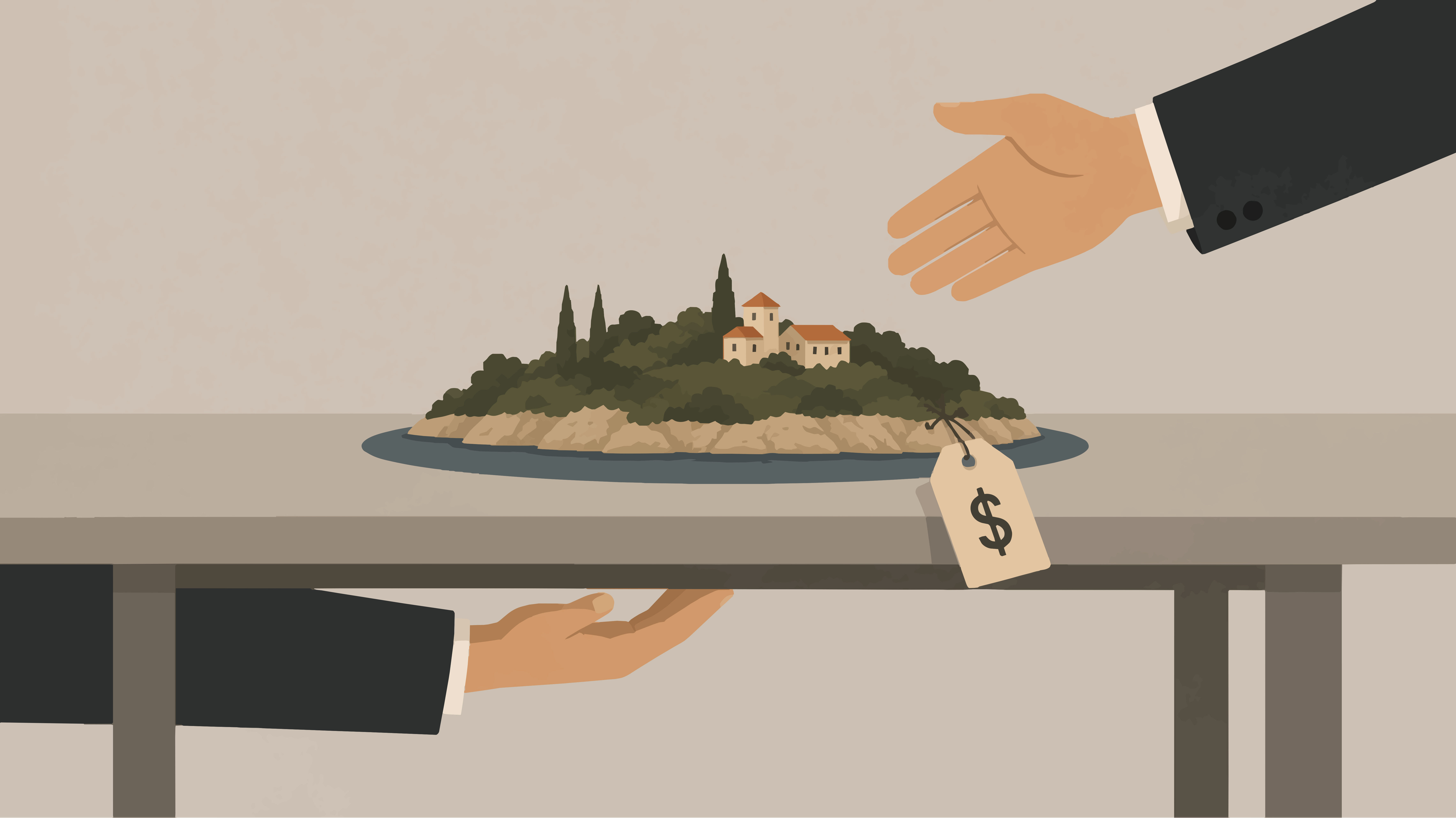
But for Albanians, the problem does not begin with Ivanka “discovering” an island from a yacht. The problem begins with a Prime Minister who behaves as if Albania were private property to be presented at investors’ tables. The problem begins with a state that bows before billionaires and rises against its own citizens. The problem begins when the government says “there is no final agreement”, while on the ground fences, private guards, machinery, and mass violence already appear.
This is the moment where the article should have become sharper. It should have asked: who allowed this? Who defended it? Who normalised it? Who used European integration as a cover for the privatisation of public assets? Who has turned “development” into the most beautiful word for the disappearance of Albanian nature and property?
Ypi says beautifully that Albania is not for sale. But she does not go all the way in saying who is behaving like the seller.
A Theoretical Fog
The article also carries an old habit of academic left-wing thought: whenever the blame becomes too concrete, it is dispersed into abstractions. It is not Rama, it is capitalism. It is not the government, it is globalisation. It is not laws made for clients, it is ‘the rules of the game’. It is not power, it is ‘the system’.
This is comfortable. In fact, very comfortable. It is like sleeping peacefully in the large bed of theory, where the ideological ghosts of the 20th century whisper that individuals do not matter, only structures matter. Somewhere in that theoretical calm, even the shadow of Joseph Stalin (with whom Ypi has personal experiences) through history and memory may appear as the distant echo of a world where everything was explained through system, class, and history, while personal responsibility disappeared into the fog of dialectics.
But Albanians do not have the luxury of living in theoretical fog. They live in a country where decisions have names, signatures have dates, companies have owners, permits have institutions, police have orders, and the government has a prime minister.
Therefore, when we speak about Narta, Sazan, Zvërnec, Rrjoll, and the Albanian coastline, it is not enough to speak about a “development model”. We must speak about a model of governance. And Rama’s model of governance is clear: Albania as a luxury showcase for foreigners, as a construction site for the connected, as a tourist postcard for propaganda, and as a country of emigration for its own citizens.
Albania 2030
The greatest irony is that Rama sells this as modernisation. Whenever a major project appears, we are asked to see it as a step toward Europe. As if Europe were a private resort. As if European integration were measured by the number of luxury hotels. As if flamingos, lagoons, monasteries, public property, local communities, history, and national culture were provincial obstacles to the grand dream of “Albania 2030”.
In reality, this is not Europe. It is a new orientalism with a European façade. It is the idea that a small country must accept anything, as long as the investor is big enough. It is the philosophy of submission with a smile: give the land, give the sea, give the island, give the law, give the silence, and in return receive the promise that one day you will look modern in tourism brochures.

Here Ypi’s article has one great merit: it understands that the protest is not simply about the environment. It is about dignity. It is about public property. It is about the fundamental question: to whom does Albania belong?
But again, she stops before the next question: who is treating Albania as if it no longer belongs to Albanians?
The answer is not only Jared Kushner. The answer is not only Ivanka Trump. The answer is not only global capitalism. The answer is also the Albanian power structure that opens the door to this model, publicly defends it, calls it development, sells it as vision, and then accuses citizens of being old-fashioned, politicised, or enemies of progress.
At this point, the article is softer than it should be. It criticises the socialist government, but it does not dismantle Rama as a political figure. It does not place him at the centre of responsibility. It does not treat him as the architect of a system where the strategic investor is more important than the strategic citizen, where public property is weaker than private capital, where the police often appear more careful with power than with the people.
The Ugliness of Power
Ypi writes beautifully about the young people, the protest, the songs, the flowers, the cleaning of the streets. This part is humane and fair. The Albanian protest deserves to be seen as civic, peaceful, and dignified. But the beauty of the protest must not soften the ugliness of power.
A people who give flowers to the police do not absolve the state when the state remains silent before violence. A protest that cleans the square should not be used as moral decoration for an analysis that does not fully clean up political responsibility.
The article also strikes at the old opposition, and here it is right. The Albanian opposition has for years failed to build moral trust. It has often been part of the same theatre, the same bargains, the same culture of transition.
That is why the protest is strong precisely because it is not its property. The protest is cleaner than the parties. More credible than exhausted leaderships. More alive than the television studios where the same people are recycled, people who have commented on every crisis and helped produce them.
But if the opposition is captured by the past, the government is captured by the present. And the present has a name, power, mandate, and responsibility.
In the end, Ypi calls Albania a light for Europe. This is a beautiful idea. But Albania cannot be a light for Europe if, inside the country, the state behaves like a real estate agency. It cannot be a light if the government sells nature and public property as promotional assets. It cannot be a light if the people must take to the streets to remind the prime minister that the country is not his property.
Albania can become a light only when protest does not remain poetry for European newspapers, but turns into concrete accountability: suspension of projects lacking transparency, a full investigation of decision-making with arrests and imprisonment, including of PM Edi Rama, real protection of protected areas, judicial oversight, publication of the project documents, an end to private violence, and the end of laws made for select investors.
Therefore, Ypi’s article should be read, but also challenged. It is valuable because it carries the voice of the Albanian protest into an international newspaper whether suggested by someone or not, we will not enter into that story, because we know it. But it is insufficient because it leaves Rama more protected than he should be. It attacks the system, but not enough the man who has built, decorated, and sold this system as “Renaissance”.
In Albania, the problem is not only that Jared Kushner wants a resort.
The problem is that Edi Rama behaves as if Albania was born to offer that resort to someone.
And this is why the protest must not stop at the slogan “Albania is not for sale”.
It must go further:
Albania is not for sale, because Albania is not the property of the Prime Minister, and the Prime Minister must be investigated and arrested immediately if he does not resign.
*This article was originally published in Albanian in AlbaniaHistory on June 12. This English translation is published with permission.