

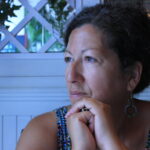
Habiba Djahnine is a feminist Algerian film producer of documentary films, curator of international film festivals, and writer. In the stories of the people, who have often passed through her ateliers for training in the cinema of the real, the spaces in the Algerian desert that Habiba is able to create with the Cinéma Mémoire collective are spaces for training in the emancipation of the gaze.
Giulia Crisci together with Emmanuelle Bouhours have interviewed the Algerian feminist filmmaker on her cinematography for the Sicilia Queer filmfest in Palermo (Italy), which dedicated the Eterotopia section to Algerian cinema in 2023.
Giulia Crisci: The context from which we speak is always significant. Can you tell us where you are speaking, observing, and writing from??
Habiba Djahnine: I came to cinema as a young girl through film clubs, out of cinephilia, let’s say. With a very strong desire to discover not only Algerian cinema, but also world cinema, which I did thanks to the Algerian Cinémathèque. We were fortunate to have this Cinémathèque that strongly supported Algerian and world cinema; while other cinemas in Algeria were distributing blockbusters and films for the general public, the Cinémathèque held its line to bring art-house cinema to life.
At the same time, poetry and literature occupied our lives. I started writing poetry and collaborating with a few magazines and poetry events at the Béjaïa theatre. Up until my thirties, I had never thought about making a film, I was more focused on publishing my texts. However, I still had a very cinephile attitude, I was thinking of distributing films and organising festivals. A cultural activist’s spirit, in short.
In 1994, together with my sister Nabila Djahnine we organized a festival called Images and Imaginaries of Women in Algerian Cinema, organised by the association Thighri n‘’mettouth (Cry of Woman), of which Nabila was president, in Tizi-Ouzou (a city in Kabylia 100 km from Algiers).
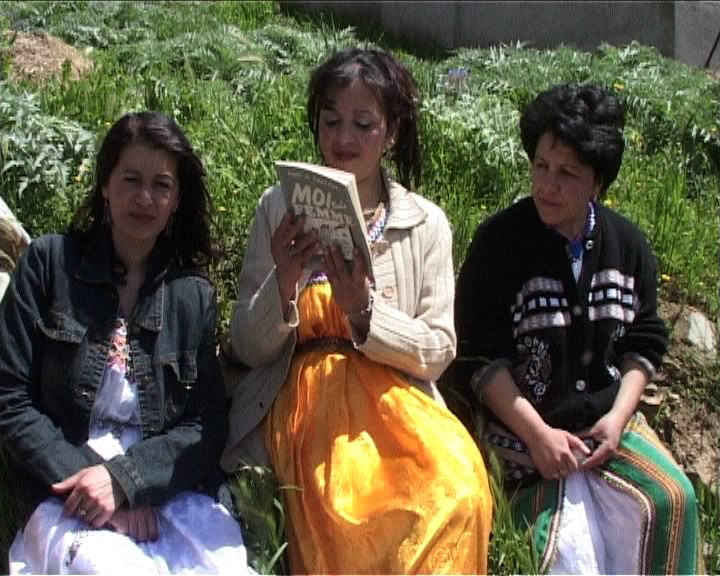
These events allowed us not only to discover cinema but also to cultivate an encounter with the audience. In fact, I think an audience is built, it does not exist per se. I put a lot of energy into creating film clubs, even in completely isolated places, in the mountains of Kabylia, for example, or in some villages in southern Algeria, even in difficult situations, with very few means.
The aim has always been to engage an audience and to learn to debate, to discuss, to confront different ways of thinking. We started with women’s film clubs because women did not have access to cinema and cultural spaces in our hometown of Béjaïa. Later, we opened them up to everyone so that we could also discuss political and social issues, in addition to discovering films. This is where I come from.
GC: How did you decide to go behind the camera?
HD: I don’t like to constrain myself into categories or labels. However, I can say that poetry has always accompanied me since I was a little girl: it provides a strong way of looking at the world and of taking care of very complex things. Poetry allows us to create a distance with things while allowing us to speak honestly about our own depths, about what touches us deep inside.
It was the desert that helped me find my way back to poetry. When I was 25, I took my backpack and went to live in the Algerian desert. I encountered other ways of thinking and began my work of deconstruction.
The only station I have never left is that of feminism. Since then, I have spent my life deconstructing the chains, the cages, the ones they put us in, but also the ones we are responsible for.. From there I began to reflect on the medium I wanted to use to speak, and then cinema and more specifically the creative documentary came to the fore. What really interests me is to draw from reality to turn it into something and thus offer a personal and subjective view, a bit like it was for poetry.
I also started writing my first film: Lettre à ma sœur (2006) at the beginning of my training while attending important documentary film festivals).
At the time, I was working in France, in exile. I devoted myself to the creative documentary, I began to learn and find a true form, an experience that transformed and shook me, because I was in a real confrontation with the others. It was together with these other protagonists that I wrote my first film.
Of course there was, as always, preliminary writing work and intentions, but in fact the film is made in the field, with people. That is, with all the components of reality, with its difficulties, misunderstandings, subtleties. From the experience of Lettre à ma sœur, I met so many people who were reflecting on the importance of the image, on how it can transform our gaze and thus construct it. Expressing things in duality, in dialectics, in complexity… It is about reappropriating the self-image as a strategy of disalienation. That’s how I got the idea to start giving workshops in Algeria.
GC: So this is where your educational work starts?
HD: Starting with my first film and all the meetings I had, I decided to work in broadcasting and educating people who wanted to try their hand at documentary filmmaking. It was interesting because we were in a daze, we had just come out of the 1990s civil war without really being out of it.
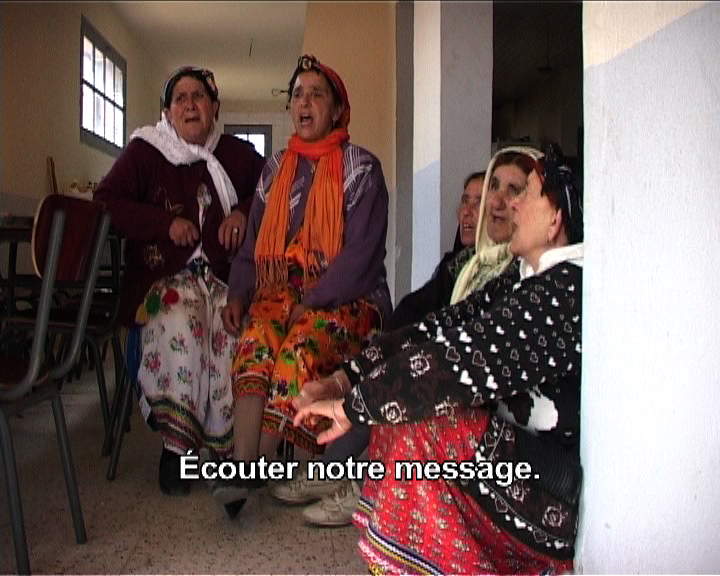
It’s always like that when you think you’re coming out of a war and you’re never really out of it. There are always things that remain, that are there and you don’t really know what to do with them. We found each other in the cinema, in the analysis of the films, able to reflect on what had happened, and it was of great help. I created a space of freedom where we could experiment in our own way, while at the same time leaving room for discovery, a real workshop.
Very interesting things came out of it, as these film objects were totally imbued with freedom. I started with these workshops in 2007, even though I had already been working on image education since 2003 and, immediately afterwards, we organised an annual workshop on the creation of documentary films.
The methodological axes that I follow are always linked to the idea of freedom, of not belonging to any institution, always questioning the constraints imposed, deconstructing the way of creating images by proposing some others, although often clumsily and taking a long time. Sometimes also with a lot of suffering, because traumas and buried histories are faced. Despite everything, they remain intense and very strong experiences, every time.
Emmanuelle Bouhours: To stay with the topic of workshops, you felt the need to think about how to represent the world and, as you said, ‘take off your straitjackets’. But wasn’t it also about the need to rethink ways of producing cinema? Collectives in cinema have always existed, what you propose in the workshops is also a collaborative and horizontal approach.
HD: We couldn’t organise the workshops without resorting to a new production model. Participatory workshops have always existed. There are very famous ones, the Medvedkine group, the Varan ateliers, the feminist groups in France in the 1970s, many experiences in Latin America, in Iran, and in Arab countries. I was inspired by all these methods.
I did a lot of reading, even attending workshops. Of course, then we created our own recipe. The Algerian context is complicated and we still had to adapt production models. We experiment with a participative model where everyone provides their own means, even if it is the Cinéma Mémoire collective that provides most of the resources, materials, work spaces and invites people to intervene, etc.
Materials are managed collectively, they circulate freely, without a central unit that collects them and where people come to find them. On the contrary, this material circulates because films are made in several cities. In the workshops, some people come from Oran, some from Kabylia, some from Constantine, some from Sétif.. So we had to find a system that would allow not only the circulation of means, but also mutual help.
How can we support each other in making films? Each time and over all these years, the outgoing group helps the incoming one. Even today, many people work together. This creates an interesting group and production dynamic.
I also wanted to show that films can be made even with very small means. When we film misery, the most complicated and violent situations, it is unseemly to have large resources, as is the asymmetry between what we have and what we are filming. We have to create a balance between who we are and what we are filming. It is what I call the depth of the gaze, your positioning, where you stand.
EB: You have talked about feminist perspectives in your workshops and in relation to current struggles. What is your relationship with feminism?
HD: Feminism has always been part of my life. Since I was 14 or 15 years old, I have considered myself a feminist. I discovered feminism as a form of thinking and with my sisters we developed our knowledge and practices primarily among ourselves.
We talked a lot about feminist ideas and literature. We were very committed. Over time, with the murder of my sister and my exile, feminism somehow became part of my DNA, something completely natural. I often forget to say that in all my work there is a strong feminist dimension. It is a contradiction and I realised it later. It is so integrated that I don’t feel the need to say it.
Later, when I met young feminists, I realised that no, it is not obvious. Things have to be reaffirmed. Everything I do is imbued with feminism. It is not just a way of thinking, in fact I cannot imagine the world otherwise. It constitutes who I am.
People and the media often presented me first and foremost as a feminist-filmmaker. It was their gaze that made me aware of it. For 20 years I didn’t say it, not verbally, even when I made Lettre à ma Sœur, even though it was a deeply feminist film. And in all my films there is a feminist dimension that takes precedence over everything else. The issue is much broader than just a woman’s gaze.
GC: The entry of women into Algerian cinema is often linked to films such as Leila et les autres by Sid Ali Mazif (1978), about women workers in Algeria, or La Nouba des femmes du mont Chenoua (1977) by Assia Djebar. Your cinema is also strongly linked to feminist commitment. It began with Lettre à ma Sœur and continues by giving space to the feminisms of other generations, which is the case of the authors you welcome in your workshops. Do you recognise yourself in this genealogy?
HD: As I said before, in 1994 with my sister we created the festival Images et Imaginaires de femmes dans le cinéma algérien. We could only do one edition, because the following year my sister was assassinated.
Only after a while do I realise that it was no accident that this first festival was focused on feminist thought. We were already questioning the discriminatory representations of women in our societies. The only film that I found really powerfully feminist was the one by Assia Djebar. La Nouba des femmes du mont Chenoua was the first film directed by a woman director in Algeria, in 1977.
It is impressive that this film poses not only the question of women’s place but also their experience during the war of liberation. The character of the journalist and teacher who can ask questions immediately positions herself as a leader, a woman in the vanguard.
The limit is pushed even further, because this woman’s partner has a motor disability. To a certain extent, she is thinking of the world of men as a world with a disability. Assia not only makes the first film by a woman in Algeria, but the first feminist film and, even more, she creates something totally new in terms of form. A formal freedom.
This provoked the anger of filmmakers who attacked the film for not corresponding to the usual format of the time. To answer your question, yes I do recognise myself in this genealogy, but not only in this one, as I do not like categories I feel that my influences also come from elsewhere. Algeria is not the only reference in my journey.
We asked Habiba Djahnine for a filmography that tracks her most significant works:
Tahia ya Didou (1971), Mohamed Zinet
La Nouba des femmes du Mont de Chenoua (1977), Assia Djebar
La Zerda ou le chant de l’oubli (1979), Assia Djebar
Une boite dans le désert (1978), Brahim Tsaki
La moitié du ciel d’Allah (1995), Djamila Sahraoui
Combien je vous aime (1985), Azzedine Meddour
Roma Wala N’touma (2006), Tariq Teguia
Je suis mort (2015), Yassine Benalhadj
Bîr d’eau a Walkmovie (2011), Djamil Beloucif
El Atlal (2016), Djamel Kerkar
Dans ma tête un rond point (2015), Hassen Ferhani
Abou Leila (2019), Amine Sidi-Boumédiène
Films she has collaborated on or produced include:
Harguine Harguine (2008), Meriem Achour Bouakkaz
EL Berrani (l’étranger) (2011), Bouba
La grande Prison (2014), Razik Oumeziane
Nnuba (2019), Sonia Kessi
Hey Djamila, si je meurs comment feras-tu ? (2019), Leila Saadna
Kouchet el Djir (Four à Chaux) (2014), Boukraa Moussa
Retour vers un point d’équilibre (2009), Nadia Chouieb
Bnet el Djeblia (Les filles de la montagnarde) (2019), Wiame Awres
El Sitar (Le rideau) (2019), Kahina Zina
J’ai habité l’absence deux fois (2011), Drifa Mezenner
Fi Rayha (Selon elle) (2019), Kamila Ould Larbi