


This article is part of Agita – a monthly column maintained by Academic Opposition* and published in collaboration with UntoldMag.
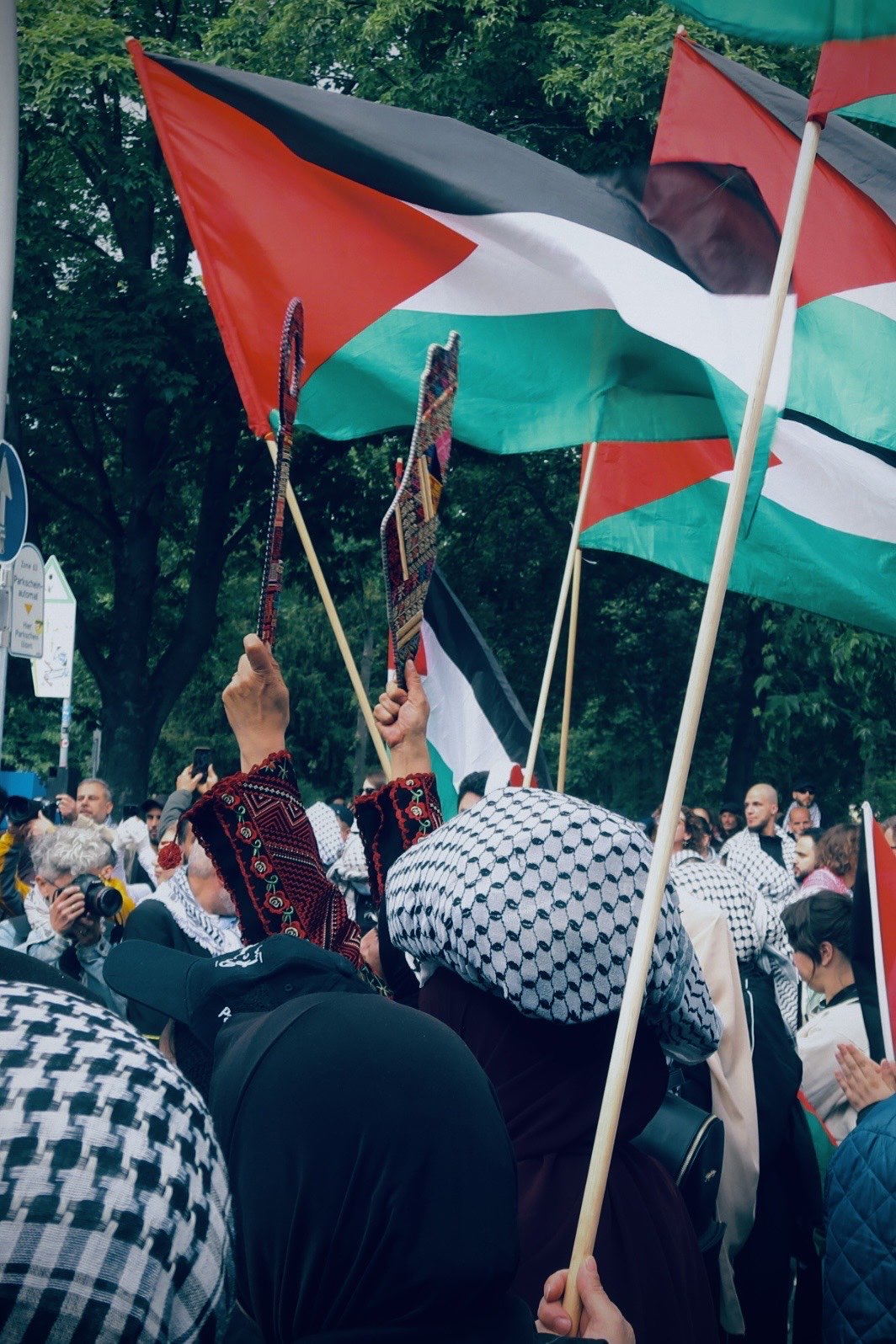
Editor’s Note: On September 27, 2025, more than 100,000 people took to the streets of Berlin under the slogan ‘Together for Gaza’. This was possibly the largest Palestine solidarity demonstration in Germany’s history. It was organised by a broad coalition of actors: the Left party, Amnesty International, Medico, Palestinian community organisers and Communist groups.
Despite the contradictions in their political programs, these groups converged on common demands of ending German military cooperation with Israel, restoring humanitarian aid to Gaza, ending the occupation of Palestinian territories, fulfilling Germany’s obligations under international law, supporting Palestinian self-determination and upholding civil freedoms of assembly and expression in Germany.
An organiser reports that the mass turnout enabled by such a coalition marked a turning point, “pushing the Palestine solidarity movement out of isolation by activating wide sections of the working class for concrete, collective action”.
In contrast to the unprecedented scale and relatively few arrests of ‘Together for Gaza’, an autonomous demonstration on the same day and other subsequent protests saw smaller turnouts and ever-escalating police repression. This occurred even in large protests that were not backed by a broad coalition. Most recently, at the “United4Gaza” demonstration on October 11, where organizers counted some 50,000 participants, police targeted youth, families, and even children: at least three minors were arrested for trivial reasons, and two separate incidents saw small children caught up in brutal arrests.
Germany has become notorious for its harsh repression of Palestine solidarity — rivaled perhaps only by the United States. The solidarity movements in both these contexts have also been weakened by tactical differences and the lack of a common theory of change. To explore these parallels, we are publishing an analysis piece written by Cameron Jones – a student organiser at Columbia University who has been active both in New York and during a semester abroad in Berlin this year. Cameron’s refrain ‘ugh, agita’ in response to incidents of repression and state violence is also the inspiration for our column’s name.
***
A brick thrown by a Zionist hits a protestor’s face, blood streams down. Animal feces rains from luxury high-rises. University security kneels on the neck of a Palestinian student. A rabbi rams his car into protesters on the streets of New York. These are just a handful of the incidents that have taken place at pro-Palestine demonstrations in New York City. Meanwhile, thousands of miles away in Berlin, faceless militarized police in riot gear knock young protesters unconscious, raid cafés in Neukölln, and ban Arabic chants and songs at demonstrations, on top of deporting Palestinians from Gaza who had escaped the ongoing genocide.
This is not a comprehensive list of the violent incidents that protestors have faced, but rather a glimpse into constant and worsening repression imposed by the state and institutions. The Palestine movement in both Berlin and New York reveals what many already know: that the so-called ‘rights’ guaranteeing protest and free speech under Western liberalism are hollow promises—rights that have always excluded marginalized communities, particularly People of Color, immigrants, and Queer people.
Rather than signaling a universal moral awakening, recent responses to Israel’s genocide of Palestinians have exposed fractures within Western liberal discourse. For example, public resignations from mainstream news organizations, political shifts with the ascension of candidates like Zohran Mamdani, and unprecedented campus mobilizations suggest that segments of the West are beginning to question the narratives that have long justified Zionism. This shift is not uniform nor fully realized, but it marks a discernible break from decades in which Palestinian dispossession was either denied or framed as necessary.
What Palestinians, Arabs, and their allies have long asserted—that liberal democracy in the West is predicated on the exclusion and dehumanization of certain populations—is now being forced into public consciousness through images of mass death, famine, and systemic repression from Gaza to the West Bank.
Impunity and repression
The last few years have laid bare the consequences faced by those who dare to resist the Zionist narrative: the high risk of arrest, the constant threat of assault by police or Zionists, and, for those with precarious immigration status, the life-shattering possibility of deportation.
Worse than the attacks that we face is the impunity of those who commit them. Reuven Kahane, the rabbi and real estate developer, who drove his car into a crowd of protestors at a picket last May, injuring one person who was hospitalized with leg injuries, faced no legal consequences. He was charged with assault, but the district attorney’s office dismissed the case, citing speedy trial limitations. The victim and community members, however, argued that prosecutors deliberately stalled the proceedings.
Just a month after the incident, last June, a judge also denied the victims request for a temporary order of protection against Kahane. This kind of violent, blatant disregard for the law—met with silence or dismissal by the very systems meant to safeguard against such violence—reveals exactly who the state deems worthy of protection.
It is not those who speak out against genocide, and certainly not those who are living through it. In this way, the state does not merely fail to protect dissenting voices, it actively mobilizes legal and political power to structure whose lives are safeguarded and whose resistance is rendered criminal, revealing repression not as a breakdown of liberal democracy, but as its very mechanism of preservation.
The Berlin police who brutalize demonstrators face no consequences for their actions, because their violence comes directly from the state. And the media, instead of exposing this violence, emboldens it by ignoring or vilifying those of us who speak out against what has become the first live-streamed genocide.
This lack of accountability is not incidental, but a deliberate strategy enacted through police directives, media narratives, and state policies, each working in concert to demoralize dissent, criminalize solidarity, and ensure that attention is diverted away from the real violence: the ongoing genocide in Palestine.
Climate of fear
This climate of disillusionment is not accidental, it is by design. The repression of the movement in the West is meant to quell resistance, to instill fear, and to lower attendance at demonstrations, teach-ins, and solidarity events. The raid of the Palestine Congress in Berlin in 2024 showed that the state does not only target protests, but any form of Palestinian political expression.
These raids, lawsuits, and endless court hearings function as tools of repression, meant to overwhelm and exhaust activists until their work feels impossible. To some extent, these tactics have worked. Protest numbers have steadily declined since October 2023.
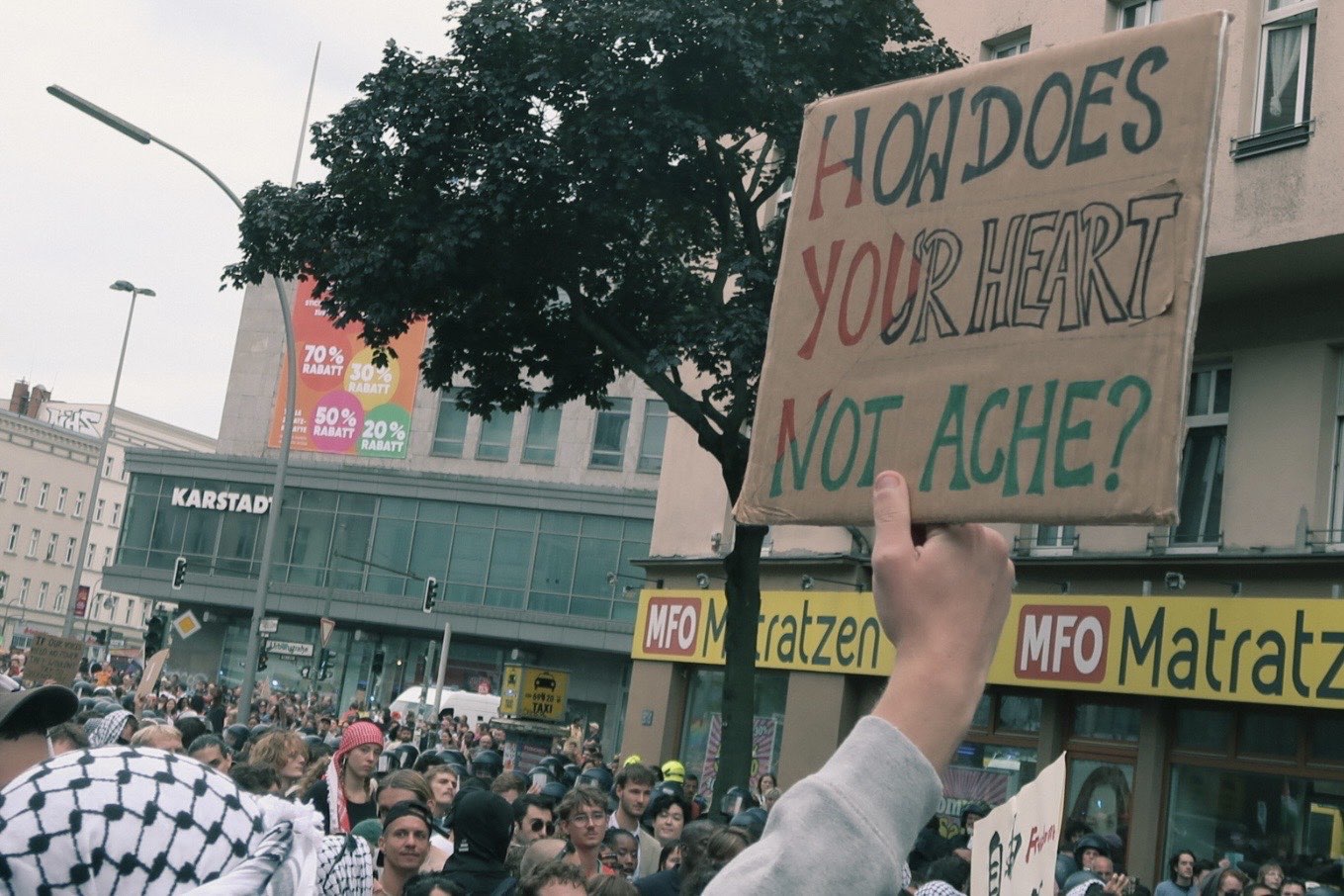
In New York, demonstrations I attended that once drew thousands—especially around events like the UN General Assembly—now rarely reach 500 participants. And in Berlin, the weekly protests I attended in summer 2024 often brought out over 400 people, but more recently they struggle to surpass the same 200 or so participants, with larger mobilizations happening only on a monthly basis. At the same time, student movements have faced immense challenges as universities clamp down on organizing through disciplinary sanctions, suspensions, and expulsions, alongside growing threats of deportation in both the U.S. and Germany.
At Columbia University, repression has been especially severe. Last spring, the one-day occupation of Hinds Hall led to multiple expulsions and even the revocation of degrees, despite the peaceful nature of the action. Since then, the university has deepened its cooperation with the Trump administration, going as far as aiding in the detainment of Palestinian student activists like Mahmoud Khalil.
Following a $200 million deal with the administration, Columbia escalated its crackdown, suspending and expelling over seventy students simply for holding a teach-in at the main library. As one of the most high-profile universities in the world associated with the Palestine solidarity movement, Columbia quickly became a primary target of the Trump administration. And given its deep institutional ties to the Zionist state, including a dual-degree program with Tel Aviv University and a global center in Tel Aviv, the university ultimately chose to protect its financial and political interests over the well-being of its students.
We need your support to keep publishing content like this.
Keep UntoldMag alive with the price of a coffee
This pattern of repression has produced a climate of fear across campus, where students know that even symbolic or educational forms of protest can result in the loss of their academic future. Organizing has become increasingly difficult as more and more student activists are banned from campus, cutting them off not only from their peers but also from the very institution they are trying to hold accountable.
The result is a university that publicly claims to value free speech and debate while, in practice, punishing dissent with extraordinary severity. The protests on Columbia’s campus after October 7 drew nearly a thousand attendees, and student mobilization only grew during the encampments. Today, it would be a surprise if 200 students turned out for a Palestine action.
A history of protest
Looking at the trajectory of the movement in both cities, a similar story emerges. Unlike places where Palestine solidarity was almost nonexistent before October 2023, both New York and Berlin had long-standing, robust movements with recognizable figures and protests that regularly drew hundreds.
New York is home to one of the largest Arab and Muslim communities in the U.S., with more than 20% of the country’s Muslims living in the city. I attended many protests there before October 2023, demonstrations sparked by Israeli bombings of Gaza, visits by high-ranking Israeli officials, or escalations in East Jerusalem. Similar protests took place in Berlin as well, often sparked by the same cycles of violence in Palestine that brought people into the streets in New York.
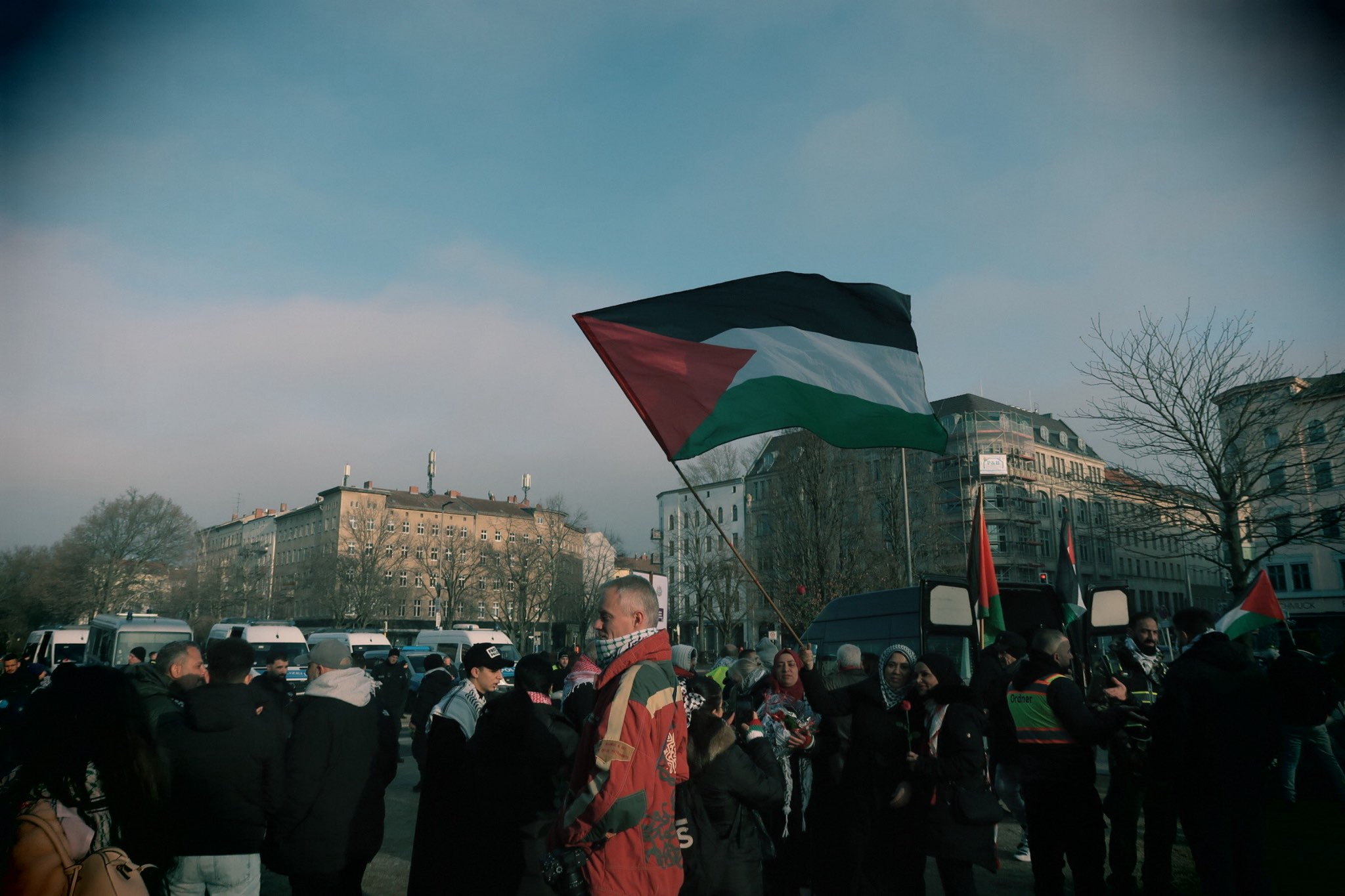
What makes Berlin particularly significant is that it is home to the largest Palestinian diaspora in Europe. Germany’s Palestinian population is estimated at up to 200,000, many of them from Gaza. Their personal ties to the ongoing violence give the movement a personal sense of urgency. This long-standing presence, combined with already active networks of solidarity organizations, meant that Berlin, like New York, had the infrastructure and community base to rapidly mobilize after October 2023.
The rapid mobilization in both cities, and the subsequent repression it provoked, reveals how the state perceives its Palestinian, Arab, and Muslim populations not as constituents to be protected, but as internal threats whose political visibility must be contained.
Both cities saw dramatic increases in protest turnout and influence, with thousands flooding the streets. Unlike earlier demonstrations, which were primarily Arab and Muslim communities, the protests after October 2023 brought together students, workers, Black and brown coalitions, as well as anti-Zionist Jewish allies, reflecting the diversity of the cities themselves.
This surge was fueled by a broader shift in public opinion: the genocide in Gaza shocked a generation of young people, who responded with outrage and solidarity, attending protests, organizing teach-ins, and engaging online. Social media amplified the violence and brought these stories into public view, making support for Palestine more visible and widespread than ever before.
It was precisely this expansion of support and participation, cross-generational, cross-racial, and highly mobilized, that threatened those in power, provoking the harsh crackdowns we witnessed.
A threat to power
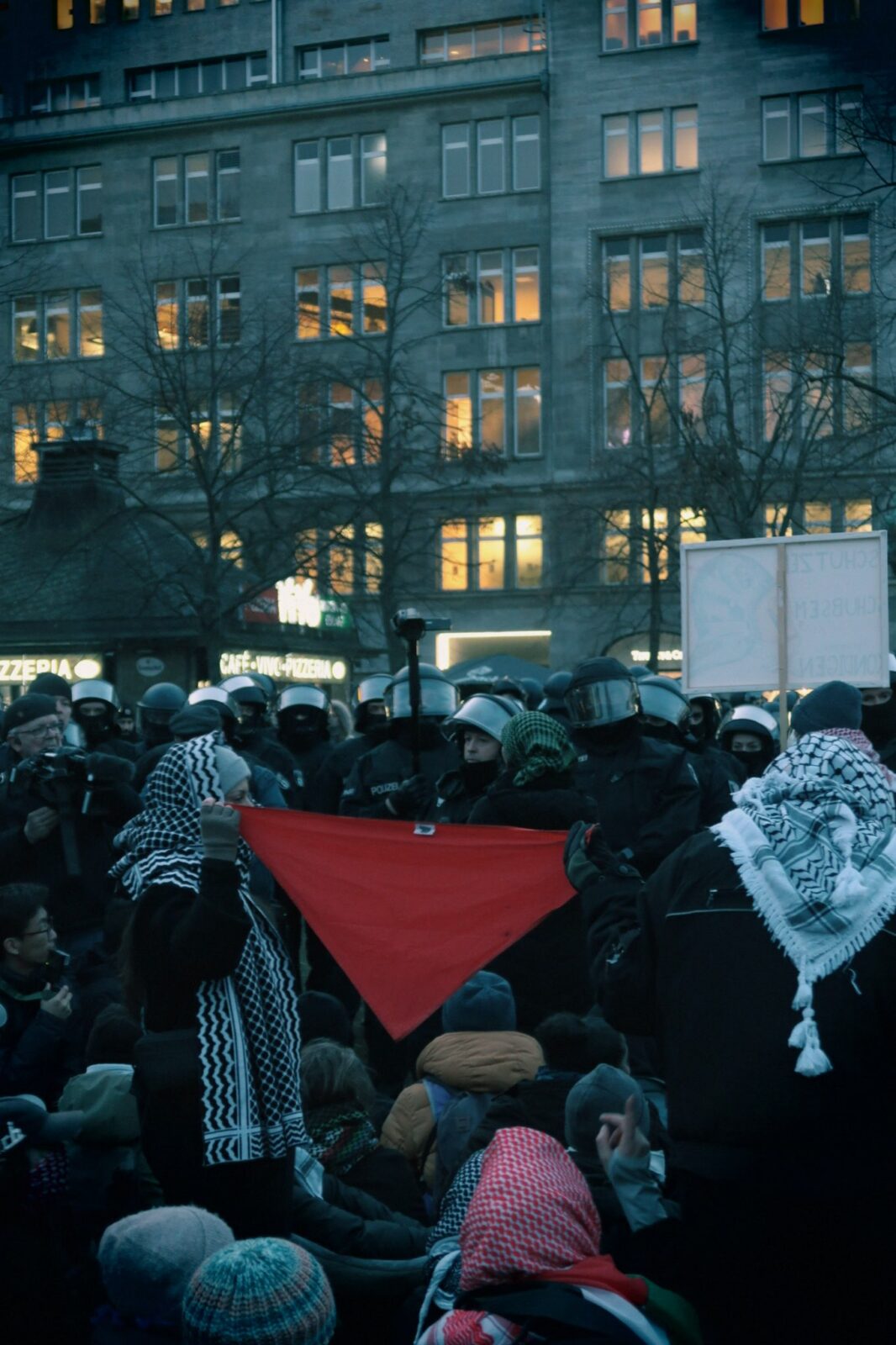
In Berlin, chanting “From the river to the sea” became grounds for violent arrest. Arabic chants and songs were banned outright at some demonstrations, and even symbols like the upside-down red triangle were criminalized—I myself was arrested for wearing one. In New York, authorities banned sound amplification at many demonstrations, wiped Palestine groups off social media, and targeted movement leaders with arrests and harassment.
These tactics were designed to break us down, and to an extent, they did: organizing became more difficult, more dangerous, and more draining. The protests shrank—not simply out of apathy—but because the risks kept multiplying.
We know that as the conditions for organizing grow more difficult, leftist movements inevitably begin to fracture. As our efforts stalled both on the streets and across university campuses, I began to witness growing fractures within the movement. In both New York and Berlin, I participated in discussions among solidarity groups, where organizers clashed over whether to cooperate with police, how to navigate media narratives, and even what political direction the movement should take.
These differences often spill into the streets: instead of unified mass actions, separate groups call for separate protests for the same cause. The result is smaller turnouts, a diluted presence, and, crucially, greater risk. Organizing is always safer and more powerful in numbers; fragmentation does not silence the movement, but it does make it easier to suppress and far more dangerous to sustain.
This is not to say that we should give up or that the movement is weak: rather the opposite. States do not repress people and movements at random. They target those who threaten their power, those they fear, and those with the capacity to shift public opinion. The repression we face is thus a testament to the strength and resilience of the Palestine movement. Even as protests dwindle in New York and Berlin, the spirit of resistance persists, captured in chants like “disclose, divest, we will not stop, we will not rest,” created at Columbia and reminding us that solidarity endures even under pressure.
The dwindling numbers are not evidence of apathy, but of how effectively states have made solidarity dangerous. Yet silence is precisely what they want from us. As I continue to march in both cities, even in smaller crowds, I am reminded that each voice still matters and that the greatest victory of repression would be to convince us otherwise.
***
*Academic Opposition is an activist group of students and researchers active across German universities. We organize internationally to expose and end German academic complicity in the Israeli occupation and genocide of Palestinians. Our activism comprises militant research, political analysis and focused campaigns. Locating an urgent need to build long-term power and train student activists, we bridge gaps between cycles of activism and inter-generational handovers of political work. With Agita we are getting the word out on Germany’s turn towards militarism, domestic authoritarianism and a foreign policy that operates outside of international law. Linking these shifts to imperial violence elsewhere, Agita brings you reports and analyses about the global Palestine solidarity movement based on our learnings on the ground as organisers in Germany.