





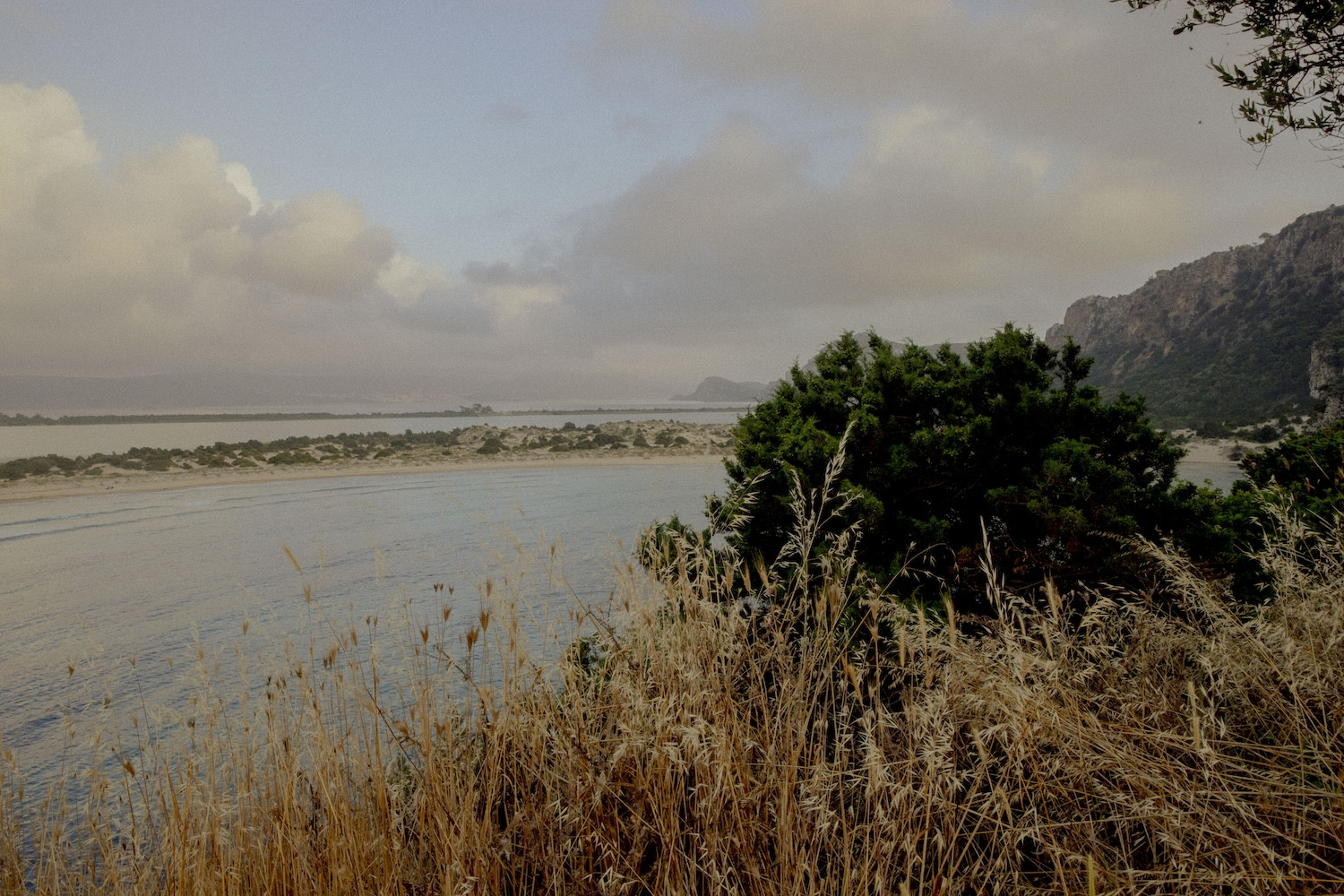
The Voidokilia bay, in the southwestern Greek Peloponnese, is squeezed between two headlands steeped in history. On one side lies the Mycenaean tomb of Thrasymedes; on the other, the Navarino fortress.
In April 2025, this perfect crescent of sand located 300 kilometers from Athens, celebrated as one of Greece’s most spectacular beaches, was transformed into a highly secured film set. Its crystal-clear waters served as the backdrop for The Odyssey, Christopher Nolan’s new blockbuster scheduled for theatrical release on July 17, 2026.
Right here, three massive triremes sailed the bay carrying Matt Damon as Odysseus and Zendaya as the goddess Athena, while the famous Nestor’s Cave, opening up beneath the castle, was used as Polyphemus’ lair.
The region of Messenia, with its Venetian and Ottoman castles, a rural hinterland dominated by olive trees, and still-wild coastlines, was chosen by the production precisely to evoke the epic nature of the myth. Yet, behind the Hollywood postcard and the undeniable beauty of these places, this land is proving to be increasingly fragile, exposed to deep environmental, social, and economic wounds.
This is not the first time. The release of a major film has become a familiar mechanism by which cinema rapidly reshapes the destiny of places, and rarely gently. After Game of Thrones, Dubrovnik saw over 1.2 million visitors descend on a city of 42,000 residents, prompting UNESCO to warn its Old Town could no longer absorb the daily influx.
After The Beach, Maya Bay received up to 5,000 visitors a day until its coral reef was decimated and its beach structurally destroyed forcing a years-long closure. Messenia is the next candidate, and the wave has not yet arrived.

A Picture-Perfect Postcard on the Verge of Collapse
“Based on data analyzed over the past 30 years, the average temperature in Messenia, in line with the country’s trend, has increased by 1.5 degrees Celsius,” explains Dr. Kostas Lagouvardos, Director of Research at the National Observatory of Athens. “This is a very high figure, compounded by a substantial increase in heatwaves and the near-total disappearance of snow.”
Lagouvardos warns that when combining these data points, it becomes clear that the climate emergency is no longer a future threat, but a present reality pushing the territory toward progressive aridity.
The combination of increasingly scorching summers and snowless winters drastically reduces groundwater recharge, exposing the region to chronic water scarcity precisely during the months of peak tourist influx. This alteration puts a strain on local communities, threatening biodiversity and the area’s famous olive groves.
From the Navarino fortress, the view spans the entire area: the beach, the curve of the dunes, and, right behind them, the Gialova lagoon. This ecosystem, protected by the Natura 2000 network, hosts 17 habitats and over 73 protected species. It is a picture-perfect postcard that hides an equilibrium on the verge of collapse.
According to the European project COASTAL, the entirety of Messenia relies 100% on groundwater, which is being drained by intensive extraction for both hotels and crops.
Receiving no more fresh water, the lagoon suffers from critical salinity for 30% of the year, which suffocates its biodiversity. The ecosystem is caught in a vice: in summer, it is overloaded by wastewater from mass tourism; in autumn, by residues from olive mills. Added to this is the chemical cocktail of nitrogen and phosphorus washed down by rain, from the fertilizers used in intensive agriculture and neighboring luxury golf courses. The result is an algal bloom that deprives the water of oxygen.

Tourism Monoculture Invading the Territory
Beyond the lagoon, the panorama opens into an even wider gulf: the Navarino Bay. To the right lies the town of Pylos; to the left stands the massive Costa Navarino complex. This network of resorts and exclusive private residences, owned by TEMES, a company belonging to the Constantakopoulos family, features four 18-hole golf courses, an agora with a private marina, and swimming pools in almost every home.
It is a gated paradise that has hosted the British Royal Family, world leaders, and VIPs such as Brad Pitt, Angelina Jolie, NBA star Giannis Antetokounmpo, who purchased two villas here, and Cristiano Ronaldo, who signed his transfer to Juventus on this very spot.

“Despite being presented as an eco-friendly luxury tourist facility, it is not,” says Ioannis Spilanis, Professor Emeritus at the Department of Environment of the University of the Aegean and Director of the Sustainable Tourism Observatory of the Aegean. “The water consumption of such a model is simply incompatible with the resources of this region.”
But the tourism-driven environmental impact of the area extends beyond the Costa Navarino complex. For a few years now, Messenia has been at the center of heavy investments. In 2010, the airport of Kalamata, the region’s capital, handled just 50,000 passengers; today, it consistently exceeds 180.000 arrivals with direct flights from Central and Northern Europe.
Furthermore, the airport was recently leased for 40 years to a consortium of companies, including Pileas SA, a subsidiary of the Konstantakopoulos Group, the same family that owns Costa Navarino, and the German giant Fraport, to triple passenger flows.

A short distance away, since 2023, the hills of Messenia have turned into an open-air construction site. The new Southwest Highway, a project worth over 300 million euros, will cut travel times to the resorts and the Methoni fortress, another set for The Odyssey, where Tom Holland, playing Telemachus, meets the wise Nestor.
“Although Messenia has not yet reached the saturation levels of some islands and we cannot talk about true overtourism, the pattern is the same”, Spilanis warns, “it is a tourism monoculture that invades the territory, depriving communities of their uniqueness.”

The Environmental Impact of Visibility
In Pylos, just a few kilometers from Costa Navarino, Georgia Visviki, a lawyer and consultant for the Legal Service of the Municipality of Pylos-Nestor, sits in her office. The blue of the sea is visible from her windows, while wedding guests are gathering in the small harbor out front.
“Everything has two sides,” the lawyer says, “on one hand, these investments bring capital and jobs, even if seasonal. On the other hand, I fear the environmental impact, given that waste is already a problem today, in addition to the loss of cultural identity.”
Visviki is also the president of the Pylos Women’s Association, an organization dedicated to preserving the traditions and culture of the area. “This has always been a multicultural area, open to the outside world, first by the Venetians and Ottomans, and later by the Italians,” she explains, “we have unique music and dances, and a cuisine rooted in our land, made of wine, olive oil, lemons, and oranges.”

In Pylos, the traces of these passing civilizations are still alive, carved in stone. A prime example is the Church of the Transfiguration, located inside the New Fortress, which preserves intact the architecture of its previous life as an Ottoman mosque.
“What we want is balanced development, a sustainable tourism that does not exploit the local community but integrates with the territory,” Visviki concludes, “the movie will bring a further wave of visibility, and the region is not yet ready to handle it.”
The Tracks of Rural Resilience
Heading north through Messenia, surrounded by olive groves and greenhouses, and moving inland, one reaches the village of Dessillas, boasting 130 years of history, perched on a hillside.
At the old station, a large group of visitors crowds around the railway lines.
“We are inaugurating a new trail that follows the railway lines between Dessillas and Diavolitsi,” explains Marios Gkrogkos, from the Amiamo Dessillas association. “It is a way to build a bridge between the memory of this place and its future, proving that abandonment can be fought through culture and community participation,” he adds.

In a region with high rates of depopulation, the association has performed a small miracle of rural resilience. They didn’t just clean up the old tracks to make a walking trail, but they have also converted the historic abandoned station into a public library, restoring a social hub to the village.
This slow-paced walk along the railway ties is not just a local attraction, but the core of a regional debate on slow mobility and the recovery of historic infrastructure to counter depopulation.
This initiative aligns with the vision of the Ethos social cooperative in Kalamata, which is active in the “Peloponnese Trails” project. “Reactivating the railway in Messenia wouldn’t require new investments, since the network already exists. It would provide vital lifelines for the villages,” Ethos representatives explain, “residents could move back into family homes, commute to Kalamata, save on rent, and alleviate the housing crisis in the cities, while also creating jobs.”

It is a gamble on authentic identity that clashes with the Hollywood spotlight. “The Odyssey will offer nothing extra to Messenia. On the contrary, we believe it is Messenia providing value to the film, and not the other way around,” the Ethos representatives conclude.
Human-Scale Tourism
Indeed, the beauty of Messenia reveals itself in every village. Heading south toward Koroni, one encounters the hamlet of Vounaria, which for nearly a century was one of the neuralgic centers of Greek pottery. It was an artform that seemed abandoned since 1990, when the last historic kiln closed its doors. But in 2018 it breathed again thanks to the determination of Maria Basilogiannakopoulou.
“I realized that even in Athens, there was strong recognition of the value of this craft, so I convinced myself to return to the places I used to visit as a child,” the artisan explains, “the type of tourism we have here causes great damage. People mistakenly think that money can only be made from that, and so they end up abandoning century-old traditions.”

In Vasilitsi, in the far south of the region, stands another outpost of cultural resistance. The house of Marilena and Voisilios is located just a few meters from the village square. Passing through the gate, visitors enter a garden that leads to their taverna. Inside, an ancient loom, historic photos, and dozens of 20th-century radios are preserved.
“Our daughter is a primary school teacher, and every year she brings her students here,” Marilena explains, “We organize loom weaving courses, we created an educational vegetable garden, and we take field trips into nature.”
The couple decided to return to Vasilitsi after living in Athens for several years. “This area is a paradise,” Voisilios says, “but a tourism monoculture cannot be faced alone; we need to network. If we truly valued our culture, which is unique, local youth wouldn’t be forced to work as waiters at Costa Navarino.”
Traces Not Scars
Right across from the couple’s home lives Aris Christopoulos. Together with five other partners, he founded Apo Kardias, a farmers’ collective dedicated to producing organic olive oil. The collective, officially established in 2021, owns several plots of land in Cape Gallo, the southern tip of Messenia, which falls within the Natura 2000 network.
“We export mostly to Germany. I don’t think tourism is an absolute evil; it all depends on the model implemented,” Aris explains, while driving his pickup truck. The paved road gives way to an increasingly twisting dirt track. Reaching the top of a hill, the horizon opens wide: Nothing but olive trees and the Mediterranean Sea.

“We sell abroad, especially to people who have been here and developed an emotional bond with our land,” Aris adds, “we don’t want mega-projects or gigantic resorts, but a human-scale tourism, connected to the territory and capable of leaving deep traces, not scars.”
Traces or scars; it is within this fragile boundary that the destiny of Messenia is being played out, a region currently suspended at a deep identity crossroads. On one side is the mirage of mega-resorts and luxury housing developments, which risks turning the land into a beautiful but empty shell. On the other hand is the silent resistance of those who reopen abandoned stations, restart old looms, and defend olive groves.
The spotlights on the film set have turned off, but the movie’s release will trigger an inevitable media and social media backlash. It is a pressure for which no land can truly call itself ready, as the cases of Dubrovnik after Game of Thrones or Maya Bay after The Beach have already proven.