



On 1 November 2025, The Grand Egyptian Museum was inaugurated in a ceremony attended by Egyptian president Abdel Fatah El-Sisi and representatives of foreign countries and prominent public figures. The museum is not simply a cultural landmark. It is a state project that speaks on behalf of the nation. Through scale, alignment, and the orchestration of how visitors move and see, the museum constructs a single official narrative of Egypt—seamless, heroic, uninterrupted.
The building does not just display history; it selects which histories can remain visible, and which must be softened, abstracted, or forgotten.
This is where the stakes emerge. The museum’s beauty carries political work: it naturalizes a version of the country in which conflict, inequality, and rupture are treated as noise rather than memory. By monumentalizing continuity, the institution implies consensus. By designing awe, it designs obedience. The danger is not that the museum tells a story—every museum does—but that it presents its story as the only one with the right to fill space.
The Grand Egyptian Museum is both architecture and argument. Its material language, spatial choreography, and territorial placement operate like a voice: articulating what the state wants to be believed about the past, and what it hopes the public will no longer remember about the present.
Architecture and the Performance of Sovereignty
The Grand Egyptian Museum acknowledges that architecture is a performance of authority, a stage on which the state rehearses its preferred version of Egypt. Its size, symmetry, and alignment with the desert plateau are not only aesthetic performances; they are choices that speak in the state’s voice. Through these gestures, the structure suggests that the nation is continuous, cohesive, and immune to rupture. What appears to be a museum of the past is, in practice, a projection of the present—a carefully built argument about who owns history and who is permitted to stand inside it.
Official discourse reinforces this message. The museum is presented as a “national gift to the world” and a testament to an eternal civilizational identity, as though a single architectural form could gather every fragment of Egypt into one unbroken narrative. The effect is deliberate: to make political discontinuity feel like historical continuity; to transform instability into destiny. In this framework, the museum does not claim legitimacy; it manufactures it. The visitor is invited to marvel not only at antiquity, but at the modern state’s ability to summon antiquity as proof of its right to rule.
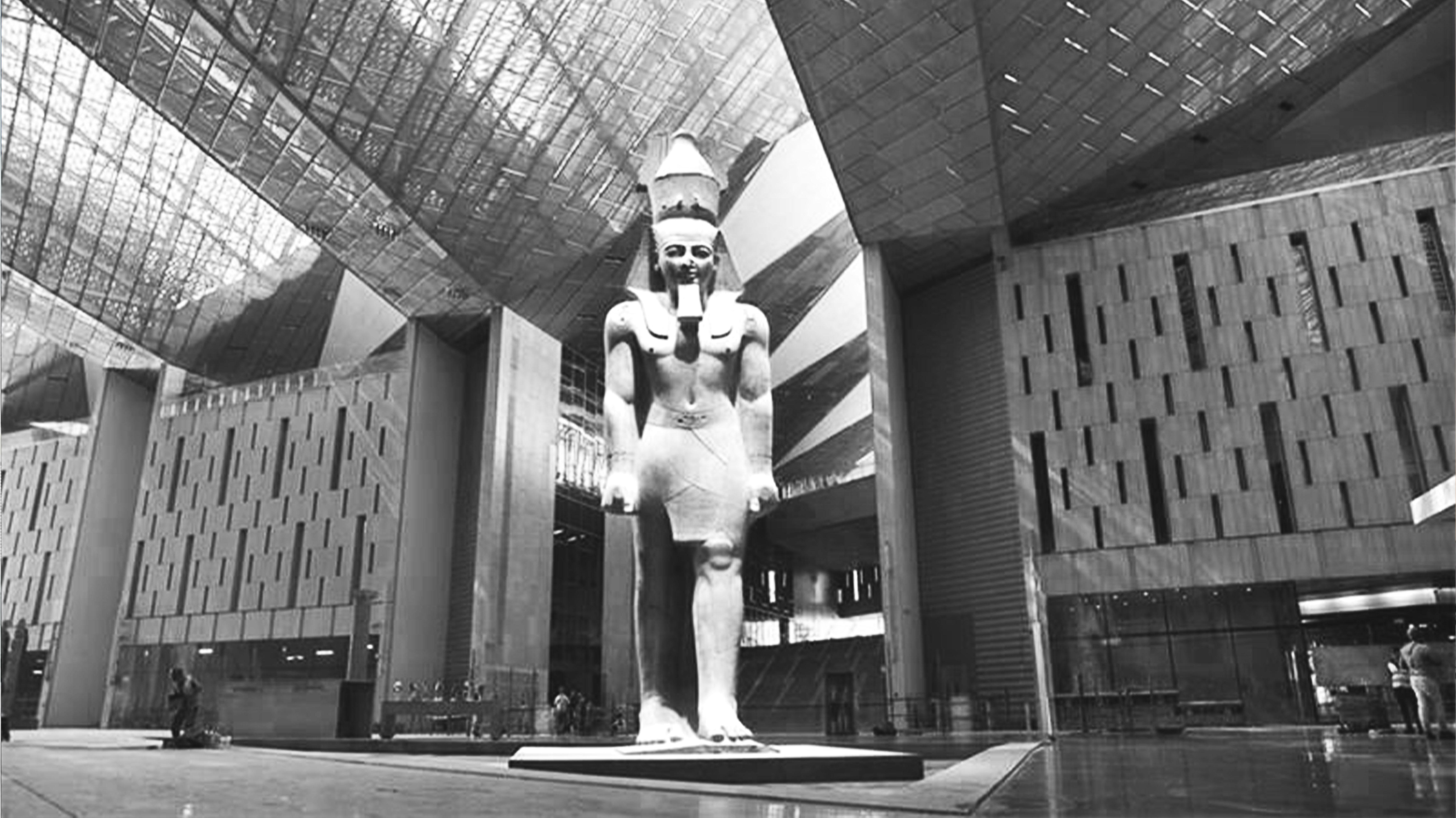
Inside, form becomes instruction. The procession from forecourt to atrium to monumental staircase guides visitors through a spatial lesson in belonging. Awe is not incidental—it is engineered. By directing the gaze upward, outward, and forward, the museum implies that the state is both heir to the ancient past and guarantor of the national future. The body learns by moving. The eye learns by being guided. Authority is absorbed not as argument but as atmosphere.

This is where the strings attached become visible. The question is not whether the museum is beautiful; it is what this beauty is doing. Architecture performs sovereignty not by describing power, but by making it feel natural, inevitable—like the only possible order. In the Grand Egyptian Museum, design becomes a form of speech. The building does not say the state is permanent; it teaches permanence. And in that lesson, certain histories—revolutionary, contested, or inconvenient—must be quiet enough to fade beneath the alabaster light.
Site, Form, and Design
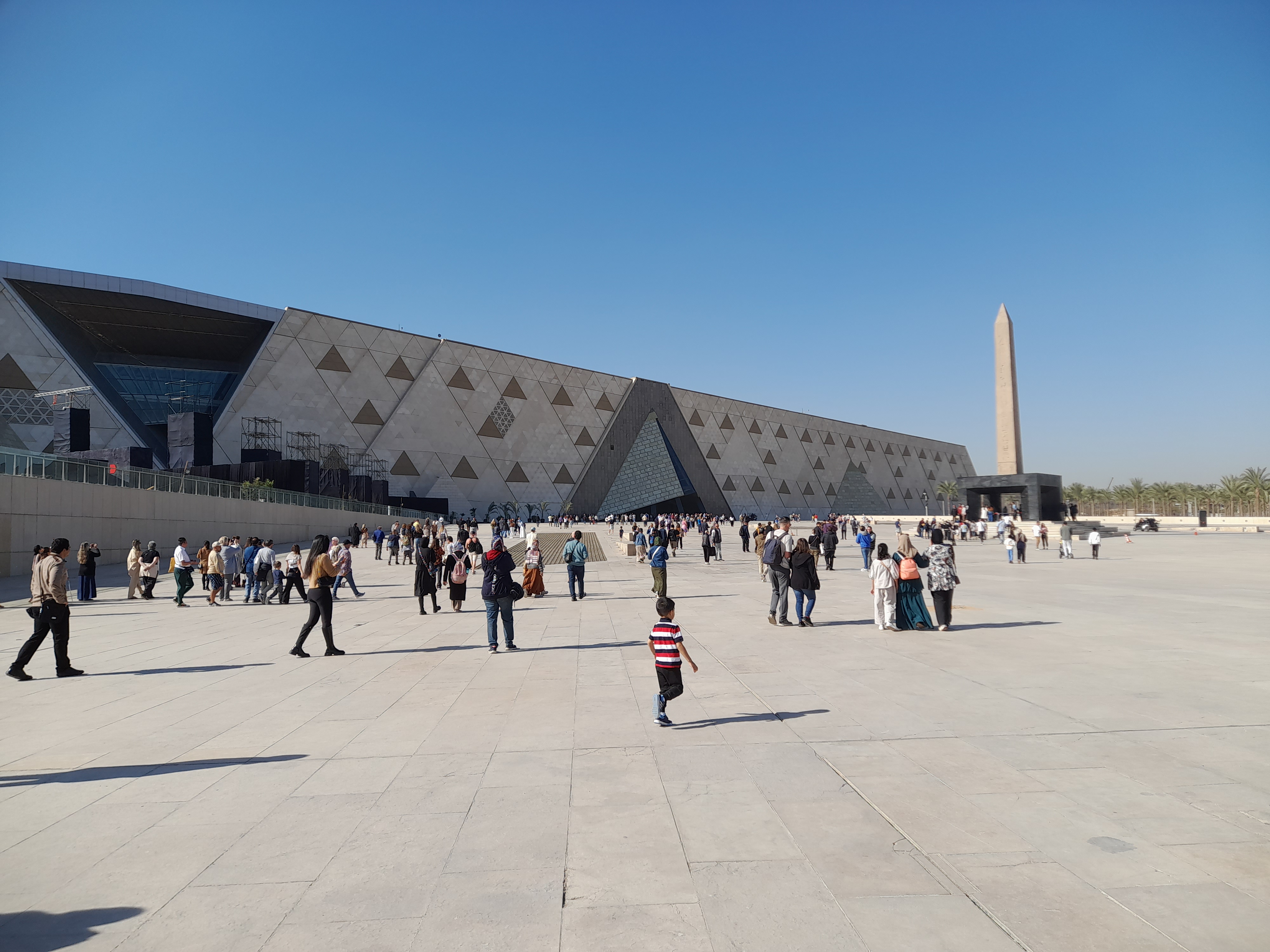
The Grand Egyptian Museum does not sit neutrally on the edge of Cairo; it occupies the city like a statement. Its site, drawn between the density of the urban plain and the rising desert plateau, stages a threshold where the state can curate what Egypt looks like before one even enters the building. The approach—highways, forecourts, controlled access points—prepares the visitor to see the museum not as a public institution but as a destination that has already decided how it should be seen.
The building’s triangulated geometry, derived from the visual lines to the Giza pyramids, is more than an architectural concept; it is a strategy of affiliation. By joining itself to the horizon of antiquity, the museum anchors the present regime to the authority of the ancient past. Material choices reinforce the logic: alabaster, historically used in temples and tombs, glows at dawn and dusk in a way that suggests reverence, authenticity, and inevitability. It is a calculated softness—an aesthetic of welcome that conceals the precision of control behind it.

Inside, the museum’s interior volumes are organized as if they were a landscape of ascent. Wide halls, controlled perspectives, and the long pull of the monumental staircase train the body to read space as progress. The building is not merely walked; it is climbed, ascended, and internalized. Architecture becomes choreography, and choreography becomes instruction. Even the generous sightlines toward the pyramids are not simply vistas; they are confirmations: this is where the story comes from, and this is where the state claims the right to continue it.
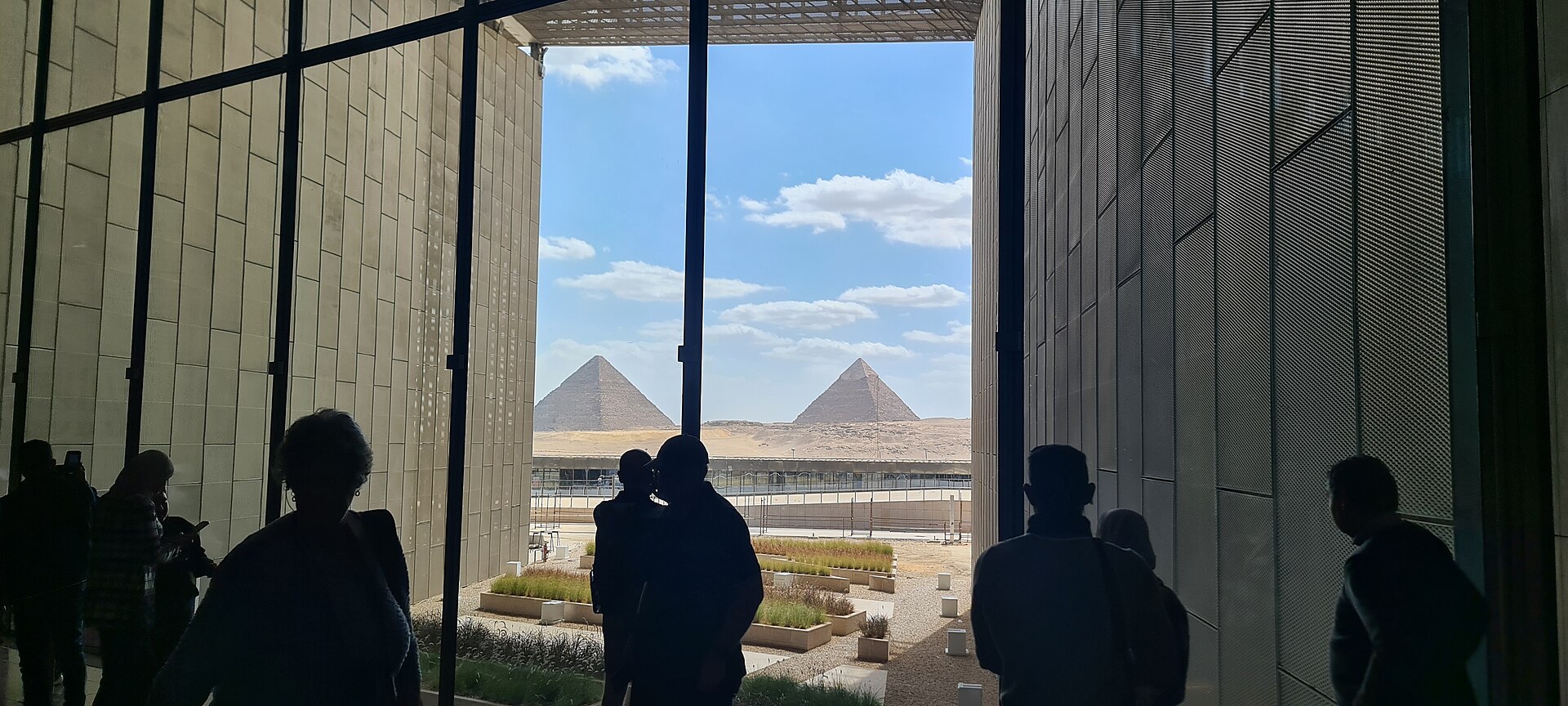
At this scale, design produces a political effect. The museum does not demand belief; it designs the conditions under which belief becomes the easiest response. It organizes the city’s edge into a controlled frontier, turning territory into narrative and access into agreement. The message embedded in the site is clear: Egypt can be seen from here—but only in the way the state prefers it to be seen.
Materiality, Light, and the Aesthetic of the Sublime State
Light does a particular kind of political work in the Grand Egyptian Museum. The alabaster façade, glowing at dawn and radiant from within at night, softens the building’s edges just enough to make authority feel gentle. It produces an atmosphere of invitation, but one in which the terms of entry are already decided. Transparency is suggested, not granted; openness is performed, not lived. What looks like light is also a kind of veil.

Inside, illumination becomes a form of direction. Daylight enters through triangulated skylights and alabaster fins that scatter brightness across statues and vitrines, creating a visual field where artifacts appear suspended in reverence. The visitor is not simply observing objects; they are being positioned in relation to them. Light gathers the eye, concentrates it, tutors it. The museum does not tell the visitor what to think—its spatial glow teaches them how to see.
This aesthetic is not accidental. By producing awe, the museum produces agreement. The softness of the alabaster, the slow bloom of light across stone surfaces, the calibrated passage from shadow to radiance—they are emotional cues that smooth over rupture. The technique is subtle: instead of commanding, it persuades; instead of asserting power, it normalizes it. Authority arrives not as an order, but as ambience.
What emerges is a choreography of perception. Light does not simply reveal the architecture; it completes its argument. It ensures that the emotional register of the museum—wonder, pride, belonging—leans toward acceptance rather than interruption. And in that emotional current, alternative narratives lose volume. Under the alabaster glow, disagreement dims, critique quiets, and the idea of a single, unbroken national story becomes easier to believe.
Spatial Choreography and State Pedagogy
The Grand Egyptian Museum is not only a sequence of rooms; it is a sequence of lessons. The spatial journey—from the forecourt to the atrium, to the monumental staircase, to the galleries, and finally to the terrace facing the pyramids—produces a controlled progression in which movement becomes meaning. Each transition feels natural, but it is choreographed with intent. The visitor is ushered from anticipation to reverence to confirmation, as if the architecture were guiding thought through the body rather than through language.

The forecourt acts like a threshold of discipline. It separates the turbulence of Cairo from the curated calm of the museum, signaling that one is crossing from the city’s contested present into a state-managed version of the past. The atrium, dominated by monumental figures, shifts the scale of the body: the visitor becomes smaller, and the state—architecturally speaking—becomes larger. The monumental staircase then performs the emotional climax. Ascending it feels like rising into the national narrative itself, as if the visitor were being placed inside the timeline the state prefers.
Pedagogy happens through design. The galleries are arranged to unfold history as an inevitability: a straight line from antiquity to modern authority, uninterrupted, unbroken, unquestioned. Rooms do not simply display objects; they display a worldview. The architecture directs pacing, determines sightlines, and maintains focus, allowing little room for hesitation or doubt. Even when the visitor pauses, the building continues narrating around them, as if the story could not be stopped.
This choreography carries a political charge. The museum does not instruct through argument or didactic panels; it teaches by shaping how the visitor moves, sees, and remembers. It performs the state’s preferred logic: that belonging is simple, that continuity is self-evident, that the nation has always been whole. The effect is persuasive not because it demands consent, but because it makes consent feel like the most intuitive response. In this sense, the museum behaves less like a cultural institution and more like a training ground for a particular way of imagining Egypt—one where disagreement has no spatial equivalent and where dissent finds no place to stand.
Urbanism, Mobility, and Territorial Control
The Grand Egyptian Museum does not stand alone; it is the anchor of a redesigned territory. The highways, landscaped approaches, security perimeters, and dedicated access routes are not supporting infrastructure—they are part of the project’s architecture. Before the visitor reaches the building, the city has already been edited. Mobility is directed, visibility is managed, and arrival is staged as proof that the museum exists at the center of an orderly national landscape. The edge of Cairo becomes a frontier where the state can choreograph what the capital looks like, and who gets to approach it.

This territorial framing reimagines the western periphery of the city as a controlled zone of presentation. The new roads bypass neighborhoods that once surrounded the plateau, replacing the improvisation of informal life with a curated route that leads directly to the museum’s entrance. What appears as efficiency is also isolation; what appears as access is also filtration. The surrounding communities, markets, and everyday noise of the area are quieted by distance. The museum reads as if it rises out of empty land, even though it does not. The silence is engineered.
Tourism infrastructure intensifies this effect. Airports, arterials, and hotel corridors link into the museum like arteries feeding an image. The state gains not only visitors but vantage points. The approach offers views that feel cinematic—framed horizons, measured distances, controlled skylines that hide the city’s contradictions. This is not about hiding Cairo; it is about selecting which Cairo will be seen. The result is a geography where the museum becomes both destination and filter: a place that promises access to the nation while deciding what the nation looks like on the way in.
In this configuration, territory becomes narrative. Space is made to speak. The controlled approach routes tell the visitor that the city is coherent, the nation is continuous, and the state is the author of both. And because this coherence is experienced physically—driven, walked, entered—it becomes easier to believe. The choreography of arrival, movement, and containment performs a political claim long before architecture comes into view: that modern Egypt can be understood from here, and that the legitimacy of the present depends on the disappearance of what surrounds it.
Authoritarian Monumentality in Historical Perspective
The Grand Egyptian Museum joins a longer tradition in which states build at scales that exceed function in order to exceed doubt. Monumentality here is not an architectural genre, but a political method: a way for governments to materialize certainty where consensus is fragile, and to project continuity where history has been fractured. Across different contexts and eras, monumental projects have served the same purpose—to turn authority into something that looks like geology, something too large to argue with.
Seen in this light, the museum inherits more than its alignment with the pyramids; it inherits the logic of monuments that stabilize regimes by stabilizing narrative. Just as earlier authoritarian and developmentalist states built to outlast the criticism of the present, the museum builds to outlast the memory of rupture. The gesture is familiar: when politics is unsettled, architecture is asked to appear immovable; when identity is contested, stone is asked to speak more loudly than people. The building functions as reassurance, not evidence.

But unlike older monumental projects, the Grand Egyptian Museum operates under conditions shaped by global capital and transnational cultural networks. Loans, consultants, partnerships, and international museological standards do not weaken the national message; they amplify it. They allow the state to present its narrative as globally verified, technically endorsed, and culturally neutral—when it is, in fact, a deeply situated political argument. The museum becomes not just a monument to heritage, but a monument to the credibility of the state itself.
This continuity with past monumentalism is less about imitation than adaptation. Ancient complexes sacralized divine rule; twentieth-century megaprojects dramatized ideological futures; the museum sacralizes heritage as proof of modern authority. In each case, scale stands in for consensus, and spectacle stands in for negotiation. The architectural language changes, but the political instinct does not. The building does not ask the public to believe; it asks them to stand in front of something that makes belief feel unnecessary.
The result is a paradox: a project that appears inclusive by virtue of cultural pride, yet exclusive by virtue of the narrative it enforces. It remembers too much of one history and too little of another. It claims to gather the nation, but it gathers only the version of the nation that can fit inside its myth. What is absent is not forgotten by accident; it is forgotten by design.
The Authoritarian Sublime and the State Machine
The Grand Egyptian Museum presents itself as a place of preservation, yet its power lies in what it constructs rather than what it protects. It uses alignment, scale, and the softness of light to turn architecture into a statement of endurance. The building does not argue for the state’s permanence; it rehearses it. It makes authority feel architectural—quiet, inevitable, already decided.

This is what gives the project its force. By organizing sightlines, controlling approach routes, and scripting movement, the museum draws a boundary around which futures are imaginable and which histories are permitted to matter. The narrative it offers is coherent and compelling, but it is a coherence built on selection. What exceeds the story is allowed to fall away. What disrupts continuity remains outside the frame of alabaster and glass.
None of this negates the museum’s achievements as a work of design. It is visually extraordinary, technically sophisticated, and unmistakably ambitious. But ambition is not neutral, and beauty is not without consequence. If the museum succeeds, it is because it persuades—not because it proves. It gathers visitors into a vision of Egypt that feels seamless enough to stand, and silent enough to hold.
The question that remains is not whether the museum will endure, but what it will ask the public to forget in order to endure. In this sense, the building’s most powerful exhibition is not its collection, but the story it makes possible—and the stories it leaves in the dark.