


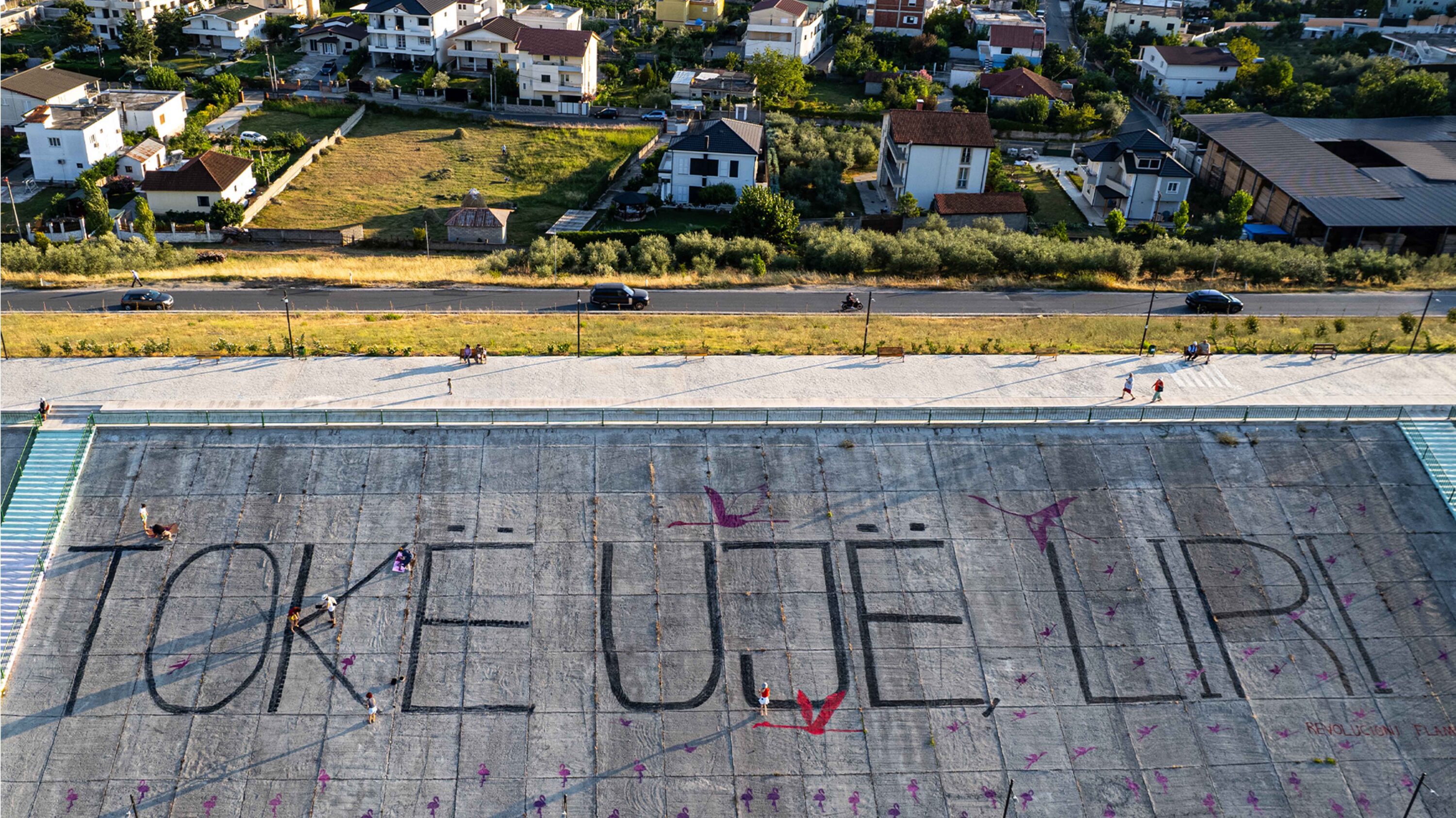
Rarely does one come across a single image that encapsulates the present situation and where it is heading. On 30 May 2026, in the Albanian coastal area of Zvërnec, a masked private guard punches and kidnaps a protester in full view of the police.
The police, too, end up on the wrong side of the fence, among the protesting community and the activists. The private security sprays police and protesters alike, without distinction. In a press release, the police commissioner denounces the protesters as violent and sugarcoats the abduction as a mere “escorting away.”
The guard is eventually arrested and the kidnapped citizen released after a couple of hours, only thanks to the public uproar. The guard works for the private security company that guards the enclosed area, likely hired by one of the country’s most prominent local oligarchs, the Kastrati Group. Before the protests, representatives of this oligarch and the mayor had met members of the local community to try to discourage and intimidate them from demonstrating.
The law has also been bent to provide more land and investment opportunities for national and international real-estate capital, as well as drug-trafficking organizations, in order to keep the Albanian economy afloat. In 2015 the government passed a law on strategic investments that guarantees tourism ventures access to land under legal dispute, the expulsion of the communities living on it, a ten-year tax exemption for five-star hotels, and the provision of infrastructure.
Because the most desirable land for luxury tourism lies inside protected areas, the government redrew the borders of those areas in 2018, and in 2024 changed the law again to allow major urban projects inside protected zones rich in biodiversity.
Albanians have rarely seen a clearer example of class division than that moment, when a private company secured predatory capital while pushing back the police and protesters alike. More surprising, and heartening, is the sight of an entire society rising up against that division. For weeks, mass protests have erupted in the capital, bringing the daily life of Tirana to a halt from six in the evening until midnight and drawing a wide solidarity across the city.
The movement first arose in response to that despicable scene, and has since turned against the government and its entire way of governing. Its demands are loud and clear: protect the environment, and stop selling land to oligarchs, both international, like Jared Kushner, and national, like Kastrati.
The Long Shadow of 1997
This class division, turning on the growth of real-estate capital, has built up systematically since at least the collapse of the infamous pyramid schemes in 1997. With the fall of the most isolated socialist dictatorship in Eastern Europe came drastic monetary measures: prices were liberalized, and the runaway inflation that followed was managed through heavy cuts to public spending, deindustrialization, and tight control over access to capital.
Most Albanians channelled their savings, largely remittances, into Ponzi schemes promising interest rates of nearly 50 percent. With bank loans all but inaccessible, these schemes remained the most accessible address for saving and borrowing. Tolerated and even supported by the main political parties and the IMF, they collapsed after drawing in nearly two-thirds of the population, causing a near civil war, an almost complete disintegration of state institutions, and some 2,000 dead in the shootouts that followed.
By the end of the decade, the unions, a key actor in the country’s democratization in 1991, had been decimated; and with deindustrialization and chronic underinvestment in education, the productivity of the workforce has remained low ever since. The country was left with some of the lowest public spending on services in the region, and with weak institutions that suffice for little more than passing laws and issuing executive orders.
With heavy and light industry in ruins after 1997, international partners and Albanian political parties promoted tourism as the only viable priority for growth, a sector that channelled surpluses upward while sustaining an unqualified, unorganized, largely informal and low-paid working class. Local oligarchs and drug-trafficking organizations would grant international capital access to new investment opportunities, beyond the existing ones in telecommunications, mineral extraction and energy.
The two main parties would compete over which of them could better secure that capital’s future return. By the end of the 2000s, the government had opened new markets, most notably in energy, and above all, hydropower. With more licenses issued for hydropower plants than anywhere else in the region, the enclosure of rivers became a key joint venture between local criminal groups, national oligarchs and international corporations. Hardly a single plant has been built without local communities protesting as they watched their environment and their way of life destroyed.
Edi Rama’s Bargain
As the 2008 financial crisis made itself felt, in the waning of the post-1997 recovery, in falling remittances and consumption, and in contracting foreign investment, the government, under IMF austerity aimed at lowering public debt, cut its already low public spending further. When Edi Rama came to power in 2013, he paid lip service to a revived social democracy for the post-crisis era, promising free universal healthcare and increased funding for higher education. However, due to a lack of institutional and financial capacity, as well as a lack of significant foreign investment, his government came to rely even more heavily on national oligarchs and drug-trafficking organizations.

By the mid-2010s the national oligarchs had expanded into large real-estate projects and into public–private partnerships for building and maintaining national roads and for delivering healthcare. Rama’s government defended these arrangements as unavoidable for a state facing scarce finances. Representatives of local drug-trafficking organizations, with transatlantic ties between Europe and Latin America, entered the political arena by running for parliament, many of them on Rama’s own electoral list.
Albania was fertile ground for such organizations: two complete institutional breakdowns, in 1991 and 1997; public services in disintegration and industrial employment gone; the youngest average age on the continent, an explosive demography, and one of the highest poverty rates in the world. More than the market economy itself, these organizations carried the promise of social mobility to impoverished young people.
In return for their support of Rama’s Socialist Party, they were given a free hand to expand cannabis production across the country, a crop that also propped up rural purchasing power through the work it offered, in an agricultural sector otherwise underinvested and heavily fragmented.
From 2013 to 2019 the economy sustained only meagre growth, below three percent. As two large foreign investments, the Trans Adriatic Pipeline (TAP) and the Devoll hydropower scheme, wound down by 2019, it needed fresh injections; a boom in construction permits, under way since 2017, supplied one, and with it a key channel for laundering the money of Albanian drug-trafficking organizations. To lend this laundering an aesthetic cover, Rama invited some of the world’s most prominent architectural studios to Albania. The country’s macroeconomic footing now depends on this real-estate investment: construction accounted for 1.17 of the 3.8 percentage points of economic growth in 2025. Society, meanwhile, is left with the promise of trickle-down.
The Artist as Prime Minister
Prime Minister Rama has managed to present himself as the one figure acceptable to both oligarchic and broader social interests. To economic actors he offered himself as a reputable international face. To society at large, he styled himself as the only modernizer capable of steering Albania into the EU. To Western partners, he promised unconditional consent to whatever they might ask of his government.
Casting himself as an avant-garde artist rather than a politician, he suspended, and in some cases demolished, the country’s main cultural institutions for years on end. State funding for the arts does not compare even to that of neighbouring Kosovo and North Macedonia, while Rama keeps opening solo exhibitions around the world, as he is doing now, even as the protests continue at home.
For as long as the EU and the US were liberal in orientation, Rama presented himself as the most liberal figure Albania could offer; and as they have shifted rightward, he has been quick to adapt. He handed the Italian prime minister, Giorgia Meloni, territory on which to externalize Italy’s refugee management, the very policy that feeds her anti-migration rhetoric at home. Over the past three years he has offered unconditional support for Israel’s genocidal campaign against the Palestinians, while significantly deepening economic and institutional cooperation. It is within this same run of accommodations to the Western far right that he handed the whole of Sazan Island to the Trump family.
Seeing how adept Rama is at giving the Western far right what it wants, the main opposition, the Democratic Party and its leader Sali Berisha, has shifted even further right, to signal open alignment with Trump’s discourse. Berisha, too, backs the government’s plan to hand the island to Kushner. That endorsement is why one of the protests’ main slogans, “Rama in prison, Berisha in prison”, has stuck: a verdict not only on the present manoeuvres around Zvërnec but also on a mode of governance that long predates Rama’s arrival in 2013.
However mixed the movement’s ideological leanings may be, they reflect a broad dissatisfaction with a state that secures land-grabs under the guise of elite tourism and invests less in its citizens than any of its neighbours.
This is not Gaza
Many activists and environmentalists, seeing the enclosure of Zvërnec, the bulldozers and the beatings and abductions, linked the image to what they had watched unfold in Gaza over the past three years. On 30 May, one of the leading environmental organizations condemning the destruction of the protected area opened its account of events with the line: “This is not Gaza. This is Zvërnec.” Activists who have organized numerous protests against Albania’s complicity in Israel’s genocide against the Palestinians have joined this movement too.
Although the two major parties support Israel’s genocidal campaign against the Palestinians unconditionally, watching the bombardment, violence and pain take their toll on Palestinian bodies has also left its mark on Albanian society as well. The two cases are far apart when measured by the sheer scale of violence suffered by the Palestinians. Nevertheless, witnessing their suffering speaks to, and profoundly shapes, a dominant experience within Albanian society, especially in rural communities: the existential feeling of being superfluous on your own land, the feeling that you are a stain that needs to be wiped from the territory, the feeling that your very existence is an obstacle to someone else’s project.
Large projects in real estate, hydropower and solar address local communities only as the backward, violent remnants of something already past, communities to be expelled, or treated as if they never existed. They are always cast as an impediment to development and modernization, an impediment to be removed. Hundreds of urban and rural communities have seen their homes and their surroundings destroyed, all of it accompanied by a discourse that never addresses them, a discourse that constitutes itself precisely through their expulsion from it.
As Albanian and international capital lay hands on protected areas and pile up real-estate projects, the pressure of being expelled from one’s land, of being cast as an enemy of every leap forward, grows heavier still.
A Rush for New Fascinations
On top of these 35 neoliberal years, a sequence of crises has sharpened the conjuncture: the aftermath of 2008; mass migration since 2015, met by a growing Western revulsion at migration; the catastrophic earthquake of 2019; the Covid-19 pandemic; and the price rises driven by Russia’s war on Ukraine and the US-Israel war on Iran. This “polycrisis,” to borrow Adam Tooze’s term, met by a government that refuses to admit anything dramatic is under way, insisting all is well and business as usual, comes close to a general panic beneath the euphoria of land-grabbing, as communities are pushed back and beyond the fences. The government only makes things worse, defending these investments as vital and necessary to the Albanian economy.
Until recently, a fascination with capital and money-making governed desire, so much so that the German philosopher Peter Sloterdijk took Albania as an exemplary case of the erotization of the economy under late capitalism. But with the polycrisis widening, and no expansion arriving through the leaks of trickle-down, what one notices instead is a deep disenchantment with capitalism. Unease and panic over what the present holds and what the future brings are replacing the cheerful fascination with capital that reigned in the wake of socialism’s collapse.
In order to avoid facing the plain fact that capitalism in its current Albanian form has pushed citizens over fences and ever-expanding enclosures, leaving them disoriented and unprotected in the face of every pressing crisis, an accelerating rush for new fascinations sets in. One manifestation of this rush is conspiracy theory. Currently, the Great Replacement theory is gaining ground, which claims that there is a plan to replace the Albanian population with Jewish colonies and foreign workers who would labour for them.
In the face of the state and capital’s complete indifference toward their citizens, an indifference that turns abruptly to violence the moment those citizens appear in public with demands, conspiracy theories construct an evil plot aimed at Albanians. In response to this indifference, such a theory is an attempt to become fascinating to oneself again, by way of an evil other. Against the uneasy feeling of being left out there beyond the fences like the leftovers of a building site, left to rot, paranoia builds a perfectly coordinated plan that leaves no subject outside its reach and aims, cunningly, at the manipulation of our minds.
Adhering to such theories makes the expulsion easier to bear. Being excluded and ignored unattended can be felt as a mark of one’s own refusal and resistance. One can even indulge the fantasy of having kept the colonies out, making the present, a present without colonies, acceptable; better, after all, than what it might have been.
The Flamingo Revolution
In their current form, both Albanian and international businesses operating in the country require territorial expansion and land-grabbing to survive. But the more they expand in such a small country, the closer the fences come and the more imminent the sense of expulsion becomes. The current protests are against real-estate capital, and against the governance and actors that brought it about.
Protesters no longer raise the cry of the 1990s: “We want Albania like the rest of Europe.” Kushner and Meloni are already investing their real-estate and their political projects here. Albania is already well integrated into the West. The purpose of this analysis is not to show how exceptional Albania’s predicament is, but rather how common-sensical and how continuous with Western and broader global dynamics, it has become.
The Flamingo Revolution is precisely a reaction against the common sense of the present deadlocks of national and global capital. One hopes it can also offer an alternative to the far right’s remedy for those deadlocks: bigger and more violent fences.
This revolution concerns the environment, the right of access to land, and the protection of that land, which is a precondition for our subsistence, reproduction and flourishing. Over the past month, a new fascination has emerged in the streets of Tirana: a fascination with collective capacity, with mass rallies, mass creation, mass organization, and mass articulation. One hopes that this fascination with common capacities will last until the commons and these capacities become the new common sense, a common sense capable to face the pressing polycrisis and its unfolding, and carrying the a surplus enthusiasm that no crisis can contain.