


I was scrolling quickly through Facebook, as I often do while I am waiting: waiting my turn at the supermarket checkout, or waiting for the school to open its doors so I can pick up my son. And sometimes I am waiting for myself, when I am anxious; that is, when something is worrying me and I realize what it is about only later.
When I turn to quick scrolling, I don’t really see the content of Facebook or Instagram, but it offers me an unconscious room to act and try to understand, inside a cloud that separates me from what I see on the phone.
I was scrolling through Facebook to see the news and the videos of the student demonstrations in Milan, Italy, and follow the reactions of the political parties, but in truth I only wanted to see the headlines so I could run away from them. I didn’t open the posts or the videos. I just jumped from headline to headline. Then the screen stopped for a moment: an article shared by my friend Gennaro, titled “Ibn Khaldun as a Colonial Archive: Toward an Epistemic Decolonization”.
The title caught me, so I downloaded the article right away to read it on my computer screen as soon as I got home.
Its author, the anthropology professor Abdelmajid Hannoum, compares the Arabic text of Ibn Khaldun’s Muqaddimah with its nineteenth-century French translations, and then the English ones that followed, to show how colonial translation turned his fluid concepts into fixed racial categories.
For example, the word jīl (generation, people) was translated as “race”, so that groups negotiating with one another over time became blocs that were hostile by nature: an Arab race versus a Berber race.
In the introduction to his translation of Ibn Khaldun, William McGuckin de Slane, the chief interpreter of the French Army of Africa, made the Berbers the heroes and the Arabs the villains, and France the liberator of the Berbers from the “Arab yoke” through its invasion of Algeria in 1830.
In this way, colonialism was justified in the voice of one of the most important Arab historians. to the point that, Hannoum notes, some intellectuals of the Nahda, such as Taha Hussein, read Ibn Khaldun in de Slane’s French and treated it as a substitute for the Arabic. In other words, we imported our image of ourselves from the colonizer’s point of view.
The article does not aim to “acquit” Ibn Khaldun so much as to shed light on how translation distorted what he actually said, and exaggerated it. Hannoum concludes that we are still under the influence of these translations today, and that AI translation, built on existing Orientalist classifications, risks reproducing these frameworks as if they were objective knowledge.
It wasn’t Ibn Khaldun who drew me to the article. Rather, I think I saw in its title a prompt to understand what was troubling me: the way words can create imagined communities, and turn a political classification into what looks like a natural description of reality.
That is exactly what I had been trying to understand as I jumped between the news headlines about the demonstrations in Milan. I didn’t want to settle for the surface of the scene, nor to see what had happened through the ready-made narratives that surrounded it. I was looking for a key to understand what it was that provoked me in the discourse that followed the student protests, accompanied them, and perhaps even preceded them. Thank you, Gennaro.
The Student Protests
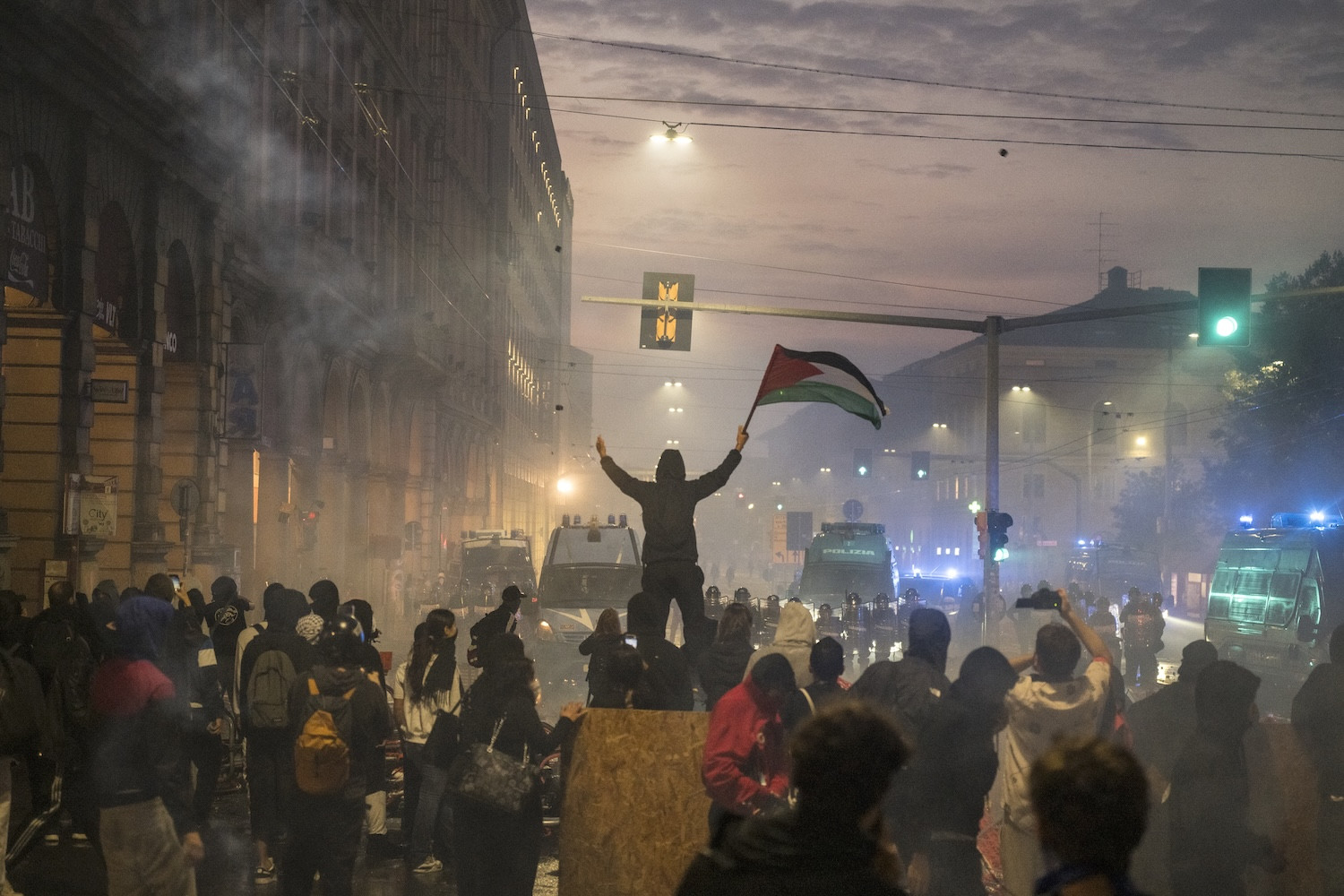
On Friday, October 16, at least 3,000 students took to the streets of Milan to protest against government policies. One of their main demands was the rejection of the new school decree, which sets a 30 percent cap on certain categories of foreign pupils per class. Their slogans were “At school, no one is a foreigner” and “Money for schools, not for war”. Palestinian flags were raised.
They brought other demands with them too: reasonable rents that students coming from outside the city can afford, and funding to make school buildings safe. There were no clashes in Milan, and the march ended with the occupation of the empty former morgue building.
Then the weekend came, with other developments. On Saturday 17, on the sidelines of a demonstration against the rising cost of living, masked young men broke away from the march and vandalized streets and shops between Piazza del Duomo, the city center and one of its main landmarks, and Corso Vittorio Emanuele, the city’s best-known shopping street.
On Sunday there was no demonstration at all: some two thousand young people came, summoned by calls circulated on TikTok accounts after the previous day’s videos went viral, to smash and loot. That day, 271 young people were taken to police headquarters, 220 of them minors.
Meanwhile, social media, news bulletins and some far-right political speeches filled up with the word maranza, which today refers to a category of second-generation young people of North African origin. However, the figures published by law enforcement themselves showed that of the 271, only 60 did not hold Italian citizenship.
The parents who stood outside police headquarters waiting for their children had come from close towns such as Bergamo, Como, Lecco, Monza and Parma. Investigators said these young people were mostly Italian, strangers to the outskirts of Milan, with no political affiliation, and had acted without planning.
Even so, the word maranza was ready, overlooking the presence of Italian young people who cannot be identified with the word, because their presence would spoil the story and force us to ask a much harder question beyond origin and nationality: what is happening to an entire generation that it takes to the streets and turns to violence?
But Who are the “Maranza”?
The word has been used since the 1980s in the slang of young people in the north to mean thugs, and according to one hypothesis it originally alluded to Italians themselves who came from southern Italy. In 2019 it came back on social media to describe young people united by a way of dressing (sportswear from international brands), music and street language. Many of them belong to the second generation, born in Italy to parents of North African origin, and some of the young people themselves have come to adopt the word as an identity with its own symbolic value.
This is not the first time young people have been reduced to a single word. In 1960s Germany, Italian workers were insulted as “Itaker” and “spaghetti eaters”, and with terms used for animals. In Switzerland they were the “Tschinggen”, an insult said to come from them shouting out numbers while playing a game, and rumors spread that they ate cats and grew vegetables in their bathtubs.
On Monday 19, the center-right gathered in a square near the Duomo and hung a banner that read “We will remigrate you all”, and another: “Maranza and occupied left-wing centers. Exemplary punishment for these criminals”. Among those present were the President of the Senate, Ignazio La Russa, from the post fascist party Brothers of Italy, and potential candidates for mayor of Milan.
The following day, in Lecco, about 30 far-right activists gathered for an “anti-maranza” demonstration, during which the national anthem was sung and the Roman salute was given. On the same day, a wave of panic and fake news about imminent riots emptied the town center, and half the students stayed away from school, despite appeals from mayors not to believe it.
On Tuesday, the Council of Ministers approved a decree “to combat juvenile crime”, which Giorgia Meloni, the prime minister, summed up in one sentence: “Whoever breaks, pays, and if whoever breaks is a minor, their parents pay”.
Demands that Need No Translation
Friday’s student movement was not out of context: these were legitimate demands for fair education, not limited to the children of immigrants, nor to Italy itself, but expressing an entire generation in Europe. But then Saturday and Sunday came, and with them came the ready-made accusations, and the heart of the conversation became violence, maranza and remigration.
This phenomenon is nothing new to our region: whoever spotlights violence even before it happens is using it to mobilize the street or, in Italy’s case for example, to prepare for next spring’s elections.
I am not here to defend the maranza, nor to justify violence. That really is not the aim of this text. We may disagree, and we may still look at Europe, despite so many of its masks having fallen, as the best refuge. But history carries great weight, and the colonial weight of these countries does not disappear by opening universities that teach colonialism, or with museums that change their names, however important that may be.
In Paris, the palace built in 1931 to be the “Museum of the Colonies” has been, since 2007, the “National Museum of the History of Immigration”, but the idealized, triumphant character of colonial expansion is still there, on the façade and in the murals.
As for the colonial role itself, the governments of these countries still need to acknowledge it, and to link it to the question of immigration, to the weapons that are still being supplied to our regions, to receiving workers without granting them full rights, to the factories that are opened in our countries because labor is cheaper and the laws are less strict, and to papers that are used as threats, such as remigration.
And we, too, need to think about what Algerian writer and philosopher, Malek Bennabi warned of when he spoke of colonizability: accepting that the other describes us in their words, and then describing ourselves in them.
The tools have changed. There is no longer any need for a translator working for the Ministry of War to translate Ibn Khaldun or anyone else. A phone in each of our hands is enough, along with an algorithm that feeds us back what we fear, and fingers that jump over headlines the way my fingers were jumping while I waited.
But the danger is the same: a label repeated without questioning, often deliberately and for political ends, until it becomes reality. And those of us who come from countries that have experienced how extremism and violence are manufactured know that this manufacturing usually begins with naming.
There was nothing in the demands of these young people on Friday, in all their groups and backgrounds, that needed translating. They were clear, and they need someone able to embrace them: schools whose ceilings don’t collapse, reasonable rents, and money for education, not for war.
And at school, no one is a foreigner.