




This article is part of Agita – a monthly column maintained by Academic Opposition* and published on UntoldMag.
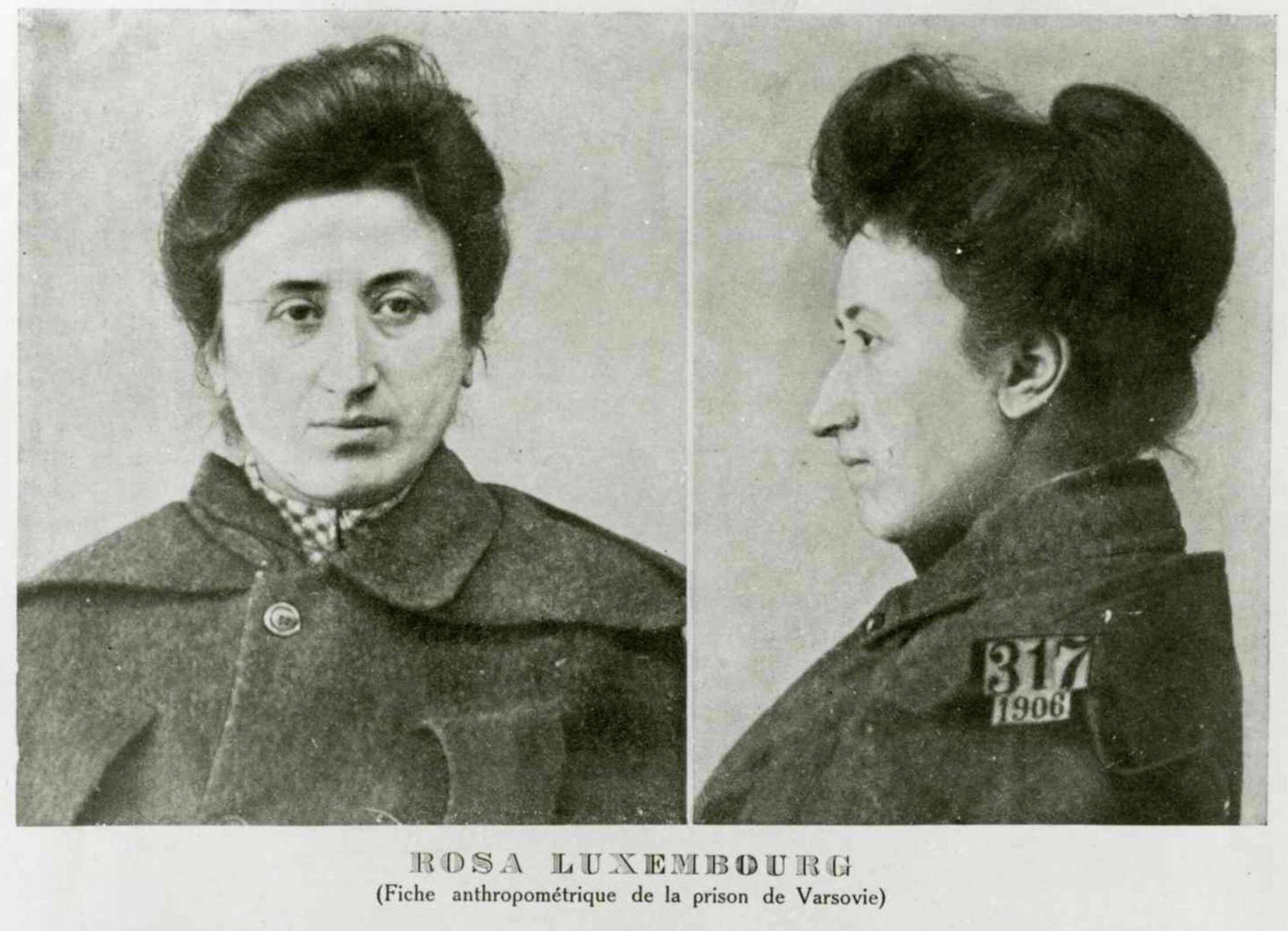
On February 20, 1914, socialist revolutionary Rosa Luxemburg stood trial for anti-war speeches she had delivered the previous year at two gatherings in the Frankfurt area. She was accused of public incitement to disobedience against the law—a charge broad enough to give prosecutors significant leeway in pursuing critics of the state and thus commonly used against political dissenters in the German Empire.
The prosecution’s witnesses alleged that Luxemburg called on soldiers to disobey orders, encouraging them not to shoot at the enemy in the event of war. In addition to the defense pleas presented by her attorneys, Paul Levi and Kurt Rosenfeld, Luxemburg—a seasoned orator—offered her own detailed rebuttal, dismissing the prosecution’s account of the events as “nothing but a dull, soulless caricature of my speeches and social-democratic agitation in general.”
Recognizing the profoundly political nature of the trial, Luxemburg did not speak only in her own name: she spoke on behalf of the movement, referencing its decade-long anti-militarist tradition and citing anti-war resolutions of the International Socialist Congresses. Standing proudly by her belief that speaking up against the impending war was her obligation, she told the court: “We do not carry out our anti-militarist agitation in secret darkness, in hiding; no, we do it in the full blaze of the brightest light of the public eye.”
Luxemburg spoke in this vein for several more minutes until the judge impatiently interrupted her, saying: “We don’t have time to listen to grand political speeches. We are handling the case legally, not politically.”
Criminalizing Dissent Then and Now
That intervention is striking not just for its hypocrisy, as there can be little doubt that Luxemburg’s trial was indeed political, but also because it resurfaces almost verbatim in Berlin courts today, in cases concerning solidarity with Palestine, especially those related to protests at universities.
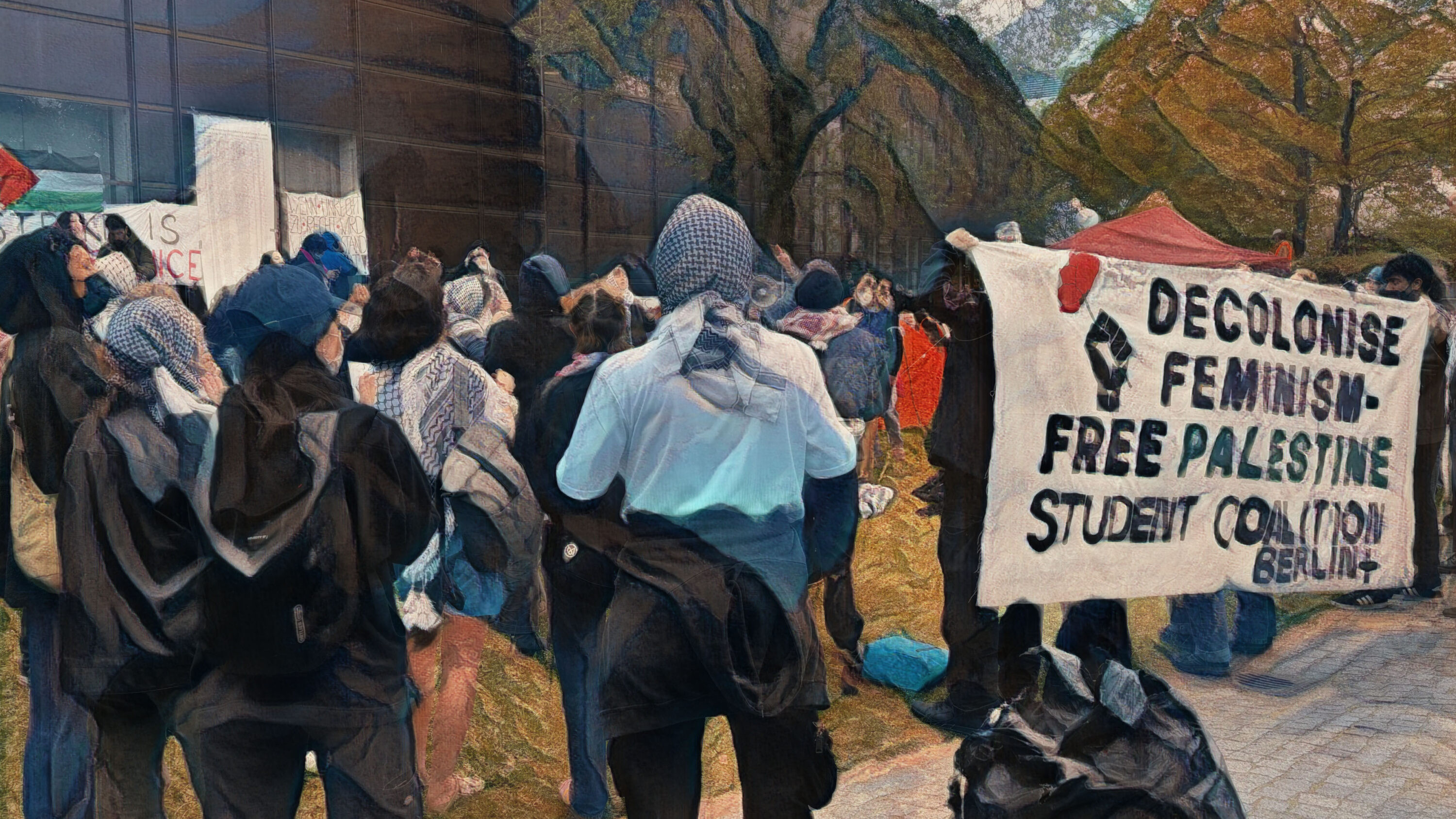
Students who refuse to stay silent about Israel’s genocide in Gaza have staged interventions at universities to disrupt what they experience as an unbearable status quo: the systematic muzzling of Palestinian voices, the absence of any critical discourse around the ethnic cleansing unfolding live on their phones, and academic complicity in legitimizing the machinery of violence.
Unlike the 2024 encampments in solidarity with Palestine that went on for weeks or even months in the United States, Britain, Spain, and some German cities, the university occupations in Berlin were short lived. Free University (FU) and Humboldt University (HU) promptly called the police and pressed charges of trespassing, resulting in hundreds of criminal cases. The two dozen student trials I have attended since then further expose how the state insists on depoliticizng students.
In Germany, politically engaged scholarship and pedagogy are commonly dismissed as activism, not “legitimate” science. The fantasy of academic neutrality persists despite decade-long efforts by feminist, queer, and postcolonial scholars to debunk it as a construct that serves hegemonic interests. This myth is less a naïve belief than a strategically deployed ideological weapon used to keep dissenting voices out of academia and reinforce Germany’s Staatsräson (reason of state). The past two years have made this explicit, with countless cancelled lectures, disinvitations, dismissals, and other acts of academic censorship and repression.
The Right Side of History
After being forcibly prevented from holding events on Palestine at their universities, students have taken the opportunity to speak out in court. They reiterate the reasons why they protest, making it very clear that it’s not just their right, but, in the face of the genocide, primarily their moral obligation. They speak about the genocide, occupation, apartheid, and settler colonialism, calling out Germany’s involvement in these crimes, including their universities’ ties with Israeli academic institutions and companies that have been proven complicit in human rights violations.
They demonstrate how the violence over there is connected to the violence over here. They speak uncomfortable truths, making state representatives squirm in their seats. Judges frequently interrupt and dismiss the statements, claiming that such discussions belong in academic settings, not in the courtroom—the irony of how the students end up in court in the first place seems to be conveniently lost on them.
Explaining why he took part in the occupation of a lecture hall at FU, one student spoke of a desire “to create a place for solidarity and critical exchange” because no such space was available at the university. The judge stopped him half-sentence with a retort: “This is not a political science seminar.” The student asked for permission to continue and went on to explain that students’ demands that FU cut ties with Israeli universities were in line with the International Court of Justice ruling ordering all states, including Germany, not to “render aid or assistance in maintaining” Israel’s illegal presence in the occupied Palestinian territories.
The judge interrupted again, sarcastically remarking: “You have delivered a great seminar presentation for the audience.” The student was eventually found guilty of trespassing and ordered to pay EUR 450; his appeal was later denied.
The judge’s closing statement was as damning as it was patronizing. “This is not a Hollywood film,” he sneered at the student. “The whole thing has nothing to do with freedom of science and teaching. You may think you’re standing on the right side of history, but that doesn’t mean you can break the law.”
In a different case pertaining to the same lecture hall occupation, another judge likewise emphasized “the rule of law” and dismissed all other concerns (that is, the defendant’s and her lawyer’s references to the genocide, international law, and the German constitution) as “mere background noise” (nur Hintergrundgeräusche).
The Repression of the Rule of Law
The trials also attest to university leaderships’ strategic inability to respond constructively and with care to students’ legitimate interventions. Rather than creating space for potentially difficult but urgent conversations, universities choose to criminalize protestors.
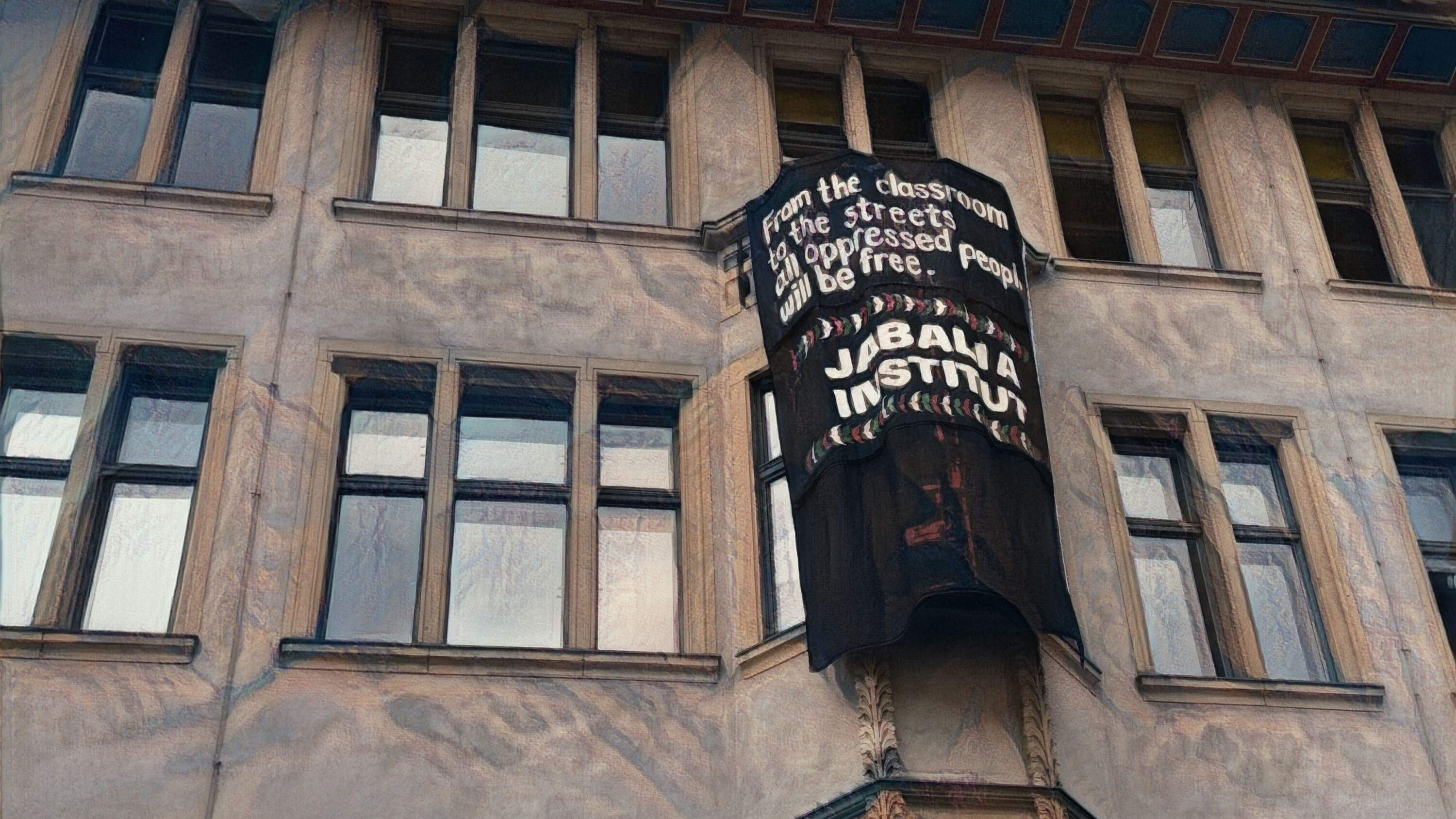
The repeated attempts to summon FU president Günter Ziegler as a witness appear to have been unsuccessful—at least one judge rejected them as having, “legally speaking, nothing to do with the content.” HU president Julia von Blumenthal did appear in court to offer her account of the events of May 23-24, 2024, when students occupied the Institute of Social Sciences and renamed it the Jabaliya Institute after the repeatedly bombed refugee camp in northern Gaza.
Blumenthal’s testimony lacked clarity, leading the court to conclude there was no sufficient evidence to support the claim of trespassing. In fact, student trials frequently end in acquittal (Freispruch) or are dismissed (Einstellung) due to lacking evidence. Their key function thus seems to be less about punishing alleged offenses and more about repressing and physically intimidating the student movement.
Student trials are part of the pervasive prosecution of Palestine solidarity in Berlin where, since October 2023, police have opened thousands of Palestine-related criminal investigations (between 7633 and 10,000 according to contradictory media reports), twice the number of cases initiated against climate activists in a comparable period.
So far, only about 2,100 Palestine-related cases have been processed by courts and only five percent of those have resulted in convictions, mostly fines. Even though the majority of the cases are ultimately dismissed or end in acquittals, their sheer number makes it the most heavily criminalized political movement in Berlin at least since German reunification.
We need your support to keep publishing content like this.
Keep UntoldMag alive with the price of a coffee
Shocking as this may be, a recent report demonstrates that criminal prosecution is only one aspect of a vast landscape of repression against Palestinians and those who stand in solidarity with them. Published by Palestinian activists in Berlin, the report painstakingly enumerates the many ways in which “German authorities systematically curtail freedoms of assembly, expression, academia, and art when it comes to anti-genocide protests and advocacy for Palestinian rights.”
The repression is “widespread, systematic, and deliberate,” and manifests in myriad ways including protest bans, visa cancellations, home raids, racial profiling, arbitrary detentions, surveillance, and censorship. Such crass manifestations of criminalization of Palestine solidarity have prompted comparisons to Nazi-era tactics against regime opponents. Yet, as Luxemburg’s case reveals, such far-reaching state-led repressions under the guise of upholding “the rule of law” have a longer history in Germany.
Resisting the Reason of State
Luxemburg was found guilty of two offences of resistance against state authority, though resistance against state violence would be a more literal translation of Widerstand gegen die Staatsgewalt, and more on point.
Article §110 under which Luxemburg was tried was removed from the Criminal Code during West Germany’s sweeping criminal law reform in the late 1960s. However, several other articles listed under that same section and title have, with some modifications, remained in force since 1871 and are now commonly applied in Palestine-related trials. These include: §113, resistance against law enforcement officers; §114, physical attack on law enforcement officers; and §120, freeing of prisoners.
The latter, despite the spectacular liberatory imagery it evokes, mainly pertains to something much more mundane: at protests and sit-ins, police routinely drag someone from a crowd; those nearby who attempt to prevent the violent arrest (sometimes simply by holding on to that person), often get detained, too, and charged under that article. The former two articles are commonly evoked when it is police officers themselves who physically attack protesters.
The police, however, are rarely put on trial. As Mohamed Amjahid documents in his evocatively titled book Alles nur Einzelfälle? (All Just A Few Bad Apples?), in Germany, less than one percent of charges against the police end in convictions. Police impunity continues despite well-documented instances of police violence and pro-police bias is prevalent in Berlin courts.
According to a report published by a court-monitoring group of which I’m part, “the courts legitimize and enforce a political agenda dictated by the Staatsräson, criminalizing dissent through biased proceedings, selective application of the law, and the procedural intimidation of defendants and the public.” Perhaps then, a more honest and accurate way to refer to the Criminal Code section that is applied to Palestine-related trials in Berlin would be Widerstand gegen die Staatsräson (resistance against the reason of state).
Legal Absurdities
Criminalized expressions of solidarity with Palestine and protest against Israel’s and Germany’s human rights violations are primarily handled by Department 231 of the Berlin Public Prosecutor’s Office, which oversees “offenses related to violence, state security, and public order disturbances, particularly incitement to hatred, the use of symbols of unconstitutional organizations, and breaches of the peace, when there is a political or religious background involved.”
Some of the most widely publicized cases filed under this category involve “From the river to the sea, Palestine will be free,” which prosecutors continue to criminalize as a Hamas slogan despite ample evidence to the contrary. Germany’s unique obsession with the chant has famously birthed myriad absurdities.
In one instance, after a judge ruled that the slogan did not constitute a criminal offense, police arrested individuals who chanted it at a rally outside the courthouse immediately after the acquittal.
The material presented as evidence in such cases can also be incongruous. In one trial, a young person was charged with using a symbol of unconstitutional organizations after briefly holding someone else’s home-made poster that had the words “from the river to the sea, peace is the only luxury” written in black sharpie around the perimeter of a peace sign.
The poster also featured Palestinian and Lebanese flags, an image of a kneeling child with outstretched arms, and the phrases “children have a right to live in peace” and “everyone has a right to a life in dignity,” in bold colorful letters. Citing court-commissioned expert reports, the defense argued that the phrase “from the river to the sea” cannot plausibly be linked to Hamas as it predates the organization’s founding by decades.
The trial ended in acquittal, but the judge advised the defendant not to use the slogan again, as no higher court in Germany has yet issued a definitive ruling on this matter.
For the Record
Luxemburg’s Frankfurt trial was widely reported and the unusually harsh sentence—one year in prison (though she ultimately served longer and was released only after the war ended)—sparked protests across Germany. Her defense statement survives thanks to its publication in the socialist newspaper Vorwärts, based on a verbatim report. As the court did not provide an official transcript, it is likely that a journalist in attendance recorded the proceedings using shorthand.
Widely taught in schools and specialized courses, shorthand was an indispensable tool for court reporters since, unlike the Reichstag, German courts did not typically employ stenographers to produce transcripts. In fact, German courts still fail to produce detailed records of their hearings in any form, making the country an outlier in the EU, where audio or video recordings, and even live streams, are common practice.
Attempts to change Germany’s anachronistic stance have been unsuccessful since 1903 when a commission tasked with reforming the criminal process rejected the use of stenography, arguing that “contradictions between the minutes and the reasoning of the judgement might enable unjustified appeals.” More recent interventions, including the 2023 draft law on the digital documentation of criminal court hearings, have also failed and no legislative progress on this issue can be expected during the current term of the right-wing dominated Bundestag.
In better news for German democracy, criminal court hearings are generally open to the public, based on Öffentlichkeitsgrundsatz (the principle of publicity), envisioned to ensure transparency, fairness, and accountability. In some cases, such as those pertaining to minors or state secrets, judges can restrict access or prohibit it entirely.
For the most part, however, the principle of publicity means that the hearing’s time and location are timely announced (typically displayed inside the courthouse) and that members of the public can physically enter the courtroom. In practice, at the Berlin Criminal Court in Turmstrasse, the location of Palestine-related hearings is often changed at the last minute to so-called security courtrooms, causing confusion and delays.
Those who wish to attend the sessions are required to undergo intimidating procedures, including invasive security searches and temporary confiscation of belongings. The measures seem as uncalled-for as they are arbitrary.
On some days, visitors’ breasts are squeezed, waistbands and bra straps inspected, tissues confiscated; on other days, security staff let people through with just a basic pat down. No one explains who makes the rules and why they’re so inconsistent. Once they get through security, visitors are directed to the waiting area located up a winded staircase, a place with no chairs, no water, no toilet, no clock. There they wait for the hearing to start.
The right to take notes is not explicitly regulated by law, but generally permitted to strengthen the transparency of judicial proceedings. In the security courtrooms, however, visitors are prohibited from bringing their own pens, notebooks, or electronic devices. Court staff half-heartedly hand out blank sheets of paper and pencils to those who ask for them.
The pencils are often blunt and, occasionally, colored (I have tens of pages of court notes written in baby blue). In an age of sophisticated recording devices and AI-powered transcription software, shorthand may seem like a superfluous skill, but it would be remarkably useful in Berlin courtrooms today. Note-taking is rendered arduous also because the acoustics, to quote a judge, are “scheisse” (shit).
Bearing Witness
In addition to the prosecution of activists and systematic intimidation of those who attend their hearings, a new alarming development has emerged: the mistreatment of witnesses. But not all witnesses. Police officers called to testify are met with remarkable patience, indulgence, and respect by judges and prosecutors. By contrast, witnesses who are activists involved in the Palestine solidarity movement are not only distrusted, but, at times, treated as if they were on trial themselves.
As we read in a statement published by grassroots organizations Arrest Press Unit and Palestinians and Allies,
On the morning of September 22, 2025, at 6:40 a.m., the Berlin police rang the doorbell of a Palestinian family. Three police officers claimed to have an order from the Regional Court requiring them to bring the mother of the family to court as a witness at 11 a.m. The witness was not shown this order. … The witness is a Palestinian human rights defender whose home and workplace had already been raided by the Berlin State Criminal Police Office (LKA) in July. Those searches were also justified on the grounds that she was a witness to a criminal offense.
The police did not allow the mother to get her three children ready for school. She was promptly taken away and held in a detention cell for two hours, without access to her personal belongings including her phone. When the hearing began, the judge dismissed her complaint about the mistreatment, evaded all responsibility, and refused to recognize the actions as unlawful.
Neither the court nor the police offered a credible justification for the use of such repressive measures. The systematic harassment campaign against the Palestinian activist, however outrageous, is hardly an exception. Other documented cases of home raids, digital surveillance, and repeated arrests tell a similar story. The lasting emotional distress inflicted on entire families and communities has become part and parcel of the affective landscape of Palestinian life in Berlin.
Recording the Archive
Even though public discourse on Israel’s genocide in Gaza seems to be shifting even in Germany, albeit appallingly late, the trials of those criminalized for speaking out will continue in the foreseeable future.
In the meantime, the repression of Palestine solidarity in Berlin needs to be recognized for what it is: a political, not merely a legal matter, as judges still insist. With sparse and selective court reporting and no detailed record of criminal trials, attending hearings in person remains the only way to bear witness and to document the prosecution of the most repressed political movement of our time.
Unless Germany follows the example of other EU states and finally permits court proceedings to be recorded, we may have to relearn shorthand to keep tabs on Berlin courts.
In the face of advancing fascisization, judicial transparency and accountability remain a pressing matter and an intrinsically German problem. The student statements heard in court today belong in the archive alongside Luxemburg’s defense speech; future historians will have much to learn from them.