

“Care is everything that is done (rather than everything that ‘we’ do) to maintain, continue, and re-pair ‘the world’ so that all (rather than ‘we’) can live in it as well as possible. That world includes… all that we seek to interweave in a complex, life-sustaining web” – María Puig de la Bellacasa, Matters of Care: Speculative Ethics in More Than Human Worlds, p3
Fewer things feel more political than memory, especially when its survival is treated as a threat. Archives, as curated sites of memory, determine not only what is remembered but also who is allowed to remember.
In settler-colonial regimes, archives are not simply records, but tools of conquest, masquerading as objectivity. Palestine has long known this: land records smuggled from Ottoman offices, Mandate documents seized or buried, Israeli state archives locked away from the very people they concern.
Today, digital platforms erase Palestinian voices under the pretext of “community standards,” ensuring that even grief is subject to moderation.
In November 2023, that assault on memory became starkly visible when Israeli airstrikes obliterated the Central Archives of Gaza City, eradicating 150 years of urban history in a single stroke. This was not collateral damage, but a calculated blow to a people’s ability to remember, prove, and exist. In doing so, it struck at every means by which a people narrate their continuity, assert land claims, and challenge dispossession.
In response, new forms of archival practice began to emerge. They were not from states or universities, but from Telegram channels, disappearing tweets, WhatsApp threads, and browser tabs opened in haste and desperation.
The Gaza Genocide Digital Archive, launched by archivists Jamila Ghaddar and Ghada Dimashk in late 2023, is an example of what formal institutions could not do: collect testimonies, videos, and messages at risk of being deleted. It captured the raw edges of genocide before they could be scrubbed clean by content moderators or rewritten by the occupier’s PR machine.
Such archives operate outside institutional frameworks shaped by immediacy, fragmentation, and a deep sense of obligation. What they preserve is memory – embodied, collective, and often held across distance. In this sense, memory functions as archive: a generative system of recording, transmitting, and safeguarding knowledge under conditions of rupture. In these practices, I see a method that values relationality over institutional legibility.
This reflection examines the politics of memory as archive in the context of war, focusing on practices that emerge from diasporic networks and witnessing. I’m interested in how memory, when mobilized through digital infrastructures, challenges dominant modes of historical narration and knowledge production. How do Palestinians in diaspora, particularly in digital spaces, create counter-archives of care?
Drawing from personal experience, theoretical frameworks, and the everyday poetics of survival, I ask: what does it mean to archive under the continuous threat of war? And what forms of witnessing become possible when no official record will hold our stories for us?
Threads Across Time: Memory as Diasporic Labor
There’s a photo I tend to revisit often. It is of my mother and grandmother standing side by side in my grandmother’s home, elbows brushing, the lemon tree visible through the window behind them. They were making spinach rolls, or قراص السبانخ, an all-time favorite passed across generations. I remember the air smelling of lemon and sumac, and in it lingering a tension of joy – the kind that comes when many hands are at work, together. That day, all of us gathered: my aunts and uncles, cousins crowding little corners of whatever the kitchen could hold, sneaking in rolls before they had even cooled.
Today, my mother still makes those spinach rolls using my grandmother’s recipe, now memorized by heart. At moments of uncertainty, her blue cookbook, which houses copious recipes written by hand off of conversations with her loved ones, occasionally makes an appearance. When I find myself intervening in her process – asking why the dough is that thin or ingredients mixed in that order – I watch resistance slowly take shape in her face, almost as though I’ve threatened to unpick the thread that held us to the root of this recipe: my grandmother.
My grandmother was among the three-quarters of a million Palestinians who fled their homes during the 1948 conflict, an event Palestinians refer to as the Nakba, or “catastrophe.” Over 400 Arab settlements vanished, while the vibrant communities in coastal areas like Jaffa and Haifa were largely destroyed. This upheaval created not only a physical exile but also a profound cultural rupture – breaking the deep bonds between Palestinians and the ancestral lands that had nurtured their culinary traditions for generations.
Palestinian food culture has always been intimately connected to the soil, giving birth to beloved national dishes like musakhan, maqluba, mujaddara, and knafeh. However, in a territory marked by military occupation and agricultural constraints, Palestinian farmers continue to encounter severe restrictions on their work. For Palestinians scattered across the globe, the kitchen transforms into a sacred space of restoration, where fractured connections are slowly rebuilt, and where cherished memories serve as bridges to an unreachable homeland.
That morning, we cooked in a kind of suspended rhythm, where each clove of garlic she chopped was an act of grounding. I remember her saying, almost offhandedly, that this was how her mother had coped too: by preparing food that could be offered to loved ones. Dishes that nourished and cared. There was no urgency or rush, only the steady repetition of something known. Even in the absence of kitchen traffic, of the laughter and shared labor, she carried the ritual forward, as if their hands still moved beside hers. That, itself, was a kind of memory work.
In Silencing the Past, Haitian anthropologist and historian Michel-Rolph Trouillot speaks of “formulations of refusal” – acts of resistance that go against forms of erasure. He argues that power operates not only through what gets included in official records, but through what gets systematically excluded or silenced. This is a deliberate process that shapes whose knowledge counts as legitimate, whose stories deserve preservation, and whose ways of knowing are dismissed as irrelevant. In the context of Palestinian diaspora, this is the way intimate knowledge passed down through generations of women – from the casual conversations to the meticulous hand movements – exists in opposition to official narratives that seek to erase them.
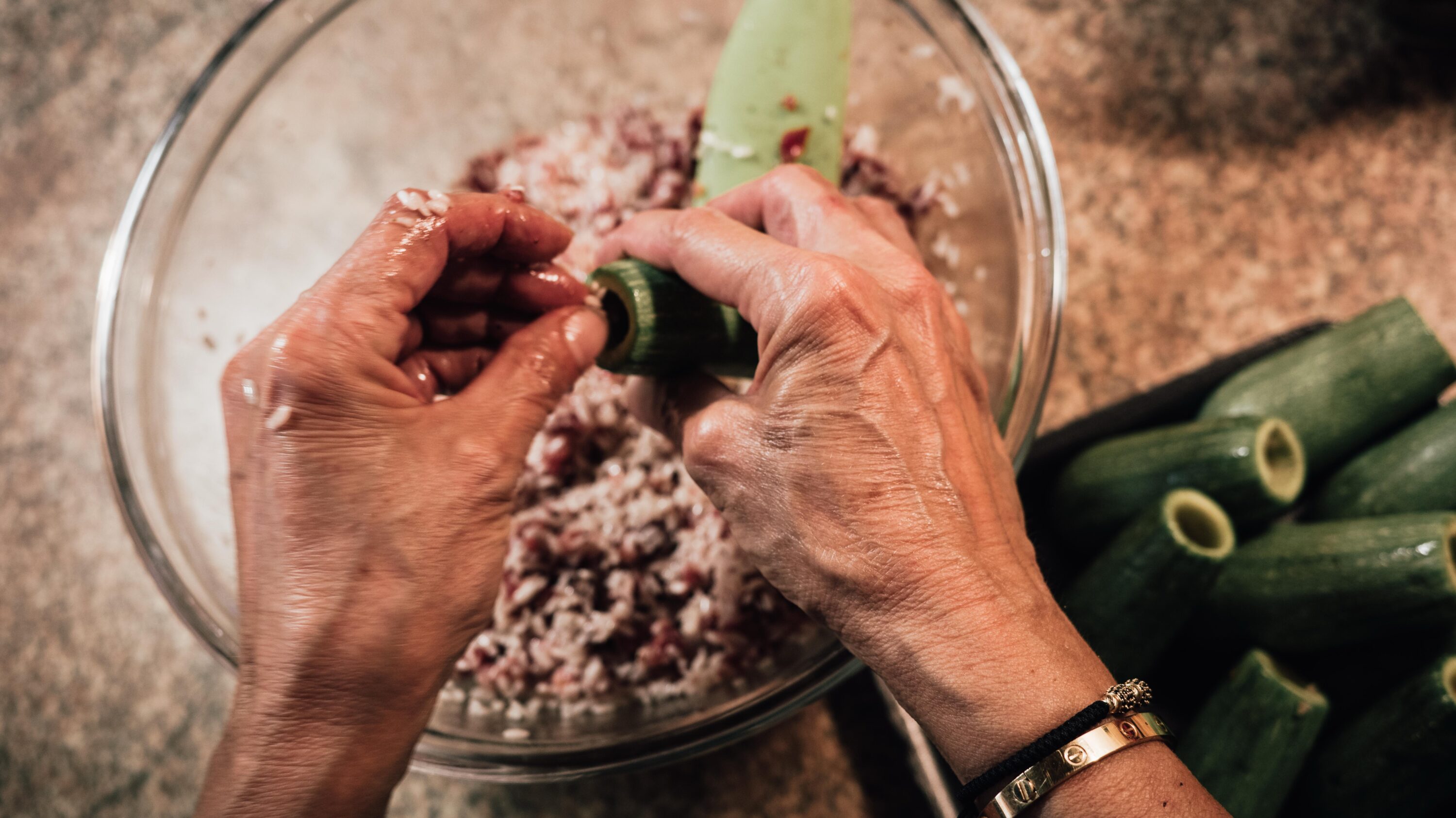
I saw it time and time again, even with more communal preparations, like stuffed grape leaves. The way four or five women gathered around a table, sleeves rolled, trays spread out, grape leaves piled high. I watched the collective choreography of mixing the rice, rinsing the leaves, and spoon filling with precision that could only have been the result of love and practice.
Over the years, I noticed that such gatherings were growing less frequent as people moved away, schedules clashed, and life slowly grew heavier. I wondered what it meant that my mother insisted on cooking what was essentially a group’s effort all on her own. Why, when I asked her why she didn’t just make something simpler, she would respond “ma biseer mama” (it can’t be done that way, mama). What kind of continuity and embodied knowledge was she trying to preserve in the act?
Embodied knowledge, I realized, is its own kind of archive, one that lives in the gifts of kept spaces. Surely, however, my mother wouldn’t call it that. Instead, she would tell me that “this is how we’ve always done it”, that she knew no other way. Perhaps I shouldn’t be surprised that when salvaging becomes second nature, one does not necessarily have a term for it, let alone recognize it as the hard labor of sustaining.
The Group Chat as a Lifeline
On the morning of October 9th 2023, my mother entered the kitchen and, right after having her morning coffee, pulled a small sticky note from the drawer. It’s a habit of hers – each morning, she takes a pencil and writes down a short list of people she wants to call or check on. Sometimes it’s family, sometimes a neighbor, sometimes someone she hasn’t spoken to in months but suddenly thought of. That morning, near the top of her list, she wrote her cousin’s name. Then she picked up her phone and sent a message: “Tamnooni, ento keefkom?” (reassure me, how are you doing?) It was a question she asked frequently, but which carried a different weight this time around.
We don’t have an active friend group chat. There are no sprawling digital threads that loop across cities and generations. Instead, most of the time, connection came in fragments: one-on-one messages passed between siblings, cousins, friends; a photo forwarded from the homeland; a voice note sent mid-commute; a “thinking of you” that arrives long after midnight.
My siblings and I share a small chat of our own, where the rhythm of daily life – updates, jokes, worries – unfolds without fanfare. There is also another thread with my uncles – none of whom live in Palestine – more measured in tone, but still held together by a quiet urgency. It is through these modest communication channels, when taken together, that have come to form the texture of what I now recognize as a dispersed archive: a living, breathing record of presence, worry, love, and survival.

Digital group chats have become an essential infrastructure for diasporic communities in conflict zones, serving as spaces for real-time updates, emotional care, and collective archive-making. Platforms such as WhatsApp, Telegram, Signal, and Instagram Stories are used not only for passing memes and voice notes but also for sharing urgent warnings and tracking safety in crisis situations.
These exchanges range from plain text to sometimes just an emoji, but they carry emotional and political charge, mapping patterns of care across geographies. And during conflict, silence in these threads can indicate danger more than disconnection.
For decades, communication infrastructures have mediated both connection and control, often shaped by restrictions imposed through occupation, censorship, and military surveillance. The rise of digital platforms has offered new tools for immediacy and intimacy, but these tools remain entangled in a history of monitored conversations, blocked SIM cards, and targeted data shutdowns. Still, people use them daily to hold each other through the uncertainty of war, displacement, and distance.
In a context where erasure is structural and memory is contested, to archive is not only to recall what has happened but to insist that something continues to happen. Lauren Berlant, in Cruel Optimism, describes the “impasse” as a temporality defined by maintenance, where people continue to live and adjust within conditions that do not fundamentally change. In such a temporal frame, the archive is a practice of repetition, witnessed through the morning check-in, the delayed reply, or the reopening of a message already read.
In June 2025, I went on a short trip to Cairo to visit a friend. Just a day after I arrived, Israel began launching missiles toward Iran. When Iran retaliated, firing missiles back toward Israel, Jordan – caught, as always, in the crosswinds of regional escalation – intercepted several of them over its skies. My mother, still in Amman, began texting me more frequently, her messages carrying a usual nervousness: “Do you think it’s safer if you come back now?”
To ease her growing anxiety, I started looking up boat routes through Sinai, thinking that I could reach Jordan by crossing into Aqaba in case flights became too risky. Meanwhile, friends in Amman were already trading half-jokes in group chats: “sirens are out. 7ayseer film agwa shaklo (it’s going to become an even bigger spectacle, it seems). ” We shared links to WhatsApp news channels, which somehow seemed to be more accessible than TV alerts.

My brother, too, texting from Qatar, sent a quiet plea: “Please stay home and be careful.” Even the institution where my office is based messaged its residents, telling them not to “worry too much, just stay inside and hopefully it’ll pass 🥰”. The gesture felt both tender and wildly inadequate.
The scattered exchanges seemed to form a kind of informal protocol: a shared rhythm for navigating threats, locating one another, confirming who was where, and how they were. In Enduring Time, Lisa Baraitser describes care as a temporal practice that is interrupted, recursive, and durational. More importantly, it is one that refuses the efficiency and linearity of institutional time.
As state and settler narratives work to obscure Palestinian life and death, the labor of remembering falls elsewhere: they are in the spaces in which memory-as-relation is being made. To treat these group chats as ephemeral is to ignore their role in memory formation and resistance. They are living maps of care, solidarity, and ongoing presence under threat. They are kept, quite simply, in the staying-with.


On Staying with the Trouble of Others
So much of what we hear – what we are asked to measure, archive, or grieve – is focused on what has been destroyed. But what if we began, instead, with the question: How might acts of care themselves be understood as forms of archiving? What if we shifted our attention from what has disappeared to what is being sustained? Out of a recognition that maintenance, repair, and attention are themselves political acts? In the face of rupture, care becomes a mode of continuity. It keeps the thread from snapping, and builds a record of what it takes to keep a world, however broken, still livable.
María Puig de la Bellacasa offers a way of thinking about care as a form of labor: affective, material, ethical. She describes it as “everything that is done to maintain, continue, and re-pair ‘the world’ so that all… can live in it as well as possible.” In this framing, care is not only human, nor is it only directed at the dramatic or the exceptional. It is, rather, the labor of sustaining life in all its ordinariness, and of insisting on relation even, and especially, when the conditions make it difficult to do so.
I think this understanding of care can shift how we might think about archives. If archiving is usually imagined as the formal act of storing, cataloguing, or preserving, then care pushes us to consider a more fragile and ongoing kind of memory work. Instead of trying to fix the past in place, this kind of archiving keeps hold of the memories that don’t fit into a neat record. Disruptions that are unruly, partial, and scattered.
Puig de la Bellacasa also writes of the inescapable trouble of interdependent existences – how care requires us to be implicated in others, not just emotionally, but temporally. Making time for care time, she suggests, disrupts the rhythms of technoscientific urgency and the timelines of reporting, resolution, and forgetting that so often shape the dominant narratives of war and crisis. It resists closure by looping, returning, and pausing, and asks us to continue to bear witness long after the news cycle has moved on.
To remember, then, in all the forms in which we do, is not simply to look back. It is to stay with: to witness, to tend, and to carry forward what might otherwise be lost.