

“You know, Diana, we are in Germany. We can’t use words like genocide or apartheid. We don’t know who will be in the audience, and I want to protect you. If an extreme right person interrupts, I’ll have to interfere and control the conversation. I am totally with you, I understand you, but you know the history here, the culture of memory. Someone might be offended, or not understand you.”
With these words, a German scholar, well established and working in a reputable institute, tried to convince me to choose my words.
It was October 2024, one year into Israel’s genocide in Gaza. Lebanon was also under attack.
And I had just realized that the panel I was invited to, addressing Beirut’s history, would talk about the city without addressing the war Israel was waging against it. So I told him it made no sense for me to speak only about history or music while ignoring the ongoing destruction, erasure, and genocide in Palestine and Lebanon.
He then invited me for a coffee to “discuss” my intervention.
The panel was meant to celebrate Beirut as a city always on the edge, a city that loses itself year after year. The city of intellectuals and culture, the city of cafés and books. A city worth mourning, but only in its metaphors.
Not the suburbs. Not the South. Not the Bekaa. Not that Lebanon.
Not the people whose histories disturb. Their ways of mourning, their rituals of grief, their resistance, are not worthy of their attention, nor part of this story. Maybe they are too mournful, too religious, not refined enough for their taste, for this imagined Beirut, cleaned, curated and made to fit a certain language.
So of course, better to leave aside the ongoing destruction by Israel, the ethnic cleansing, the dehumanization of an entire community. The stories of entire villages in the south being erased. The noise of the histories and memories I would bring into the conversation.
On that same day, a rocket hit Ras el-Nabaa, less than 200 meters from my parents’ home, where my aunts and their families were staying. Just meters away, seconds away… yet a million lifetimes away from me. Bombs, erasure, families gone, memories shattered.
The silence goes on, relentless.
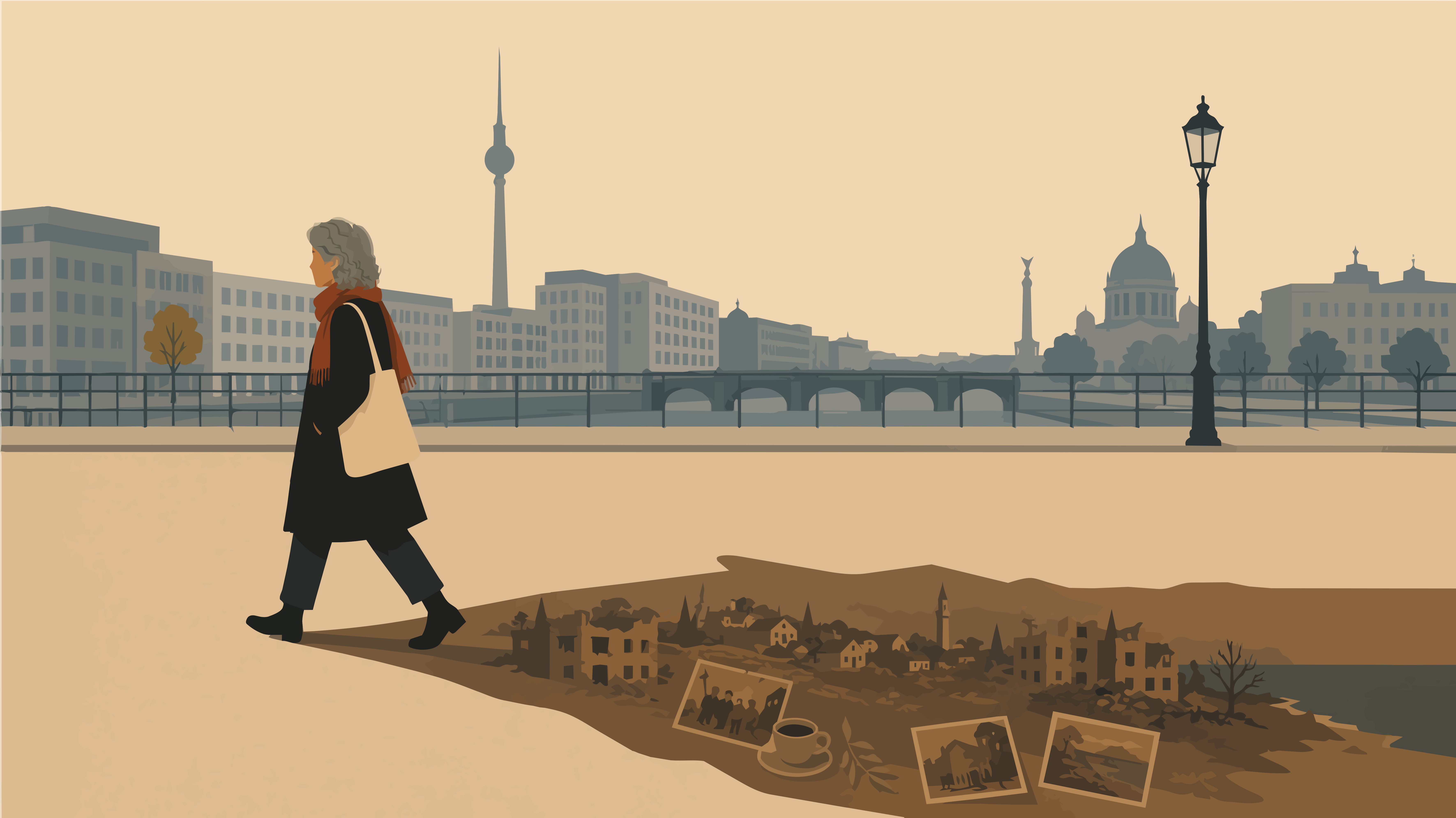
And yet, here I was, sitting there, safe in Berlin, listening to him asking me to watch my words. To be careful with my language, not to disturb the fragility of German history.
He kept reassuring me that he would “protect” me, in case some “extreme right wing” guy, the usual monster everyone fears, would interrupt the panel. Because my words would offend him. Would offend them.
Our words scare them. Our history still unsettles them.
But for him, there was no problem using this fear. No problem disciplining me through his own imagined violence. His history, his memory, was something I was expected to accept. To carry.
***
Since October 7, I have heard so many European scholars, people who built their careers on our region, tell me quietly, in private, that they are “with Palestine”, or that they are ashamed of their government.
Quietly. Always so quietly.
But when it comes to speaking publicly, to standing against what is happening in their own institutions, their silence is so loud. They speak about freedom of expression. They love that phrase. But when it comes to Israel, or to questioning German memory and the structural racism it created in their institutions, suddenly it disappears.
Since I became German, some even laugh about it. They come to me, joking, almost hysterically, creepily: “Now you are part of it. Our German guilt. Our memory.”
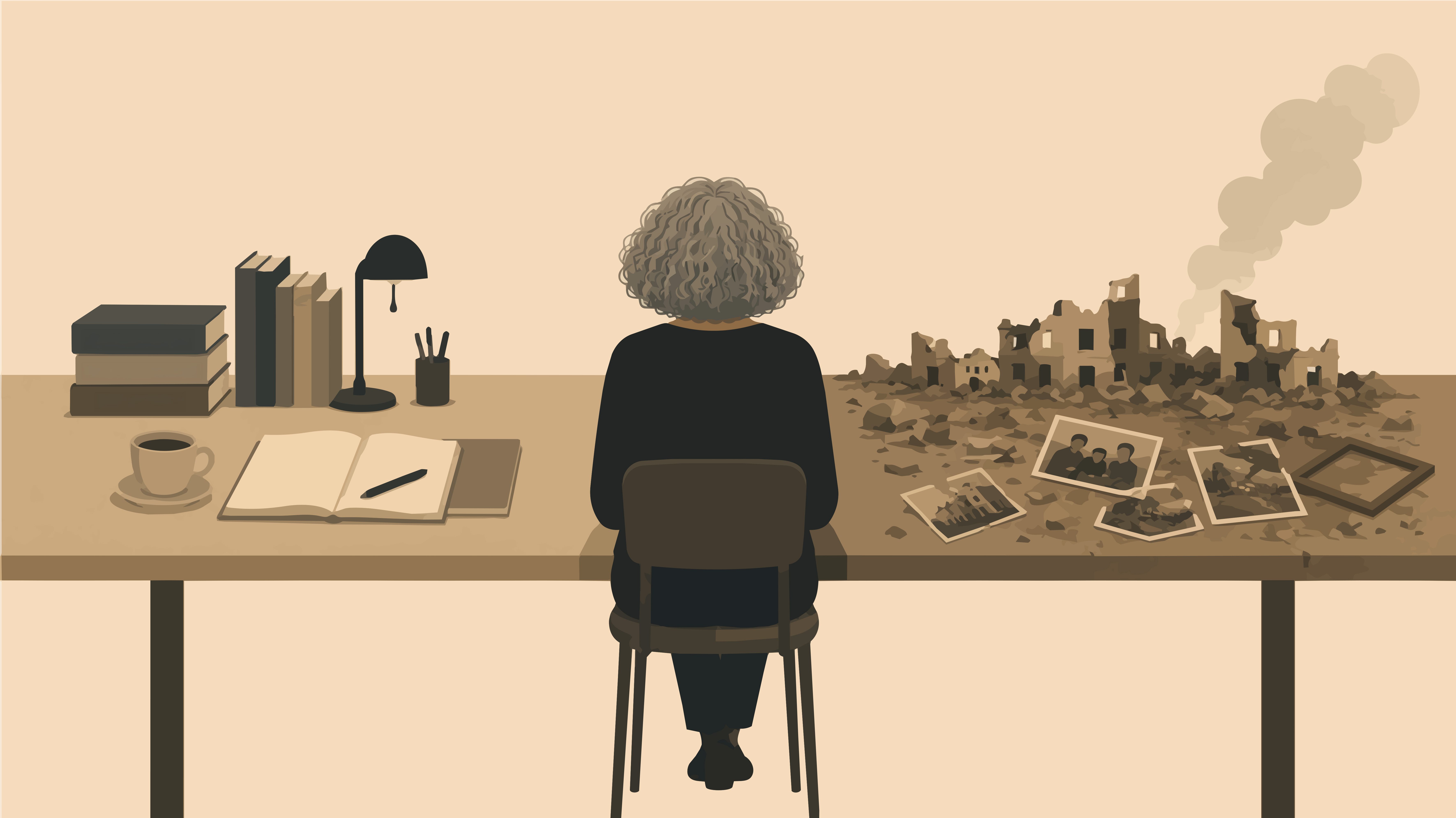
They laugh and laugh. And my world turns upside down. They laugh while my memories shatter, piece by piece. They laugh while everything around me loses meaning. They laugh while I live this constant dissonance. Here, in Berlin, everything is calm, yet so disturbing. There, everything is collapsing, yet it makes so much sense.
They laugh and laugh, in silence, living their everyday lives, convinced they are safe in their own small, individual worlds. As if safety was natural. As if it was not built on distance. On silence. On what is not said.
***
It is 9am. A peaceful, sunny day in Berlin. March 2026.
I am sitting in the office. I hear a sound.
Drones.
I feel it in my body. I move in my chair, and I look around. Does anyone else hear it? No one reacts. I look again. I am in Berlin.
I have told myself, with a lot of guilt, that the sound of drones is something new to me. That I wasn’t used to it, nor internalized it. Not yet. Not like my family and friends there. They had become hunted by that sound. I kept telling myself this was not my trauma.
But my body tells me otherwise.
It reminds me that it has already absorbed this fear, the fear of something hunting us from above. It didn’t forget the shiver it creates. Fear travels with us. It does not stay there, nor respect borders. It sits in the body, quiet sometimes, then suddenly very loud.
My body has carried this for years. The fear of planes haunting the sky. We used to call it umm kāmel. It watched us. Today they call it zanāni. Now it hunts, speaks, erases you like a bug.
My heart starts beating fast. I look outside. I am still in Berlin. It’s just the neighbor cutting the grass in this nice, fancy and quiet neighborhood. But in my body, it is a drone. Following me here. Into this calm, safe life.
I ask my colleague: do you feel something?
She says yes.
For a second, I think maybe she feels it too. Maybe she understands something of this. Maybe I am not that hunted.
Then she says: yes, this weather… this long winter in Berlin. It’s so depressing.
Yes, I say. The winter.
***
It always comes back to the same moment. The same questions. The same hunted memories.
February 2024. Sitting at a table with German scholars. More than 20,000 people already killed in Gaza.
One of them, a specialist of the region, was speaking loudly, almost proudly. He was talking about the Israeli war on Gaza, its repercussions in Europe, and the pro-Israel stance of universities. He criticized those who expected more from German scholars.
Then I said: “But German scholars are not really fighting back, nor willing to take a clear stand. Maybe this is the moment to give something back to the places you build your carriers on. Even a little.”
Something changed.
His eyes turned red, his face tightened. He looked straight at me and asked me:
“But do you condemn Hamas?”