




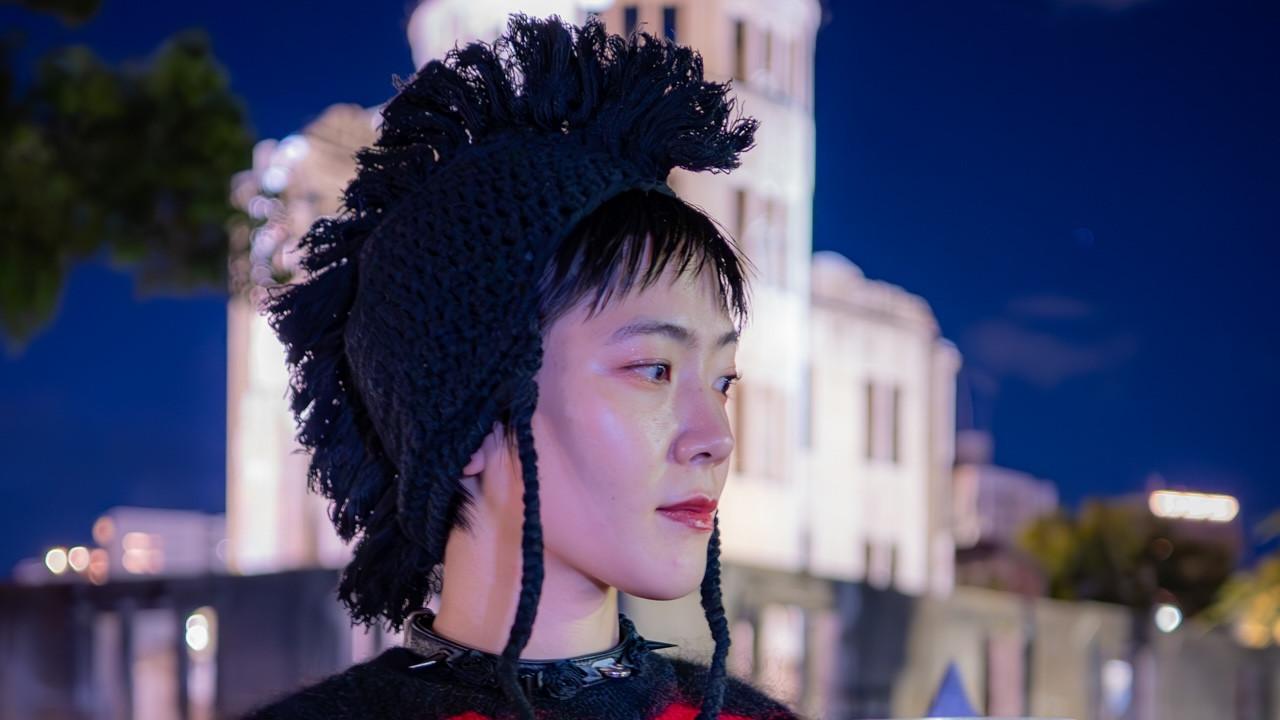
Sailor Kannako is a Japanese musician and artist based in Hiroshima and Tokyo. She began DJing around 2012 in Tokyo and started composing and performing with poetic vocals around 2020. She is also the vocalist for the hardcore punk band TAMAKI(珠鬼).
In this conversation, she describes her involvement with Palestinian solidarity activism, and the creative intertwining between political actions, local art and culture.
Enrico De Angelis: Can you tell us a bit about your artistic story?
Sailor Kannako: I was born and raised in Hiroshima, but moved to Tokyo in 2011 to attend university. I began my career as a DJ around 2012 and started composing music around 2014, gradually evolving into my current voice-performance style.
In 2022, I returned to Hiroshima to help with my family’s business. Starting in January 2024, I began participating in the standing protest against the genocide in Gaza in front of the Atomic Bomb Dome, occasionally performing live there as well.
EDA: Can you tell us more about your music style and inspirations?
SK: My style is to shout poetry set to music. My poetry expresses the desire to be liberated from the social oppression I experience daily. I shout to take control of my life, even as expectations of “how one should live” are imposed upon me. In Japan, where social norms are highly valued, we are constantly taught not to disrupt conformity within the group, making it easy to lose sight of what we truly desire.
View this post on Instagram
As a woman, I have had many experiences that made me feel that no matter what I said, nothing would change. During my teenage years, I felt my voice wasn’t heard within my family. And as an artist, I’ve been judged by my appearance and confined by stereotypes, which have hindered my true expression.
Even when I experienced sexual violence, I was told “it happens all the time,” erasing my pain. Remembering these experiences of being silenced, and empathizing with others who have faced similar experiences, is my inspiration.
EDA: How did you choose your name as a performer?
SK: Since I’m a fan of the Japanese manga series Sailor Moon, I simply chose an artist name that embodies that character. As an artist, I want to liberate myself and not hide any part of who I am—being an anime fan, loving Lolita fashion, expressing political messages. So naturally, they all blend together.

In Japan, expressing political opinions in art isn’t welcomed, but I think politics is just as much a personal matter as my tastes or fashion. Everything is a message, and there’s no need to separate them.
EDA: You are very involved in activities of solidarity with Palestine. How did this happen? Why Palestine?
SK: Among the people around me in Tokyo’s underground club and the hardcore punk community, there are those raising their voices against the genocide in Gaza. I learned about what was happening there from the posts they shared, but I didn’t immediately start solidarity actions. I unconsciously told myself there was nothing I could do to stop it, trying to look away from the horrific reality.
However, when I learned that a Palestine solidarity protest called “Vigil for Gaza” had been held daily in front of the Atomic Bomb Dome, I realized that by trying to ignore the ongoing genocide, I was living in a world far removed from peace.
I grew up in Hiroshima, close to the memory of war. I listened to the voices of victims of the Atomic Bomb (Hibakusha) and vowed never to let such a catastrophe happen again. Yet here I was, doing nothing while it happened all over again. I felt ashamed and realized that I am already in the midst of war when I dismiss others as beings who can be oppressed or killed.
I began participating in the vigils and learned about Palestinian history, which I had previously known nothing about. I empathized with their situation, where their voices of resistance have been silenced by the world. Their frustration—deprived of human rights under colonial rule, labeled as ‘terrorists’ even when resisting, and oppressed for decades—resonated somewhat with what I had expressed through my own music and poetry. The world that suffers the Palestinian people is a world that suffers me too.

EDA: In which kind of activities are you involved? And which impact do they have?
SK: I’m involved in BDS campaigns targeting companies cooperating with Israel, and in protests demanding action from the Japanese government to achieve a ceasefire. In 2024, an activist group in Tokyo launched a petition campaign urging Japanese companies Itochu and Nippon Aircraft Supply to cut ties with Israeli weapons manufacturer Elbit Systems. In response to their call, we also collected signatures at Atomic Bomb Dome. Additionally, through an initiative by Rebecca Maria Goldschmidt, a fellow Vigil member and anti-Zionist Jewish artist, I participated in an art protest in front of Itochu‘s Hiroshima branch.
Over 30,000 signatures were collected, leading Itochu and Nippon Aircraft Supply to terminate their contract with Elbit Systems.
That summer, when the city of Hiroshima invited Israel to its peace memorial ceremony (while canceling Russia’s invitation), our Vigil community launched a petition campaign demanding the withdrawal of the invitation.
Every day, in front of the Atomic Bomb Dome, we called for signatures and submitted over 25,000 signatures to Hiroshima City. Yet they did not withdraw their invitation. Despite calling itself a symbol of peace, the city took no concrete action to stop the ongoing genocide. As if nothing had happened, it invited Israel to the ceremony again in 2025. I believe Hiroshima wants to avoid political decisions that might incur the US’s displeasure. War and peace are political issues, yet Hiroshima seeks to avoid making a political statement. This contradiction is incomprehensible to me.
View this post on Instagram
While posting about these actions on Instagram, I have received many messages from people in Gaza asking for donations. To raise funds, I released a song and created T-shirts.
Then, I received a message from Esraa El-Banna, a university student and artist in Gaza, asking if I could help spread their comic, “To the world: a comic from Gaza”, in Japan. It’s a comic created by Esraa and her friend Jehad Abu Dayya during their life of repeated forced displacement, a message of resistance to the world calling for an end to the genocide. This led me to work on publishing a bilingual Japanese-English edition.
EDA: How are Palestine solidarity actions perceived in Japan?
SK: The Palestine solidarity movement has not become mainstream in Japan, but I think it differs from any previous movement by engaging diverse people regardless of age, social class or background. It is not necessarily led by intellectuals or experienced activists: ordinary citizens create and share tools for taking action, and they run campaigns.
Solidarity with Palestine connects people engaged in diverse issues: anti-nuclear, feminism, climate change, queer rights, rights of foreigners and refugees, the issue of Okinawa, forced to bear the burden of U.S. military bases, Japan’s past colonial rule and sexual slavery system imposed on Asian nations. It is a fight against colonialism, capitalism, and patriarchy taking away from us our right to self-determination. It is a fundamental movement of love that allows us to believe in our humanity, which is why I think it is drawing in people who have never been involved in political movements before.

Moreover, this movement has changed fashion. I believe it’s unlike any previous movement that more people now unhesitatingly wear political messages on their outfit in daily life. Just as punks sew anti-racism patches onto their jackets to customize them, we freely express solidarity with Palestine through fashion by wearing keffiyehs or patches. The movement clearly demonstrates that the personal choice of what to wear is inherently political.
Listen to Sailor Kannako’s song: PRESENT DAY