




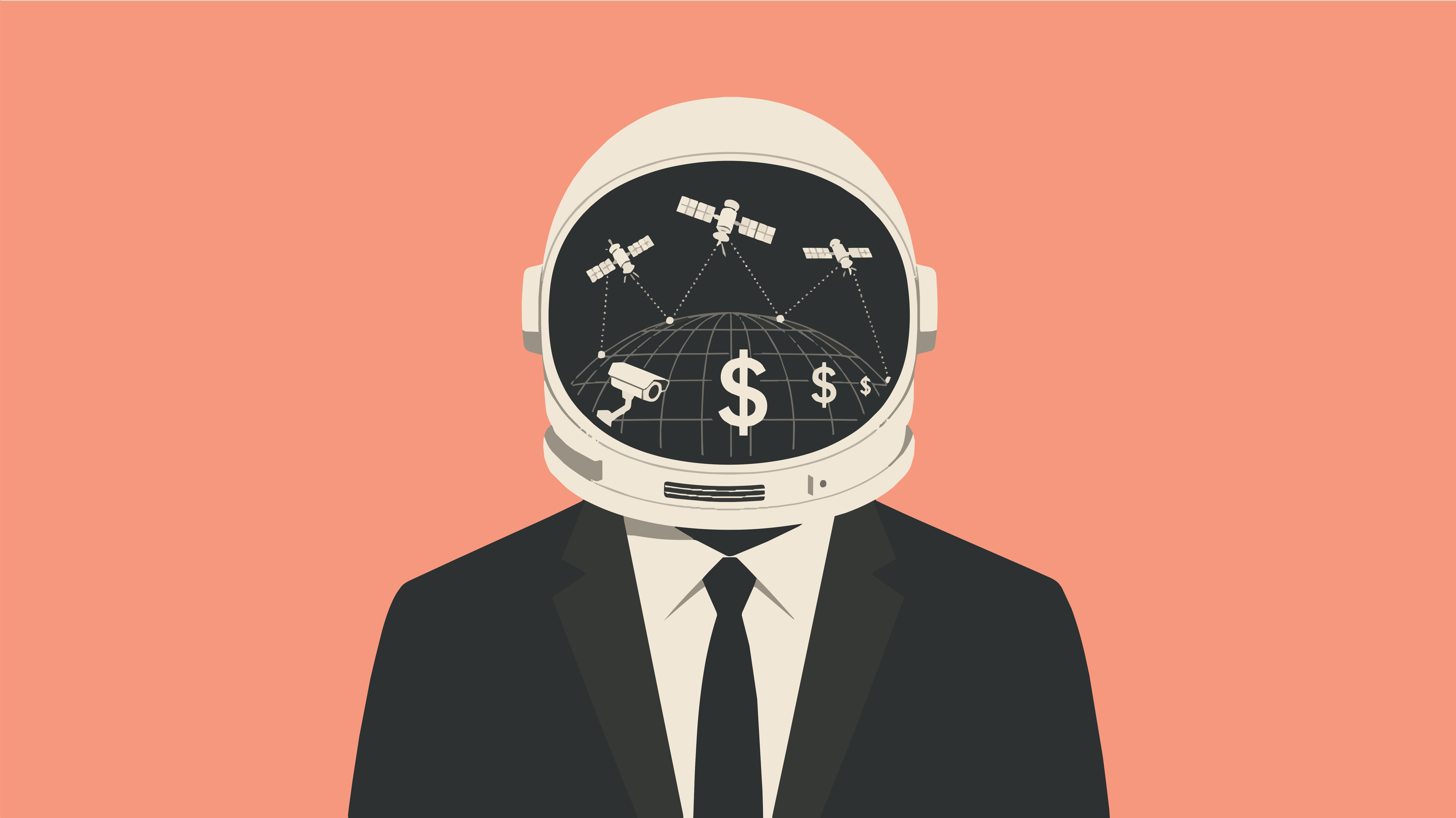
Standing before Pentagon leadership at SpaceX Starbase in Texas in January this year, Elon Musk introduced Pete Hegseth not as the Secretary of Defense – the title the United States has used since 1947, when the Department of War was deliberately renamed to move away from offensive military language – but as the “Secretary of War.”
Then he told the room what SpaceX is actually for: “We want to make Star Trek real. We want to make Starfleet Academy real.”
This was not an aside. It was a mission statement, delivered to the people who sign US defense checks. He went on to describe a future of “big spaceships” exploring alien civilizations. “That is the goal!” he said. “And that is what I think the public thinks of when they think of Space Force!”
The speech was revealing – not for what it promised, but for what it concealed. It was the clearest example yet of a pattern that has been building for decades: Silicon Valley’s tech elite borrowing the ideas, images, and authority of science fiction while throwing out everything that made those stories politically meaningful.
Quinn Slobodian and Ben Tarnoff, in their recent book Muskism, argue that the right question is not “who is Musk?” but “what is Musk a symptom of?” – treating him not as an individual but as the representative of a whole worldview, just as we speak of “Fordism”. That worldview is expressed through science fiction: not as decoration, but as the medium that makes its accumulation strategies feel natural, necessary, and inevitable. This is not to say that Science Fiction precedes or causes these projects – it is part of the cognitive and institutional scaffolding within which certain ambitions become thinkable and certain power grabs feel like common sense.
No example makes this clearer than Musk’s own words. Because Star Trek, the franchise he claims to be bringing to life, stands for almost everything he and SpaceX are not.
In Gene Roddenberry’s vision, the future is not built by billionaires or defense contractors. The United Federation of Planets has abolished money. Humanity has left capitalism, nationalism, and militarism behind. The Enterprise does not explore space for profit or military advantage; it explores for knowledge, diplomacy, and shared understanding. Starfleet is not an army; it is a peacekeeping and science organization. This is not background detail. It is the whole point of Star Trek.
Strategic Looting
What Musk is doing – what Silicon Valley has perfected – is what I call “strategic looting.” They take the look and feel of science fiction while throwing out its politics. They want the Enterprise, but with defense contracts. They want the warp drive, but not the equal society that made it possible. They want the adventure, but not the social change that gave it meaning.
Musk is not alone in this. It is how the whole tech industry operates. These companies have learned that science fiction’s hopeful imagery can be put to work while its warnings are quietly ignored.
Peter Thiel named his surveillance company Palantir after the all-seeing stones in Tolkien’s Lord of the Rings – objects used by those hungry for power. Tolkien wrote them as instruments of corruption; Thiel turned them into a brand for a company whose main early investor was In-Q-Tel, the CIA’s venture capital arm, and whose business is selling mass surveillance to governments and militaries. The goal, as Slobodian and Tarnoff show, was never to escape the state but to vassalize it: to make the government’s exercise of power dependent on purchasing services from a private monopoly. The look is borrowed. The warning is thrown away. The contract is signed.
A Manifesto for Silicon Valley
The depth of this project has now been made explicit. In April 2026, Palantir posted a 22-point manifesto on X – a condensed version of CEO Alex Karp and head of corporate affairs Nicholas Zamiska’s book The Technological Republic: Hard Power, Soft Belief, and the Future of the West, which racked up 35 million views in days.
The document calls for reinstating the military draft, declares that Silicon Valley owes a “moral debt” to the United States, argues that the “engineering elite” must build AI weapons rather than “obsession-driven apps,” and dismisses non-Western cultures as “middling, and worse, regressive and harmful.”
As I argue at length in a recent article in Science as Culture, the book is not really philosophy. It is a sales pitch. Establish that Silicon Valley owes a debt to the American state. Call out Google, Amazon, and Meta as companies that wasted that debt building social media. Present Palantir as the one company that actually paid up. The conclusion follows: Palantir is not just a tech firm – it is the rightful heir to state power.
Eliot Higgins of Bellingcat put it plainly:
“Palantir sells operational software to defence, intelligence, immigration and police agencies. These 22 points aren’t philosophy floating in space; they’re the public ideology of a company whose revenue depends on the politics it’s advocating.”
The Tolkien name provides the mythology. The manifesto provides the politics. The defense contracts provide the money.
In each case, the pattern is the same: take the technology, the imagery, the sense that the future is inevitable. Throw out the warnings, the criticism, the politics that gave those stories their meaning. William Gibson’s Neuromancer (1984) invented the word “cyberspace” and imagined it as a corporate battleground where human beings are just another resource to be mined – that vision becomes a product demo. Foundation’s galactic civilization becomes a justification for private space colonies. And now, Star Trek’s dream of humanity working together becomes a pitch to generals.

Materialized Science Fiction
The setting of Musk’s speech matters. He was not at a fan convention or a tech conference. He was speaking to the people who run the US military and decide where its money goes. When he said Space Force should make people think of Star Trek, he was not talking about exploration. He was pitching a military vision wrapped in the language of a show millions of people love.
This is “materialized science fiction”: the process by which science fiction stories are turned into real projects, with their original meaning stripped out and replaced with something that serves those already in power. These tech billionaires do not misread their source material by accident. They understand it well enough to know exactly which parts to keep and which to discard. The distortion is deliberate.
Slobodian and Tarnoff’s Muskism offers the most rigorous account yet of what this political project looks like in practice. By 2025, they show, SpaceX accounted for 95 percent of all orbital launches in the United States – a position that made the Pentagon and NASA “deeply reliant on Musk,” making SpaceX the de facto gatekeeper for government access to low Earth orbit. They call the endpoint of this logic “sovereignty-as-a-service”: “the logic of the modern internet platform, scaled up to the level of the nation state”.
The wager of Muskism, they write, is that “sovereignty, going forward, will be infrastructural before it is territorial — defined by access to bandwidth, compute, launch cadence, and orbital real estate as much as by borders and bureaucracies”. What is sold as independence through technology is, in practice, entry into Musk’s walled garden – to which he holds the master key.
Their analysis is indispensable. But my argument here goes one step further. For Slobodian and Tarnoff, science fiction functions primarily as what they call “financial fabulism” – “science fiction in the mouth of the right entrepreneur could conjure capital from thin air”. That is true as far as it goes. The argument here is that Science Fiction does not only conjure capital at the pitch stage; it continues to accompany and amplify the accumulation strategies as they unfold – part of the cognitive and institutional scaffolding within which certain ambitions remain thinkable, certain power grabs feel like common sense, and certain futures get built while others get closed off.
Muskism names the symptom. Materialized science fiction explains one of the mechanisms by which it reproduces itself.
A Tool for Grabbing Power
In a recent essay, Slobodian and Tarnoff push the argument further: where Fordism offered mass consumption and post-Fordism offered financialized aspiration, Muskism offers something qualitatively different. Not a social contract but what they call a “fan contract” – loyalty rewarded with amplified reach and a share of the attention economy, combined with the threat of expulsion for those marked as outside the walls. If Fordism and post-Fordism were, in different ways, organized to secure social peace, Muskism, they argue, is oriented toward social war.
What connects Thiel’s surveillance business, Zuckerberg’s digital world, Andreessen’s push against regulation, and Musk’s military space programme is not just a love of science fiction. It is a shared political goal: replacing democratic control with tech industry control, and using borrowed science fiction prestige to make that look acceptable. In their hands, science fiction stops being a literature of hope and becomes a tool for grabbing power.
Star Trek’s Federation was not built by tech billionaires or defense contractors. It came from humanity choosing, together, to cooperate rather than compete, to share rather than exploit. That choice came after humanity nearly destroyed itself. The Enterprise does not fly to escape Earth’s problems. It flies because those problems have already been solved.
Musk’s version turns this inside out. His spaceships are not a reward for fixing things here. They are a way to avoid fixing them. Why tackle climate change when you can go to Mars? Why fight inequality when you can promise abundance in space? Why repair democracy when you can build a private kingdom on another planet?
A Guest List for the Few
As Slobodian and Tarnoff observe, Mars functions in Muskism as a “failover mechanism” for the civilizational collapse Musk learned to expect from science fiction – The Hitchhiker’s Guide to the Galaxy opens with the destruction of Earth; Asimov’s Foundation begins with the collapse of a galactic empire.
As the Argentine novelist Michel Nieva argues, the appeal of Mars to Musk is not solving the problems of capitalism but relocating its logic to a new address. And as The Atlantic has reported, the question of who boards the Starship is not rhetorical – it runs directly through Musk’s pronatalist politics, his amplification of eugenicist accounts, and his dismantling of USAID while children died in South Sudan.
Slobodian and Tarnoff go further: Musk is an indicator species for a broader Silicon Valley vision of a post-human future in which humans merge with machines, are gradually supplanted by AI, and the colonization of space is carried out not by people but by “cyborgified” organisms that are only distantly human. The guest list for the Starship, it turns out, may not include humanity at all.
There is an additional irony here. The historian Jill Lepore has shown that Douglas Adams wrote The Hitchhiker’s Guide to the Galaxy for the BBC in 1977 with an explicit target in mind: the mega-rich and their privately owned rockets, settling colonies on other planets because no world was ever quite good enough. The typewriter Adams used had a sticker on it. It read: “END APARTHEID.” Musk grew up in Pretoria listening to the same BBC broadcast, claims the book as a formative influence, and is now building exactly what Adams was satirising.
The science fiction story gives cover for walking away from the present. It also, it turns out, comes with a guest list.
From Utopia to Pitch Deck
When the world’s richest man stands before military leaders and says he wants to make Star Trek real, he is not being a fan. He is doing politics – winning contracts, shaping policy, building support for a vision that has very little to do with Roddenberry and everything to do with power. The audience was not the public. It was the people who control the defense budget.
Musk used Star Trek’s imagery because it carries weight: it makes privatized space exploration sound like a shared human adventure rather than a billionaire’s project. It makes working with the military sound like boldly going where no one has gone before. The same logic governed DOGE. To explain his approach to dismantling the federal bureaucracy, Musk cited Star Trek II: The Wrath of Khan: in the film, Captain Kirk wins an unwinnable training simulation by reprogramming it. “The only way to achieve success,” Musk said, “is to reprogram the matrix such that success is one of the possible outcomes. That’s what we’re doing”. The same logic runs across the whole industry.
The irony is that Star Trek saw this coming. The Ferengi – a species that puts profit above everything – were written as a warning, not a model. The Borg – a collective that strips away individual freedom – were the opposite of everything the Federation stands for. Corporate-run worlds were shown as places to be feared.
None of this means pretending Star Trek had no flaws. Critics, most notably the media scholar Daniel Bernardi, have rightly pointed out that the Federation’s vision of universal values often looked like American values in disguise – that its “we come in peace” approach echoed the language of the very colonialism it claimed to have left behind, and that alien cultures were usually judged against a human, Western standard.
That criticism is fair. But even a flawed utopia contains more political imagination than a defense contractor’s pitch deck. The question is not whether Star Trek was perfect. It is what gets lost – and what gets used as a weapon – when even its imperfect values are stripped away.
This is what materialized science fiction looks like from the inside: not the utopia the stories promised, but the infrastructure of a political project that has no use for utopia. And yet here we are: a tech elite pitching Star Trek to defense contractors while running companies that harvest data like a natural resource, treat workers as replaceable, and fight every attempt at oversight. They have cut these stories open, taken the parts that suit them, and thrown away everything else.
Until the politics catch up with the aesthetics, what we are getting is not science fiction made real. It is a small group of very powerful people using science fiction’s authority to close off the futures it once imagined – billionaires in borrowed costumes, acting out the adventure while gutting the story that made it worth telling.