



When autumn comes, we start seeing clouds. After long summer days of bright light and scorching sun, I realise how much I miss the clouds, these floating veils in the sky, tempering the sultry heat. My body understands why in Islam, shade is considered sacred.
The winds start changing; il-majjistral, the northwest wind, feels like a breeze from paradise after the endless days of ix-xlokk, the maltese word for southeast, referring to the strong wind that starts in the Sahara Desert and blows north across the Mediterranean Sea that in Malta, is referred to as the ‘desert wind’.
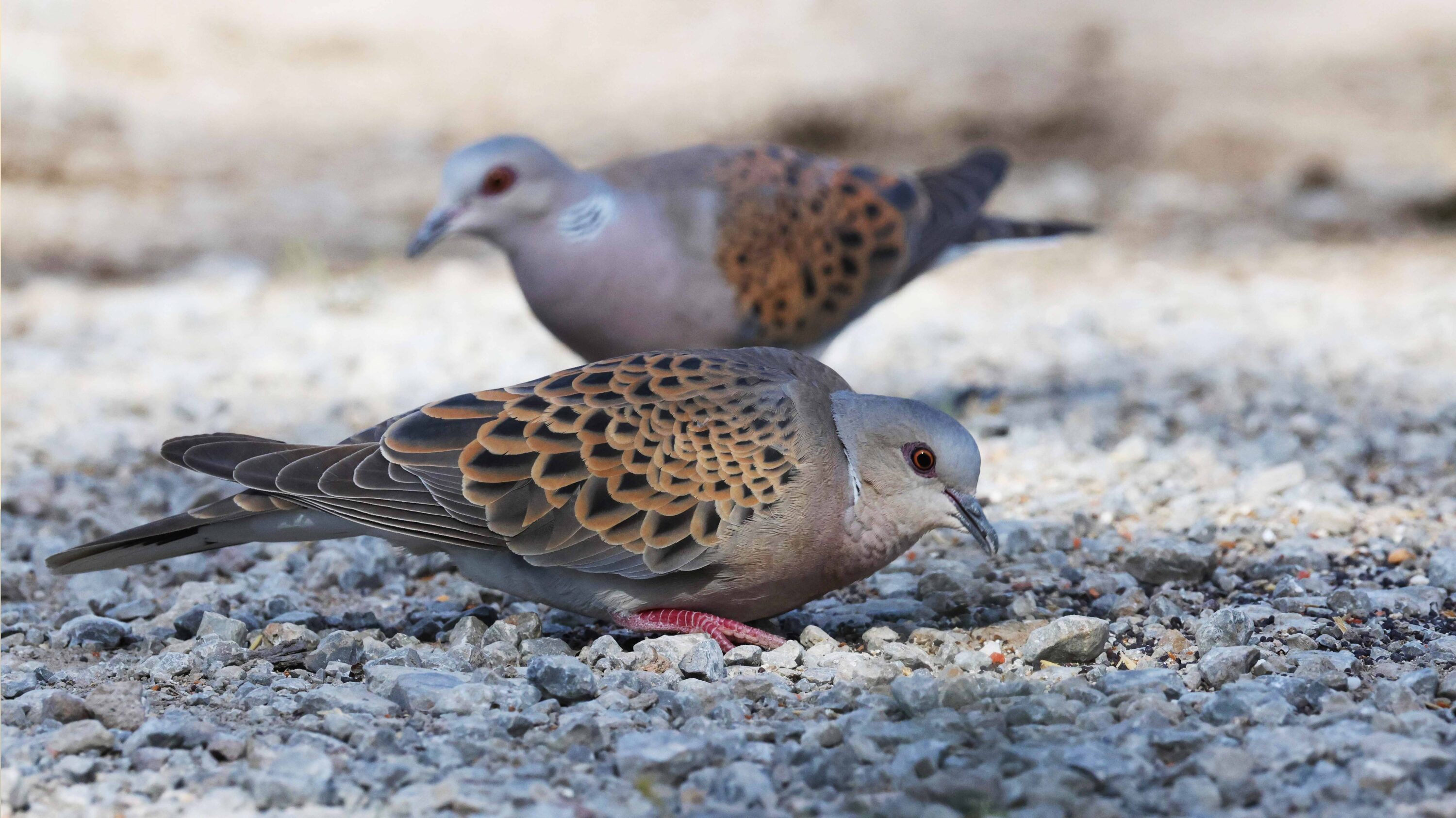
Migratory birds will soon start journeying towards Africa, among them, the turtle doves, Il-Gamiema as they are called in Malta.
For people trying to travel the Mediterranean Sea by boat, the crossing becomes more dangerous. And this year has been one of the deadliest.
At some point in its history, the Mediterranean has been split into North and South, with the latter recast as distant. Within that, Malta is now repositioned as a border country whose territorial waters are weaponised. Yet neither the wind nor the turtle doves recognise such lines on maps nor orientalist framings.

Lines of Flight
People and doves have travelled and migrated for millenia and they continue to do so across the same blue sea, waiting for fair wind conditions. Both look at the stars for orientation, like lines of flight.
We owe our sapiens origins to East Africa, linked to a pan-African landscape and green Sahara periods. European turtle doves remained, neither living their lives confined to national borders nor defining belonging as a species by colonising or claiming one place.
It fascinates me how this dove prefers the heat and would rather cross over the two continents instead of adapting to the northern winter while my spirit aches for their forests.
People face similar questions: Do I stay, or do I move? Do I have to run away to survive? Can I claim home here, and if not, where? Shall I give in to nomadic desire? It is an ancient question about survival, homemaking, and attachment to a place. They are also questions about owning land: Old stories about conflict between nomadic and agrarian peoples and their competing cosmologies.
In Sudan, agrarian people speak about nomadic people moving in with their camels and eating all their millet, sorghum, and beans, leaving them with nothing. Humans, all of us, cannot escape the human condition, that condition that Simone de Beauvoir defines as ‘ambiguity’.

Arduous Journeys
Detention centres are now the de facto European method to ‘manage’ irregular migration; they have never worked as a deterrent.
I will never forget Friday afternoons in the Safi detention centre, Malta´s largest, while visiting to offer cultural orientation classes, men facing Mecca, standing in Qiyam, praying behind wire fences to the one who is greater than us and all the barbed wire and human cruelty in the world. Their Adhan seemed to take flight, like birds do.
Migration is an arduous material and spiritual journey. Yet, European turtle doves have mastered life on both the European and African continents. Some people prefer to live like that as well. These doves may return to their same partner and nest each and every year if they survive, even though there is a question about their monogamy – whether it is seasonal or lifelong.
In Morocco they love nesting in olive and orange orchards. However, many, especially juveniles, do not make it on their first epic flight as they are hunted everywhere.
The reasons for the catastrophic decline in their population include climate change and the loss of habitat. In 2015, when the European turtle dove was listed as vulnerable on the IUCN list, BirdLife International had already documented a 30% drop in the global population over the previous 16 years. In Europe where they mostly breed, populations collapsed by 80%, a single lifetime of erasure. Yet the solutions are not mysterious. Fallow, a farming technique in which arable land is left without sowing for a year or two, and hedgerows are urgent, straightforward answers. We know how to save them. We choose not to.

There are three flyways that the doves use: the Western, Central, and Eastern flyways. Malta is on the central/Eastern flyway. Malta is the only EU country that still allows spring hunting as they make their way to their reproductive grounds. Officially 1,500 birds are allowed to be killed but according to local experts fewer than 10% of hunters actually report their kills.
People also move because of the climate crisis, desertification, violence, and loss of home and kin. Violence takes many forms and does not distinguish among species. The survival of turtle doves is intimately entangled with human activity, that of agriculture and ‘weed’ seed availability. These migrating birds are also dependent on finding places to rest, such as islands along their flyways. Like people crossing from Libya to reach Italy, ending up stranded here, in Malta. Il-Gamiema requires sanctuaries for survival, as the human spirit does.
Hunting and Captivity
In Morocco and Algeria, nest failure was linked to desertification due to the disturbance of agricultural practices. They also need forests and woodland shrubs. They thrive in liminality. Unlike humans, liminality makes us even more vulnerable. After 11,000 years, turtle doves are no longer finding a shrine to shelter them. We evolved into trading mammals, a stock market exchange determining who lives and who dies. Their journey speaks of hostile landscapes and coastlines.
People tell those stories of terror as well. I remember one man who recalled how, as they were making headway on their boat journey, they saw fins approaching them, and, believing they were surrounded by sharks, people on board got scared, only to find out that they were being accompanied by dolphins.
Portugal, Spain, France, and northwestern Italy have observed a moratorium for hunting turtle doves for the past five years, and a recovery of the species was recorded on the western flyway. But now France wants to increase the hunting quota once more.
The Western Mediterranean route for people on the move has surged this year as other routes become more dangerous and even deadly. IOM reported that deaths have doubled this year along the Central Mediterranean Route.
A bird directive, an international species action plan and various other policies are in place. Meanwhile, the EU migration pact entered in full force on the 12th of June, including the possibility for offshore detention centres pending the approval of the European Council.
The UK, The Gambia and Senegal partnerships are playing a crucial role in turtle dove conservation and habitat restoration. However, in 2025, in those same European Union countries, there was a limited reopening for the autumn hunt. Which begs the question: do we merely manage species and protect their survival so that they can be hunted again?

Hunters may have a similar understanding to conservation, the programme that the Federation of Maltese Hunters and Trappers (FKNK) runs in Malta, is a case in point. I understand that hunters have an intrinsic interest in conservation. If these birds go extinct, there will be no more hunting for them. However, some doves have indeed gone extinct, and some species are among the most threatened in the world today.
How would policy change if we thought of them as lore tellers preserving history, culture and stories rather than objects of our projections and predatory instincts? What changes if we remember that humans belong to the same species who simply adapted to diverse climatic conditions over time as people moved?
I wonder whether captive breeding programmes can be considered for community conservation initiatives, let’s say, for institutions that own gardens around Malta and Gozo.
But there are ethical concerns about captive breeding: Is it restoring wild populations? Do results justify captivity? Is nesting in the wilderness connected to a better outcome for the juvenile’s first journey? Because there seems to be a link between nestlings being exposed to the night sky and celestial rotation and the development of migratory orientation. Is that why we’ve been feeling so lost on this planet? We no longer stargaze.
The Silence of a Shadow
This bird’s journey goes beyond that of a species crossing continents and national borders. They are a reminder of our long-entangled relationship with doves. Their ancestral memory circulates across time, history and cultures.
We can recall their pagan associations with goddesses such as Inanna, Isis, Demeter and Fides. There were times when killing them was prohibited, but they were also used in rituals and sacrifice, sometimes eaten as a sacred meal. The turtle doves have long been used as a food source, and still are. They get a mention in Jewish and Christian scripture and a Christmas carol. In Kabbalah their call becomes the voice of the Shekhinah that may be heard in the silence of Shabbat. In Sufi traditions they are the ‘Al-Qumairi‘, voicing the sorrow of separation from the Beloved and our spiritual home. In Iraqi Arabic they are called ‘Fakhtāya’ and in Turkish, ‘Kumru’. ‘Çifte kumrular’ is used as an expression to refer to lovers or newlyweds. For Amazigh cultures, they are a blessing.

Stories speaking of fidelity, fertility, and abundance, or lamentation, mourning, widowhood, sacrifice, and prayerful remembrance. In classical Arabic and Andalussian literature, the turtledove’s neck markings symbolise the yoke of love, the way we become enslaved by what or who we love. Juan de la Cruz framed human desire in that same way. Imaginative and symbolic interpretations intersecting with our long and complicated ancestry. ‘Sticky’ birds Sara Ahmed would say. Because identities are perhaps flyways, routes, neither borders nor clinging to one place.
The shift in mythical and religious cosmologies altered the way we, peoples of the Mediterranean, relate to our natural surroundings, digging a chasm between nature and culture. The decline of the turtle dove species signals how we’ve changed (or not) and the dangers that lie ahead of us. A metaphor that is shot at instead of being read. Raymond Pierotti confronts us, saying that the human species is the top predator and neither a lost sheep nor prey. The Western psyche displaced, denying its fangs.
What remains are our long and violent tensions of conquest within and across ethnicities and complicated nationalities, among those embracing monotheism itself, stitched with colonisation and imperialism and a desperate need to recover some sense of the sacredness of land, sea, and sky. Remembering the dove form, an imago Dei, a spirit descending like a dove, that connective tissue ruptured.
This September, as in previous end-of-summer and autumn seasons, while the Maltese population celebrates il-Bambina, a major national holiday that combines the religious feast of the birth of the Virgin Mary with the national day of victory, people will start shooting at migrating doves again here and across all the Mediterranean.

Many of us know how it feels when you are shot down at the cusp of arriving. As this dove starves, dies of exhaustion or is shot from the sky, our souls starve for contemplative architecture.
Meanwhile, the turtle dove remains listed as vulnerable on the International Union for Conservation of Nature’s (IUCN) list.
I have never heard the turtle dove’s wild ‘turr-turr’ in our countryside, ‘turtur’ in Latin, the origin of its name, ‘la tortora’ in Italian, or ‘gur-gur’ in Sumerian. I do feel an emotional pull in my chest when I hear their call on recordings and videos posted online, similar to what I feel when I listen to the Corsican U Lamentu and Mediterranean vocalisations, L’Incanto Sospeso.
If we do not act now, future generations may only have the silence of their shadows and a digital recording left.
***
The author would like to thank Mr Mohamad Abram, Mr Mohammed Rahim Yasin, and Mr Nuri Silay for their insights.
Thanks to Ms Vicki Winslow and Mr Peterson Toscano for reading the text and commenting on it.
Thanks to Dr Neal Haddaway, Mr Millo Magnocavallo, and Ms Annalise Falzon.