




On 29 March 2025, the Minister of Culture in Syria’s transitional government took the podium and began his inaugural speech by reciting verses from the Qur’an, followed by two lines of poetry, words that seemed to condense an entire mood rather than a political occasion:
“We have fasted from joy for ages,
and now we break our fast upon the plate of dignity.
Record, O time of victory, record,
Damascus is ours until the Day of Resurrection.”
He quickly added a clarification, as if aware of the exclusion already implied:
“When we say ours, we mean everyone of every race, faith, and from every origin to every horizon.”
Yet the contradiction is already inscribed in the moment itself. Even in its gesture toward inclusivity, the speech evoked a purified, exalted Damascus, a vision of triumph rooted in a timeless Arab-Sunni imaginary rather than in the fractured present.
Capital of the Umayyads
Within hours, the clip circulated widely across social media. The verses became a digital anthem for the “new Syria”, often paired with a single, gleaming phrase that seemed to hold the promise of rebirth: “Damascus, capital of the Umayyads.”
The Umayyad Caliphate or Umayyad Empire (661–750 CE) was the second caliphate in Islamic history and, at its height, one of the largest states of the medieval world. Its territories stretched from the western frontiers of China to southern France, encompassing North Africa, the Maghreb, al-Andalus, the Sind, and Transoxiana.
Centered in Damascus and marked by the Arabization of state administration under ʿAbd al-Malik, the Umayyads left a lasting political and cultural legacy that continues to be invoked and romanticized in contemporary Syrian and Arab imaginaries.
The expression itself was not new. Bashar al-Assad had used the same words years earlier to court the nostalgic imagination, portraying the city as “the beacon of the Umayyads and the cradle of Arab civilization.” Yet in the post-Assad imaginary, the phrase acquired a different resonance. It became both nostalgic and redemptive, a dream of authenticity after decades of humiliation and dictatorship.
In this evolving rhetoric, “Damascus, capital of the Umayyads” is more than a slogan. It is an affective myth: a promise of purity and resurrection projected by an Arab-Sunni imaginary trying to restore coherence amid collapse.
The Umayyad dream no longer belongs to power or opposition alone; it is deeply embedded in the moral and spiritual imagination through which many Syrians – particularly from the Arab-Sunni community – envision their place in history. Far from being a passing rhetoric tied to the fall of Assad or argumentatively the ascent of ”the majority” again’, it has become a framework for self-recognition, a way of reconstituting “the nation” as a moral community destined for restoration.
Orientalism from within
In this imagination, victory and virtue are inseparable. The nation’s rebirth is conceived not only as a political project but as an act of moral purification, a return to an untainted origin where faith, masculinity, and honour align.
This is the same grammar that once structured cultural myths like Bab al-Hara (the gate of the neighbourhood), a hugely popular Syrian TV drama series, first aired in 2006, that nostalgically imagines a 1930s Damascus neighbourhood as a tightly knit, patriarchal community of “honourable” men defending “tradition” and the homeland, and has been broadcast across the Arabic speaking region for 13 seasons. The yearning for an immaculate past, the masculine guardianship of a virtuous community, and the exclusion of difference as the condition of purity.
Here, Orientalism no longer arrives from the West. It emerges from within, through the desire to idealize the self by imagining it as both sacred and victimized, timeless and threatened. The Umayyad dream, in this sense, is a form of self-Orientalism: an internalized gaze that seeks redemption not through transformation, but through resemblance to an imagined essence of the Orient itself.
If the Umayyad dream shaped the ideological vocabulary of the new political order, it also found powerful expression in the media and digital public sphere. Figures in pro-government media and among online influencers began invoking “Banu Umayya” (Umayyad people) not merely as a historical dynasty but as a moral lineage, a metaphor for honor, continuity, and faith.
One striking example came from Qutaiba Yaseen, a widely followed influencer aligned with regime narratives, who shared a video titled “Men of Dignity from Sweida stand alongside the sons of Banu Umayya in Damascus.” The clip showed a group of Druze men celebrating what he called “the liberation of the land of the Umayyads.” While his caption emphasized unity and brotherhood, the very choice of imagery – where belonging is validated through the Umayyad idiom – reveals how deeply this moral geography structures the imagination of “the new Syria.”
Visual grammar
Across social media, dozens of Facebook groups and pages now carry names such as “Syria al-Umayyah” or “Banu Umayya.” Their posts blend patriotic iconography with religious overtones, producing a digital landscape where history is both sanctified and aestheticized.
Even episodes of misunderstanding highlight how emotionally charged this symbolism has become. During the July 2025 sectarian violence in Sweida, a predominantly Druze city, in which hundreds of people were killed and members of Syria’s defence and interior ministries were later detained on suspicion of abuses against civilians, a banner reading “Sweida without ummiyyah” (illiteracy) was mistaken for “Sweida without Umayyads,” triggering outrage among armed groups and their supporters.
The intensity of the reaction spoke not to confusion alone, but to the extent to which Umayyah now functions as a sacred signifier, an emblem that fuses history, faith, and national legitimacy.
The romanticization of the Umayyad dream unfolds through gendered imagery that fuses purity, heroism, and faith into a single visual grammar. Viral videos set to the song “Banu Umayya, their origins are gold” portray men as guardians of a sacred lineage.
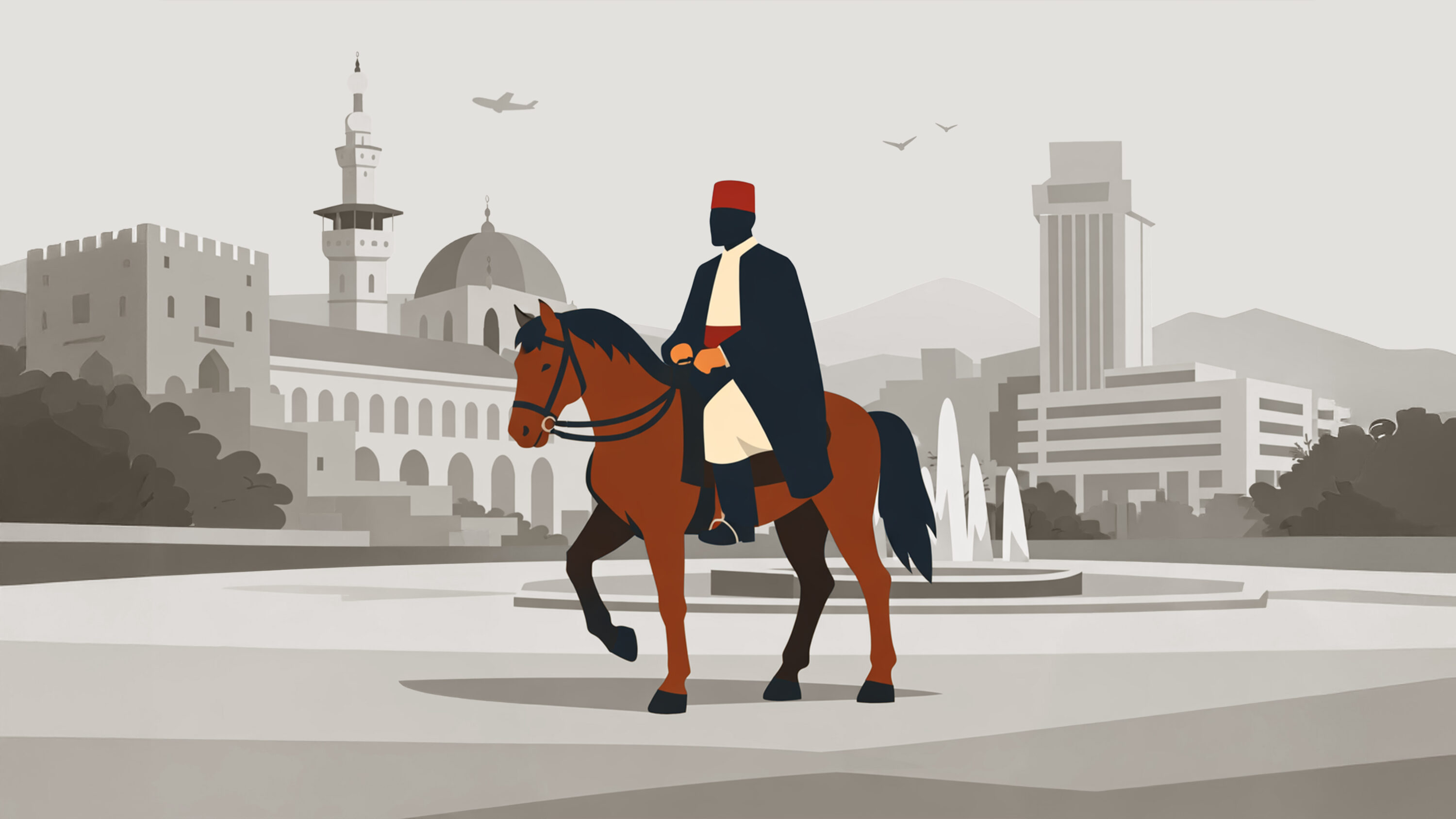
One shows Ahmed al-Sharaa, the head of the transitional government, riding a horse in a slow, cinematic sequence, a tableau of masculine virtue and divine favor. Another, filmed in Damascus’ Umayyad Square, features a masked horseman carrying the tawheed flag, a black flag bearing the Islamic declaration of faith (the shahada) in white, echoing the same melody of glory and moral renewal.
While variants of such flags have existed historically as religious symbols, in contemporary Syria and the wider region this specific black shahada flag has become strongly associated with jihadist and Salafi-jihadi groups, and therefore carries militant and sectarian connotations rather than being a neutral religious emblem.

These scenes are not merely political symbols; they reveal how moral imagination is gendered, sanctified, and aestheticized. The horse, the flag, the disciplined body, all perform a yearning for order through the image of the righteous man. This visual culture does not imitate anyone’s gaze; rather, it springs from within, from a longing to see the self as pure, elevated, and whole.
Such imagery invites a question rather than an accusation:
What does it mean when a society envisions its rebirth through these codes of purity and virility?
Perhaps the “Umayyad dream” is less about reclaiming power than about reimagining the self, a collective effort to restore coherence through an idealized reflection of what it believes it once was.
The fiction of the moral past
In this expanding media ecosystem, the Umayyad dream operates less as nostalgia for empire than as a mode of moral self-fashioning. It provides an affective grammar through which the Arab-Sunni imaginary reclaims virtue and coherence amid collapse, a language of sanctified belonging that transforms loss into purity.
But the Umayyad dream is not the only vessel of nostalgia or self-Orientalism.
Years before the revolution – and still today – the TV series Bab al-Hara built another dream: one that turned “Old Damascus” into a mythical homeland for an entire Arab imaginary.
As noted once in The Guardian, the series “has been an extraordinary phenomenon from the moment it was launched,” watched “from Morocco to Kuwait” and becoming a shared ritual of Ramadan evenings. Beyond entertainment, it crystallized a collective fantasy of what “authentic Arab life” once looked like, a Damascus of honour, piety, and masculine solidarity.
What distinguishes Bab al-Hara from other television dramas is not only its popularity but its power to shape collective memory. It became a reference point for how millions imagined Syrian – and by extension, Arab- identity. Danny Makki observed once that the series “misconstrues the history of what Syria was during the mandate era,” yet paradoxically defines how that history feels.
For viewers across the Arab world, the Hara (the neighbourhood) became shorthand for virtue, resistance, and rootedness, an imagined moral homeland that transcended geography and class.
In this sense, Bab al-Hara did not just represent nostalgia; it manufactured it. It offered Arabs from Rabat to Riyadh a mirror in which to see a purified version of themselves, turning Damascus – remote, complex, and plural – into a moral epicenter of the Arab world.
In Bab al-Hara, purity is not only spiritual but domestic. The home becomes a miniature nation, ruled by paternal wisdom and feminine modesty. The neighborhood is a moral microcosm where every deviation – a woman’s defiance, a man’s betrayal – threatens the order of the whole. Through its melodrama of virtue and shame, the series transforms social hierarchy into moral truth.
A ritual of belonging
This is not merely nostalgia for a simpler past; it is an aesthetic theology of purity.
The men of Bab al-Hara embody the same disciplined masculinity seen later in the post-2011 Umayyad revival, vigilant, protective, and righteous. The show taught generations to feel authenticity as something lost and endangered, and to imagine moral restoration through obedience and gendered order.
Bab al-Hara does not simply reproduce Orientalist clichés of the “Arab patriarchal society.” It performs them from within, as a cultural desire. The Damascus it imagines – pure, communal, and morally intact – is a mirror of how the self wishes to see itself: uncorrupted by modernity, yet triumphant in its own virtue.
The Umayyad dream and Bab al-Hara reveal two distinct yet converging temporal imaginations through which the Arab-Sunni self performs its own “purity.” Both rely on what Ghassan Moussawi calls fractal Orientalism, a process through which societies reproduce the same binaries of progress and backwardness, purity and corruption, not between East and West but within themselves.
Rather than a Western gaze imposed from outside, this is a local hierarchy of virtue: a self-sustaining taxonomy that distinguishes the “authentic” from the “deviant,” the “moral” from the “fallen.” It is constantly rehearsed through media, memory, and ritual performance, allowing communities to define themselves by continually reasserting who belongs and who does not.
In the Umayyad imaginary, history is compressed into a single, sanctified century. The Umayyad Caliphate – just one among many civilizations that flourished in the region – becomes reimagined as the timeless essence of Syria’s identity. What came before and after – Aramaic, Byzantine, Abbasid, Ottoman, and modern plural histories – fades from collective memory.
The brevity of the Umayyad period paradoxically strengthens its symbolic power: its scarcity becomes proof of purity. This moralized temporality underpins contemporary political and religious discourse, where the call to restore “the Damascus of the Umayyads” becomes not an historical project but a ritual of belonging.
Historical fabrication
Bab al-Hara performs a similar manipulation of time, but within the domestic and social sphere. The series constructs a Damascus that never existed, erasing the city’s real modernity during the early 20th century. The show’s central motif of “gated neighborhoods” is a historical fabrication: “It was never the case that Damascus neighborhoods had gates.
Damascus has seven main gates, known to this day. The character of the Aqid – the paternal leader who rules the neighborhood – is likewise an invented tradition, unknown to actual Damascene social structures. Historian Sami Moubayed noted that Bab al-Hara’s Damascus erases the city’s modernity: its tramways, newspapers, intellectual clubs, theaters, and publishing houses vanish, replaced by the simplified archetypes of the “Shamian setting” established in earlier dramas: barber, baker, vegetable seller, policeman.
In both imaginaries, the past is not remembered but rebuilt; time is aestheticized and moralized. The Umayyad past is purified into faith and conquest, while the Bab al-Hara past is purified into patriarchal virtue and social order. Each constructs a closed moral chronology that excludes historical complexity: one through divine authority, the other through domestic hierarchy.
Together, they illustrate how some Syrians and Arabs perform self-Orientalism not by imitating the West, but by staging its own ideal self, the pure, disciplined, and timeless Orient it longs to inhabit.
If temporality in both Bab al-Hara and the Umayyad dream collapses history into a purified origin, their social and political dimensions translate that origin into hierarchy. Both imaginaries depend on the repeated performativity of authority – patriarchal in one case, and theocratic in the other – as the guarantor of purity.
In Bab al-Hara, patriarchy is not only a narrative structure but the moral axis of the world itself. As mentioned earlier, the Aqid as well as the Abadayat (strong men), stand as embodiments of collective virtue: decisive, self-sacrificing, and untainted by doubt. The stability of the neighbourhood depends on their ability to preserve honor through control, to punish deviation through violence, and to restore moral equilibrium through obedience.
Female characters, in turn, serve as moral signifiers, either preserving communal dignity through modesty or threatening it through disobedience. Violence, far from being chaotic, is ritualized; it performs justice as purification. The show’s moral universe thus reduces social complexity to a binary between discipline and decay, mirroring “a theater of virtue.”
The Umayyad imaginary scales this logic upward. The masculine ethos of the neighbourhood – the man who protects his neighborhood and restores its honor- becomes the figure of the righteous man of the nation. What Bab al-Hara staged as domestic virtue now returns as public theology: a call for moral guardianship at the scale of the state.
This transformation is not merely rhetorical; it is enacted. Across social media and public gatherings, performances of faith and virility merge into a shared script of revival. The “pure man” of the neighborhood becomes the “defender of the Ummah,” the guardian of a faith imagined as both wounded and sovereign. Within this discourse, reclaiming moral order also implies reclaiming political legitimacy for the idea that the nation’s rightful rule, historically associated with Arab Sunnis, was “lost” under ”the non-Sunni Assad authority” and must be restored.
These notions have taken performative and embodied forms. Ahead of the coastal clashes in March 2025, Damascus authority-aligned preachers and local figures called for al-nafir (mobilisation) – a term rooted in jihadist lexicon – framing mobilization as a sacred duty of protection and purification. Ending up with massacres against the Alawite community there.
With the July assault on the Druze in Sweida, tribal networks in Syria invoked al-faz‘a – traditionally a communal call for mutual aid – but here transformed into a performative act of aggression. In both cases, the vocabulary of purity and defense migrated from the household to the battlefield; the moral economy of the Hara became the national grammar of mobilization.
Performing the past: From the Baath to the Ummah
It is important to note, however, that the Baathist regime itself was an early architect of this self-Orientalizing grammar. As researcher Husam Itani observes, “the Umayyad revival draws from the same well as Baathist ideology, which turned the past- too- into a dream meant to guide the future.” The continuity is not merely symbolic: both frameworks reimagined moral order through the disciplined masculine body and the myth of civilizational resurrection.
Rahaf Doghli also demonstrates in her book Romanticizing Masculinity in Baathist Syria, Baathist rhetoric recentered the figure of the man as soldier-citizen, the disciplined, sacrificial masculine body whose loyalty, obedience, and willingness to wield ‘legitimate violence’ constitute the very essence of belonging.
This legacy of moralized masculinity survives today in both the rhetoric of Islamist governance and the popular culture that preceded it. The Umayyad imaginary does not replace the Baathist one; it inherits and re-performs it, translating the soldier-citizen into the believer-warrior, and loyalty to the leader into devotion to God.
In this sense, social and political self-Orientalism in Syria is not a passive inheritance but an active practice. It is sustained through gendered performance and emotional investment, through rituals of loyalty and moral speech. Authority here is not imposed from above, it is lived, rehearsed, and believed in.
Across this imagined spectrum – from the Hara to the “Umayyad capital” – the yearning for origin reveals itself not as a national sentiment shared by all Syrians, but as a project rooted in the Arab-Sunni imaginary of moral restoration. It envisions not a plural Syria but a purified ummah, a spiritual polity redeemed through discipline and faith.
Today, this imaginary finds its most visible expression in the rhetoric and performance of Islamist factions such as Hay’at Tahrir al-Sham, whose call to moral and territorial “liberation” extends the same logic that once governed the Hara: the defense of community purity through masculine virtue and divine order.
In this vision, the past is not recovered, it is rehearsed. The Umayyad century, brief and distant, becomes the horizon of eternity; the Damascus of Bab al-Hara, fictional and domesticated, becomes its emotional blueprint. Both transform history into a theater of redemption where belonging depends on the exclusion of difference.
Too often, Orientalism has become a convenient scapegoat, a totalizing explanation that attributes all the region’s distortions to Western power, leaving little room to interrogate the failures within. By locating domination exclusively outside the self, this reading absolves the internal hierarchies, mythologies, and desires that sustain oppression from within.
Here, the notion of internal/self Orientalism becomes more revealing: it exposes how communities construct their own “Others,” reenacting the same logics of exclusion and moral superiority once ascribed to the West. In this sense, what is performed today is not merely resistance to Orientalism, but its domestication, the reproduction of its gaze in the mirror of the self.